

Automation or Delegation? AI Changes Everything!
Article Summary
📖 9 min readMost freelancers use AI as a glorified search engine — poor automation with no memory or context. The real shift happens when you move from task automation to responsibility delegation. This requires an AI with persistent vector memory, capable of retaining clients, projects, and preferences without daily re-briefing. The hidden cost of constant re-briefing reaches 200 hours/year for a freelancer with 15 clients.
Key Points:
- Automating removes a repetitive gesture, delegating transfers a responsibility — most freelancers do the former while believing they're doing the latter
- Constant re-briefing costs ~200 hours/year for a freelancer with 15 active clients (5 min × 3 interactions/week × 15 clients)
- Vector memory (pgvector) stores meaning, not keywords — it enables AI to understand relationships between client information
- The MCP protocol exposes 36 tools (CRM, tasks, memory, social media) directly in Claude Desktop, transforming automation into augmented intelligence
- Shared context coherence across tools matters more than feature count — a tool with contextual memory multiplies the value of every interaction
Automation or Delegation? What Most Freelancers Get Wrong About Their Relationship with AI
There’s a confusion that costs dearly. Not in dollars — in hours. In mental energy. In missed opportunities.
Most freelancers and small teams use AI like a glorified search engine. They ask a question, get an answer, close the tab. Repeat tomorrow. Repeat the day after. Without ever capitalizing on the accumulated context.
That’s automation in its poorest form: replacing one task with another task, slightly less tedious.
The real question isn’t “can AI do this for me?” It’s “does AI know enough about my work for me to truly delegate to it?”
The difference between the two is everything.
Automate vs Delegate: Two Philosophies, Two Outcomes
Automating means eliminating a repetitive action. Generating a report, sending a follow-up email, reformatting a document. Useful. Limited.
Delegating means transferring a responsibility to someone — or something — that understands the context, the stakes, the preferences. That doesn’t need you to re-explain every morning who the client is, what they want, what’s already been tried.
That’s why most AI experiences remain disappointing. We automate gestures without ever delegating thinking. And to delegate thinking, you need a counterpart that remembers.
“Artificial intelligence without memory is a brilliant consultant with amnesia. Impressive for a session. Useless long-term.”
Current LLMs — Claude, GPT, Gemini — are extraordinarily capable within a given context window. But that window closes. The next conversation starts from scratch. You re-brief. You re-explain. You re-contextualize.
That’s time. A lot of time. And it’s precisely the problem Nova-Mind’s architecture was designed to solve.

The Real Cost of Permanent Re-Briefing
Let’s do the math honestly.
You have 15 active clients. Every time you open an AI conversation to work on a project, you spend an average of 4 to 7 minutes re-setting the context. Who’s the client, what’s the objective, what constraints, what tone, what deliverables have already been produced.
15 clients. 3 AI interactions per week per client. 5 minutes of re-briefing. That’s 225 minutes per week. Almost 4 hours. Every week. Explaining things you already know, to a tool that should already know them.
Over a month: 16 hours. Over a year: 200 hours.
200 hours not producing, not billing, not sleeping.
This isn’t a productivity problem in the traditional sense. It’s an architecture problem. Your AI stack has no shared memory. Each tool lives in its own bubble. Your CRM doesn’t talk to your assistant. Your assistant doesn’t know your projects. Your projects aren’t connected to your client history.
Result: you’re the only connection point between all these systems. And it’s exhausting you.
What Vector Memory Concretely Changes
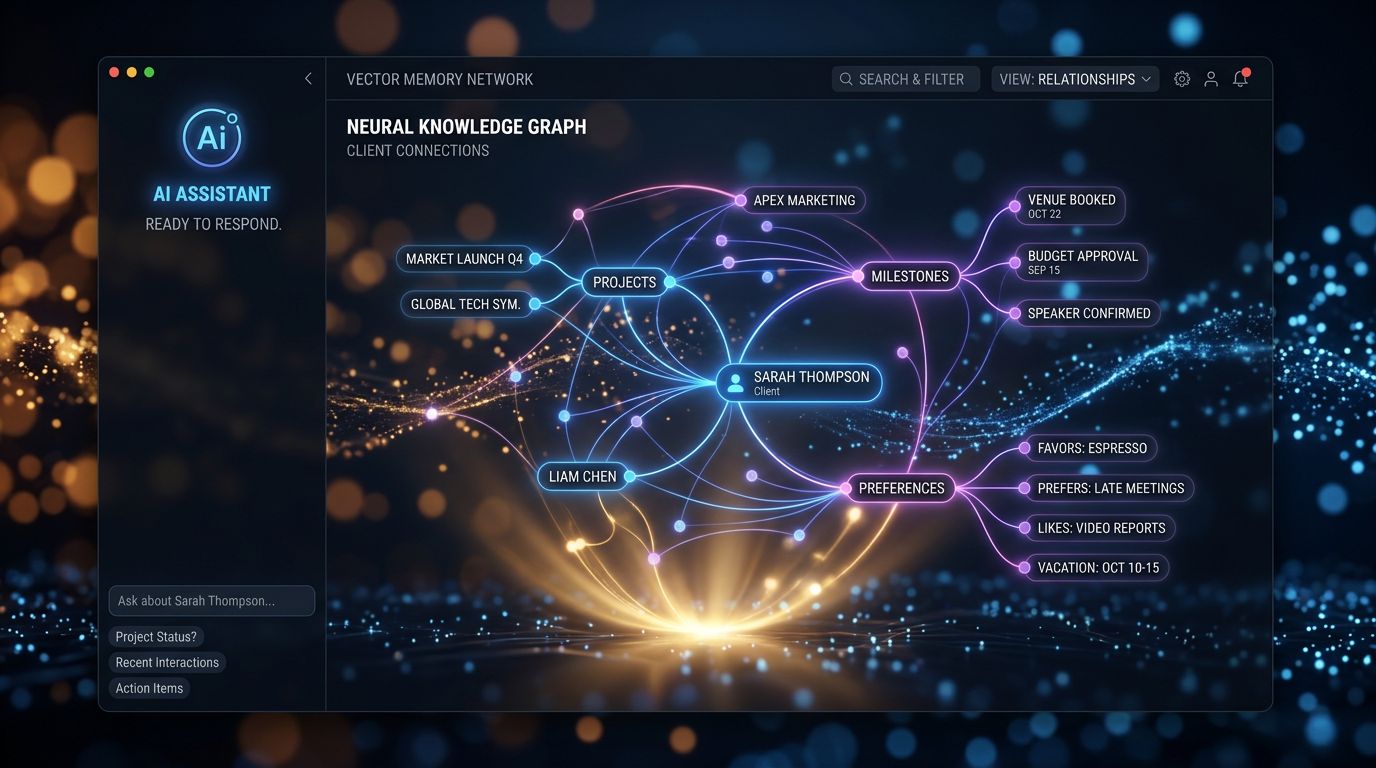
Vector memory — pgvector for those who want the technical detail — allows an AI system to store information as semantic embeddings. Not just keywords. Meaning.
In practice: when Nova remembers that your client Marchand & Sons prefers deliverables in PDF with specific pagination, that they have a tight budget in Q3, and that the last proposal nearly fell through due to a misunderstanding about deadlines — she doesn’t just store data. She understands the relationships between these pieces of information.
Next time you work on that client, you explain nothing. Nova knows. She proposes. She adapts.
That’s real delegation.
Here’s what it changes in practice:
- Client onboarding: Nova already knows the context. You focus on strategy, not data entry.
- Proposal writing: tone, budget constraints, exchange history are automatically integrated.
- Project tracking: no need to dig through Notion or search for the right email. Memory is there, searchable, contextual.
- Deal management: the integrated CRM and AI assistant share the same repository. No copy-pasting between tools.
Why Your Current Stack Can’t Do This
Here’s where it gets interesting.
Notion is excellent for documentation. Slack is decent for communication. Trello does the job for visual tasks. But none of these tools share a unified context with your AI.
When you ask Claude “write a follow-up email for this client,” Claude doesn’t know who that client is. It doesn’t know what’s already been sent. It doesn’t know the tone you’ve established, the commitments made, the friction points. You have to paste everything into the prompt. Every time.
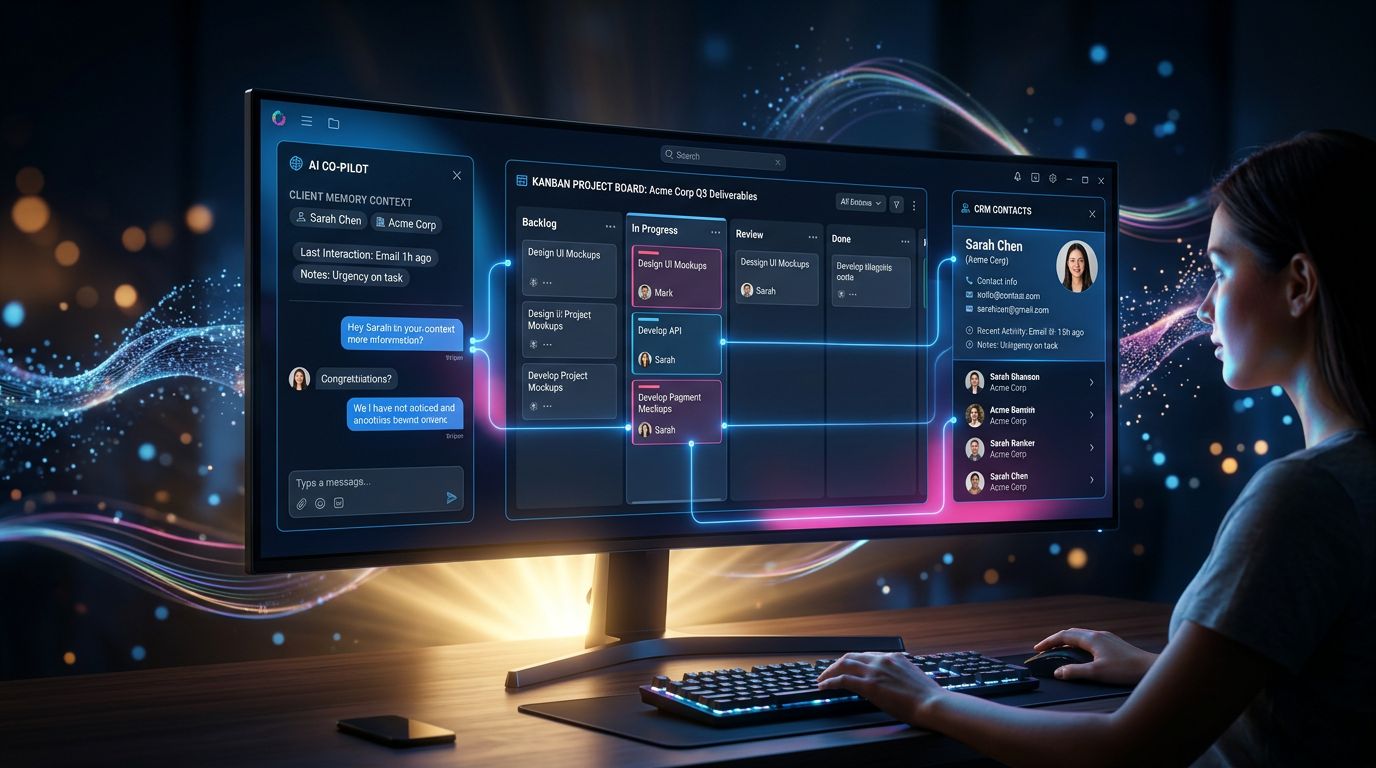
Nova-Mind’s MCP integration changes this equation. The MCP protocol (Model Context Protocol) exposes 36 tools directly accessible from Claude Desktop: CRM, tasks, memory, files, social media. Claude can query your client database in real time. It can create a task, retrieve a history, generate a LinkedIn post knowing your configured editorial direction.
This is no longer automation. It’s augmented intelligence with real context.
“An AI tool without context is like a new hire who’s never given access to client files. Competent, maybe. Effective, never.”
The “Almost All-in-One” Trap
Let’s be honest about one thing.
The market is full of tools that promise total integration and deliver a patchwork of poorly connected features. We’ve all been there. The tool that “integrates with everything” but requires Zapier for every connection. The CRM with an AI assistant that only knows manually entered data. The collaborative platform that offers generative AI disconnected from your real projects.
Nova-Mind isn’t perfect — no tool is. But the architecture is fundamentally different from the start: memory is central, not grafted on. The AI assistant isn’t a feature added to a project management tool. It’s the heart of the system, around which projects, CRM, collaboration, and content generation orbit.
The difference is fundamental. Not marketing — architectural.
Data stays private (Supabase, dedicated infrastructure). The app runs locally via Tauri on macOS, Windows, and Linux. At €39/month, ROI is measured in weeks, not years.
Three Insights to Rethink Your Relationship with AI
1. Measure the cost of re-briefing before looking for new tools. Time yourself for a week. How much time do you spend contextualizing your AI? That number is your baseline. Any tool that doesn’t directly address it is a marginal optimization.
2. Distinguish task automation from responsibility delegation. Automation removes a gesture. Delegation transfers a decision. Your goal should be to delegate more, not just automate faster.
3. Evaluate your stack on context coherence, not feature count. A tool with 200 integrations but no shared memory costs you more than it brings. A tool with robust contextual memory multiplies the value of every interaction.
The Real Question to Ask Yourself
After analyzing dozens of freelance and agency stacks, the pattern is always the same: teams that use AI transformatively don’t try to do more. They try to think less about low-level tasks so they can think more about the problems that truly matter.
This isn’t philosophy. It’s cognitive management.
Your mental bandwidth has a finite capacity. Every re-briefing, every copy-paste between tools, every search in the wrong tab — that’s wasted cognitive bandwidth. Bandwidth you’re not dedicating to your client, your strategy, your next project.
AI shouldn’t add to this load. It should absorb it.
What It Changes When It Actually Works
A freelancer who truly delegates to their AI — with context, memory, real integration — doesn’t work less. They work on different things. Things only a human can do: relationships, strategic intuition, non-reproducible creativity.
The rest? That’s the AI’s job. Provided it knows what it’s talking about.
If you haven’t yet calculated how much weekly re-briefing costs you, do it this week. Note the number. Then ask yourself if your current stack has an architectural answer to this problem — not a marketing promise, a structural answer.
If the answer is no, Nova-Mind is available starting at €39/month. Not a limited trial with features hidden behind a paywall. A real work tool, with real memory, designed for professionals who have better things to do than re-explain their context every morning.
Test it. Measure it. Decide on the numbers, not the pitch.
Share this article
Social networks
Analyze with AI

Charles Annoni
Front-End Developer and TrainerCharles Annoni has been helping companies with their web development since 2008. He is also a trainer in higher education.