


Social Automation: What Your Competitor Is Publishing While You're Still Thinking
Article Summary
📖 9 min readIn social media, consistency beats perfection. Automation doesn't replace your editorial direction — it removes the 80% of execution tasks with no added value so you can focus on the 20% that make the difference. A well-configured pipeline can recover up to 8 hours per week.
Key Points:
- The problem isn't creativity, it's friction: every step between the idea and the published post is an opportunity to give up — remove the friction and you remove the abandonment.
- 90% of AI users for social media treat it as a one-off writing tool, not a system: no memory, no coherence, no continuous editorial direction.
- Content adapted to the native format of each network generates 3 to 5 times more engagement than cross-posted content without adaptation — LinkedIn, Instagram and X don't follow the same rules.
- A complete automated pipeline (monitoring → editorial angle → generation → visuals → scheduling) reduces social media management from 6-10 hours to 1-1.5 hours per week — up to 8 hours recovered.
- Start with one platform: configure your editorial direction, run it for 3 weeks, measure real data, then scale — the system improves with every iteration.
The Silence That Costs You
You have an idea. It’s a good one. You know it.
But between the idea and the published post, there’s the brief to write, the visual to create, the caption to polish, the hashtag research, finding the right time slot, choosing the platform… And in the end, the idea stays in the back of your mind. Or in a Google doc you’ll never open again.
Meanwhile, your competitor publishes. Not necessarily better. But consistently. And in social media, consistency beats perfection hands down.
Here’s where it gets interesting: this isn’t a creativity problem. It’s a friction problem. Every step between the idea and publication is an opportunity to give up. Remove the friction — and you remove the abandonment.
The Real Reason Your Social Media Strategy Never Takes Off
Everyone has a “strategy.” Nobody sticks to it.
Not from lack of willpower. From lack of a system. Social editorial strategy is one of the most time-consuming activities in digital marketing — and one of the least automated. We automate emails, invoices, follow-ups. But posts? We still write them by hand, one by one, usually under pressure.
The result: inconsistent content. Tone that varies with the mood of the day. Frequency that collapses as soon as the calendar gets busy. And analytics that remain a page opened with guilt once a month.
What nobody tells you: most agencies that seem “always active” on social media have outsourced or automated 70 to 80% of their social production. Not because they have bigger budgets. Because they understood that social content is an infrastructure problem, not a talent problem.

What Social Automation Actually Changes
Automating doesn’t mean pumping out generic content at scale. It means eliminating low-value tasks so you can focus your energy on what matters: editorial direction.
The distinction is fundamental.
Editorial direction — that’s you. Your positioning, your tone, your preferred topics, your values. What you want to stand for, what you refuse to say. That can’t be automated and shouldn’t be.
Execution — that’s the machine. Turning a direction into an Instagram caption, adapting the same angle for LinkedIn vs X, finding the right format, generating the visual, scheduling at the right time. All of that can and should be automated.
After analyzing the workflows of dozens of freelancers and agencies, the verdict is clear: the effort-to-value ratio on social execution is catastrophic. We spend 80% of the time on mechanical tasks to produce 20% of the strategic value.
Automation reverses that ratio.
Artistic Direction as a Lever, Not a Constraint
Here’s the classic trap of social automation: delegating everything to AI without a framework. The result? Content that looks like everyone else’s. Smooth, generic, interchangeable.
The solution isn’t to automate less. It’s to frame it better.
A platform like Nova-Mind lets you configure, per project and per social network, a precise artistic and editorial direction. Tone for Instagram (warm, visual, storytelling), tone for LinkedIn (expert, factual, actionable insights), tone for X (short, punchy, sharp opinion). These aren’t the same rules. They aren’t the same audiences. The AI needs to know that — and respect it.
Concrete result: the same topic treated three different ways, automatically, with no manual rewriting. Not copy-pasted and tweaked. Native content per platform.
“The content that performs on LinkedIn is exactly what fails on Instagram. Same message, same brand, opposite results. The platform isn’t a detail — it’s the format.”
This isn’t theory. Engagement data consistently confirms it: content adapted to the native format of each network generates 3 to 5 times more interactions than cross-posted content without adaptation.
The Full Pipeline: From Monitoring to Publication
My obsession with detail has taught me one thing: systems that last are those that cover the entire chain. Not just content generation. The full pipeline.
Here’s what a social media automation pipeline that actually works looks like:
1. Monitoring — RSS feeds, industry sites, newsletters. The AI watches, aggregates and identifies relevant topics based on your configured themes. You stop searching for inspiration. It comes to you.
2. Editorial angle — For each identified topic, the AI proposes an angle aligned with your positioning. Not “here are 5 AI trends.” But “why this trend contradicts what you’ve been arguing for 3 years.” The nuance matters.
3. Content generation — Captions per platform, with each format’s constraints (length, tone, structure). Multi-model to vary approaches (Claude for analytical depth, Gemini for narrative flow).
4. Image generation — Visuals consistent with the project’s artistic direction. Not a generic stock photo. A visual generated according to your aesthetic parameters, with your colors, your style.
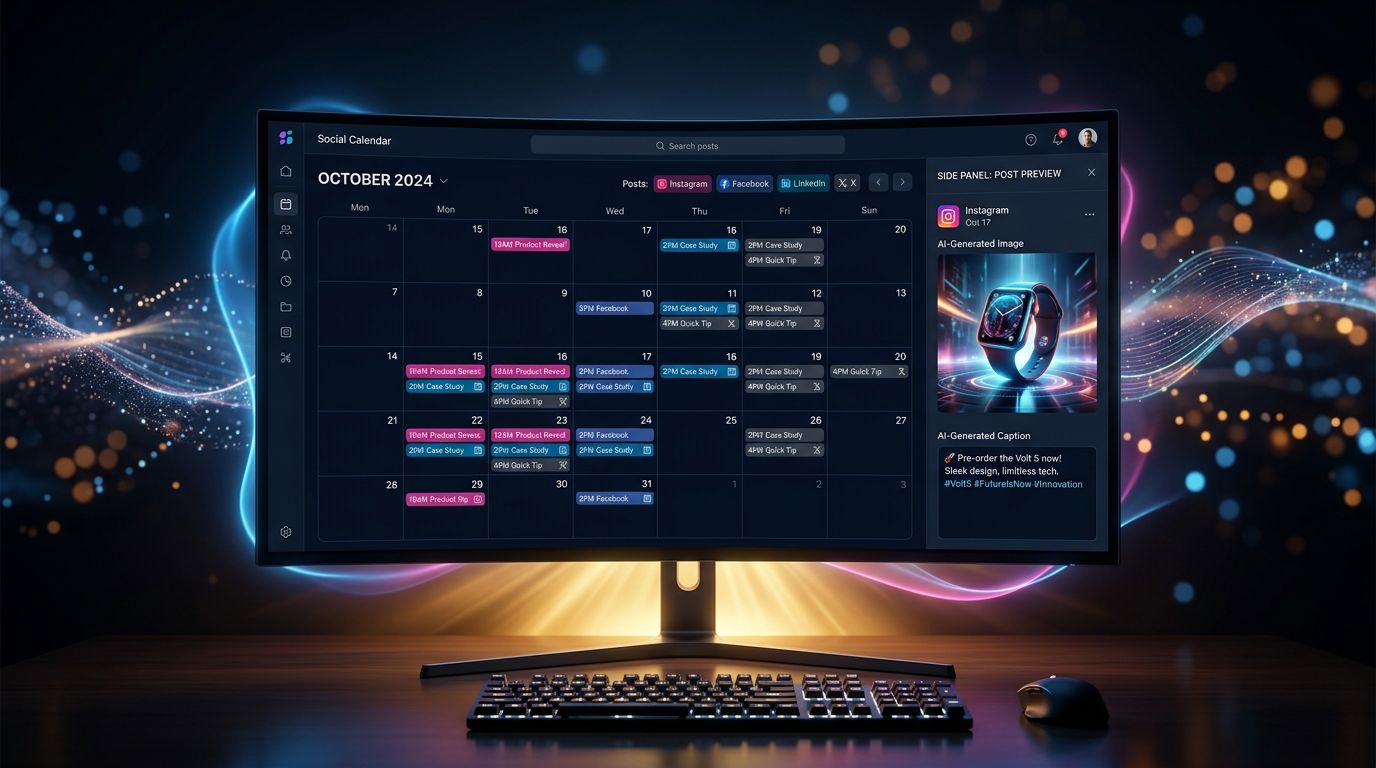
5. Scheduling — Publication at optimal times based on each platform’s analytics. Visible, editable calendar, with the option for manual intervention before validation.
Each step can run autonomously. Or with your validation between each phase. You choose the level of control.
What You Actually Gain (In Hours, Not Promises)
Let’s be precise.
A freelancer who manages their social presence seriously spends an average of 6 to 10 hours per week on content creation: ideation, writing, visual creation, scheduling, tracking. That’s a full day. Every week.
With a properly configured automated pipeline, this drops to 1 to 1.5 hours of oversight and validation. Everything else runs automatically.
8 hours recovered per week. 32 hours per month. Almost a full week of work.
This isn’t “boosting your productivity.” It’s billable time made available again. Or rest time. Or strategic time to develop your offer. What you do with it is up to you — but the time is real.
Let’s flip it: does your current social presence, managed manually, generate enough value to justify 8 hours a week? If the answer isn’t a clear “yes” — there’s an ROI problem.
Three Principles for Social Automation That Doesn’t Sound Hollow
My expert advice, after iterating through dozens of configurations:
Configure before you generate. Invest time in editorial direction. Tone, topics, formats per platform, what you refuse to publish. The more precise the framework, the more relevant the generation. It’s a 2-3 hour investment that pays off over months.
Keep your hand on the angle. Execution automates. The angle deserves your attention. A post that goes against a trend, a sharp opinion, a position statement — that’s you. Not the machine. Define those moments of singularity and protect them.
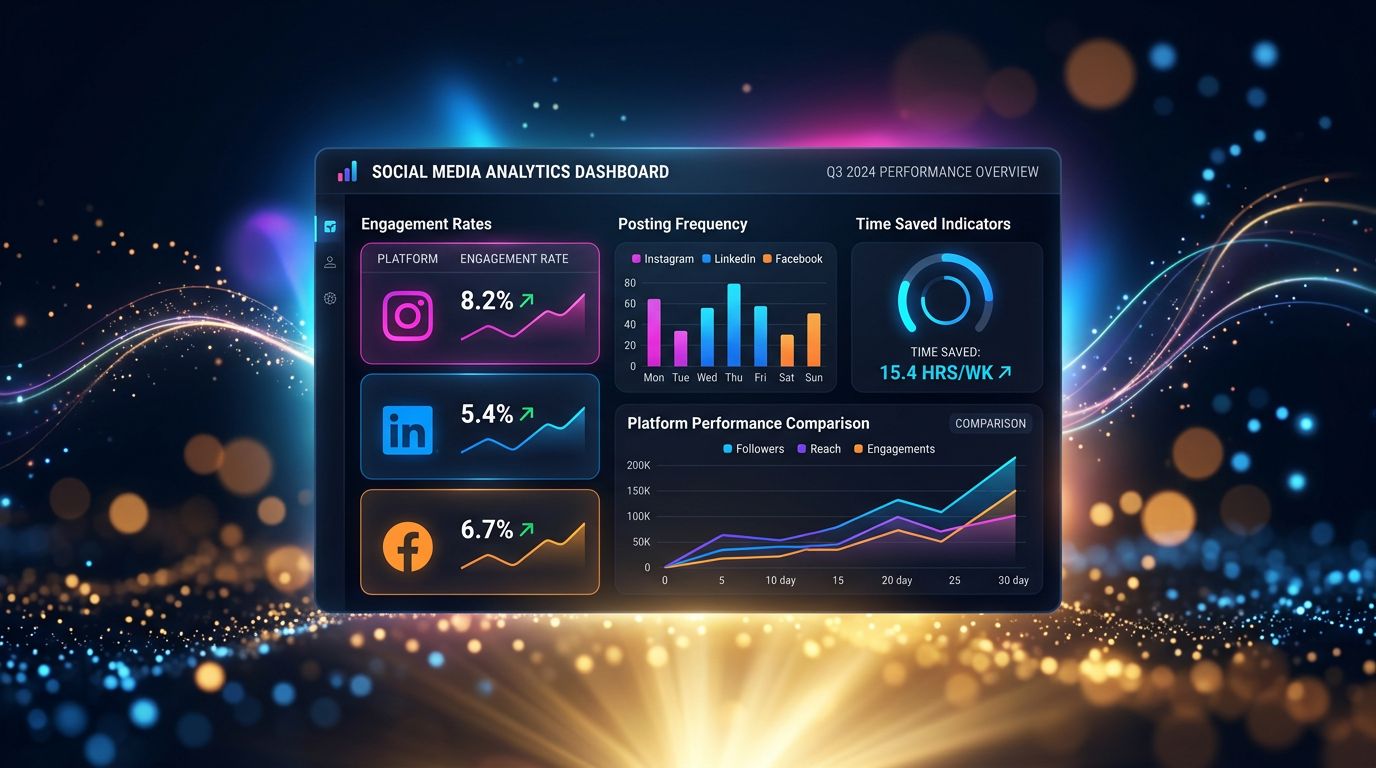
Measure what matters. Engagement rate per platform, organic reach, conversion rate toward your real objectives (newsletter, consultation, sale). Not raw likes. Metrics that tell you whether your content is working for your business.
The Mistake 90% of AI Social Media Users Make
They use AI as a writing tool. Not as a system.
They ask “write me a LinkedIn post about remote management.” They get something decent. They publish it. They repeat the next day. No memory, no coherence, no direction.
That’s AI used as a glorified search engine. Not as infrastructure.
The difference with a system that works: the AI knows your clients, your ongoing projects, your positions defended over the past 6 months, your past successes, your calendar. It doesn’t generate content in a vacuum — it generates content that fits into a coherent editorial continuity.
That’s exactly what persistent memory changes. No more “remember, I’m a B2B agency targeting industrial SMEs.” The AI knows that. It factors it in. Automatically.
Start Small, Scale Fast
You don’t need to automate everything at once.
Start with one platform. Configure your editorial direction for LinkedIn if that’s where your clients are. Define 5 recurring themes. Let the pipeline generate a week of content. Validate, adjust, relaunch.
After 3 weeks, you have data. You know what performs, what resonates, what falls flat. You refine the framework. You scale to a second platform.
It’s a learning process — for you and for the system. But unlike manual management, every iteration improves the system. Not just the next post.
If you’re tired of spending your Sunday evenings preparing your week of social content, or watching your digital presence collapse as soon as your schedule fills up — Nova-Mind was built for exactly this problem. Configurable artistic direction per platform, multi-model generation, automatic scheduling, persistent memory on your clients and projects.
€39/month. Not a subscription to a post generator. A social infrastructure that works for you, even when you’re in a client meeting.
Try Nova-Mind — and publish your first week of automated content before Friday.
Share this article
Social networks
Analyze with AI

Charles Annoni
Front-End Developer and TrainerCharles Annoni has been helping companies with their web development since 2008. He is also a trainer in higher education.