

What You Don't Measure Costs You Exactly What You Think You're Saving
Article Summary
📖 10 min readMost freelancers lose 2h/day to organizational friction — information hunting, re-contextualization, coordination between disconnected tools — totaling €35,200/year in uncreated value at €80/h. The human brain can only hold 4 to 7 items in working memory: beyond that, performance drops. The solution lies in granular measurement (unbilled time by task, real stack cost in hours, cognitive load) and an AI assistant with persistent memory that eliminates constant re-contextualization.
Key Points:
- 2h/day of friction × 220 working days = 440 hours/year or €35,200 in uncreated value at €80/h — the invisible cost paradox
- The brain holds only 4 to 7 items in working memory: unmeasured cognitive load is your brain's technical debt
- The client perceived as most profitable may consume 40% of administrative time — only granular tracking reveals these counterintuitive patterns
- Well-being isn't a soft skill but an operational performance indicator: it predicts overload periods and quality drops
- 5h/week lost to AI re-contextualization (20 min × 15 interactions/day) — persistent memory is the delta between chatbot and real assistant
What You Don’t Measure Costs You Exactly What You Think You’re Saving
You turned down a €29/month subscription because “it’s too expensive.” Meanwhile, you spent 11 hours this week tracking down client info scattered across Gmail, Notion, and your voice notes. At your daily rate, that friction cost you between €500 and €1,100.
Welcome to the invisible cost paradox.
Most freelancers and small teams manage their productivity by instinct. Not out of negligence — out of lack of data. Nobody taught you how to measure the real cost of your organization. And the tools you use daily have zero incentive to show you how much you’re losing by using them.
Let’s look at this from another angle.
Unbilled Time: Your Profitability’s Blind Spot
There’s a rule every consultant knows in theory and almost nobody applies in practice: every hour must be tracked, including non-billable hours.
Not to bill them. To know what they cost.
A freelancer billing €600/day actually works between 9 and 11 hours. They bill 7.5 hours. The gap — 1.5 to 3.5 hours — goes where exactly? Administrative emails. File hunting. Answering questions already answered. Client onboarding that asks for the same information. Manual updates to a CRM nobody really reads.
That’s not work. That’s friction.
“What gets measured gets managed.” — Peter Drucker
Friction has a precise cost. If you lose 2 hours per day on low-value tasks across 220 working days, that’s 440 annual hours. At €80/h, that’s €35,200 in value not created — or not billed — every year. Not because you lack skills. Because you lack a system.
Why Your Brain Is a Bad Project Manager
Here’s what “organization and productivity” courses never tell you: your brain isn’t designed to manage fragmented context.
Cognitive load isn’t just “having a lot of work.” It’s simultaneously managing multiple contexts without a system to externalize them. Every time you need to remember who this client is, what stage this project is at, what decision was made during the last call — you’re spending mental energy that should have gone into real production.
Neuroscience is clear on this: the human brain can hold between 4 and 7 items in working memory simultaneously. Beyond that, performance drops. Errors increase. Creativity contracts.
Let’s flip the perspective: it’s not you who’s disorganized. It’s your stack that forces you to store everything in your head because no tool truly knows your context.
Notion doesn’t know that this client is particularly sensitive about deadlines. Trello doesn’t know that this project is linked to an ongoing business opportunity. Claude forgets everything the moment you close the window. You remember — but at what cost.
Unmeasured cognitive load is your brain’s technical debt.
What Productivity Analytics Actually Reveal
My obsession with detail taught me one thing: dashboards rarely lie, but they only show what you ask them to show.
Most time tracking tools give you raw data: X hours on this project, Y hours on this client. Useful. But insufficient.
What actually changes how you work is granularity:
- How much time do you spend on tasks worth less than €50/h in value created?
- Which project type generates the most administrative friction?
- What time of day does your productivity systematically drop?
- Which client consumes the most unbilled time?
These questions seem simple. But answering them requires task-level time tracking — not just project-level. And that tracking needs to be coupled with contextual data: task type, associated client, project phase.
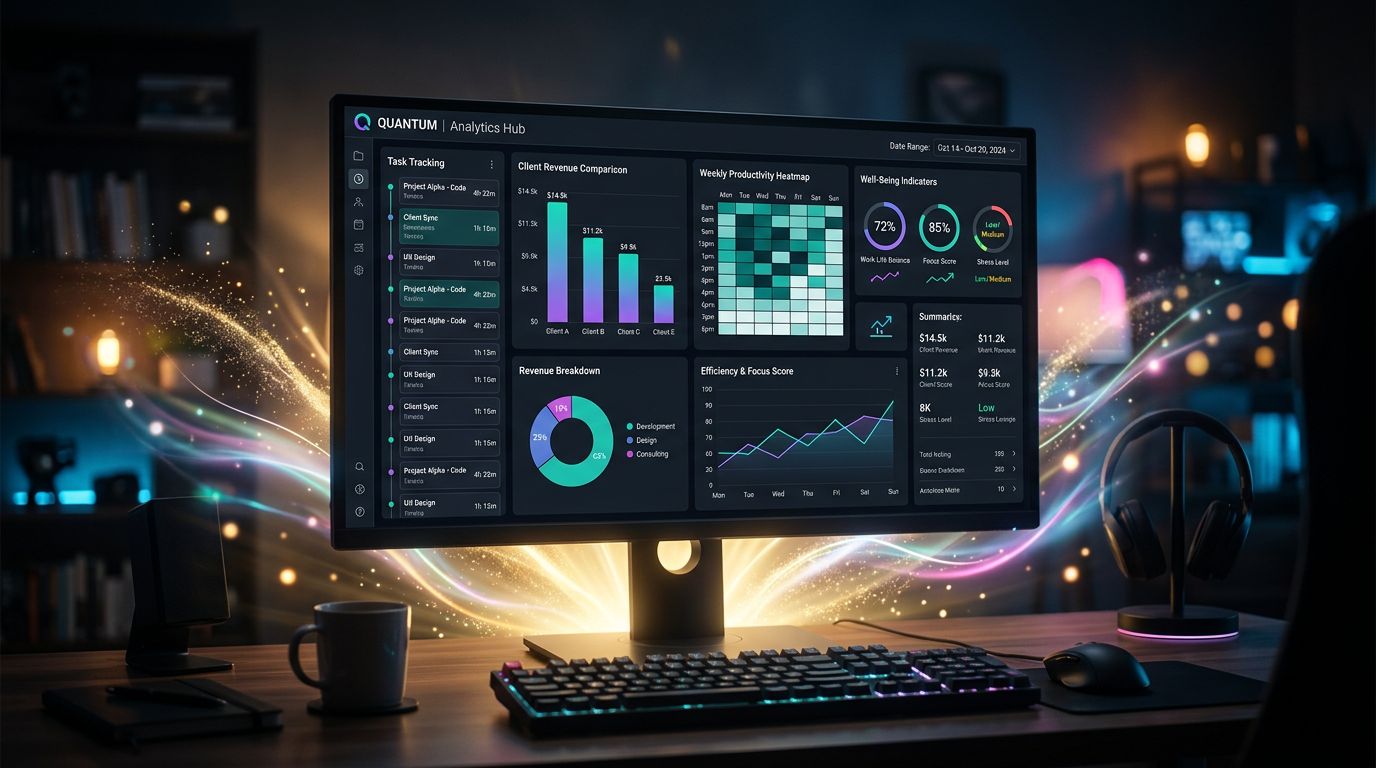
When you have that data, patterns emerge that are often counterintuitive. The client you thought was most profitable may turn out to consume 40% of your administrative time. The “simple” project may hide 3 hours of unbilled weekly coordination.
“Data doesn’t speak for itself. It answers the questions you ask.” — Cathy O’Neil, Weapons of Math Destruction
Well-Being as a Performance Indicator (Not a Soft Skill)
Here’s where it gets interesting.
There’s a direct, measurable correlation between perceived cognitive load and deliverable quality. Not a vague, theoretical correlation — an operational one you can plot on a graph.
Teams and freelancers who integrate well-being indicators into their productivity tracking consistently observe two things: better anticipation of overload periods before they become crises, and more precise identification of tasks that drain energy disproportionately to their actual value.
This isn’t positive psychology. It’s resource management.
Your production capacity is a limited and variable resource. Ignoring it in your management is like running a project without watching the budget. You can hold on for a while. Then everything derails at once.
Tools that integrate well-being as an analytical dimension — not as a decorative feature, but as a management signal — let you adjust workload before quality collapses. It’s measurable. It’s actionable. And it’s exactly what classic dashboards don’t show.
An AI That Knows Your Context Changes the Equation
After analyzing dozens of freelance and agency workflows, the breaking point is always the same: the AI assistant doesn’t know who you are.
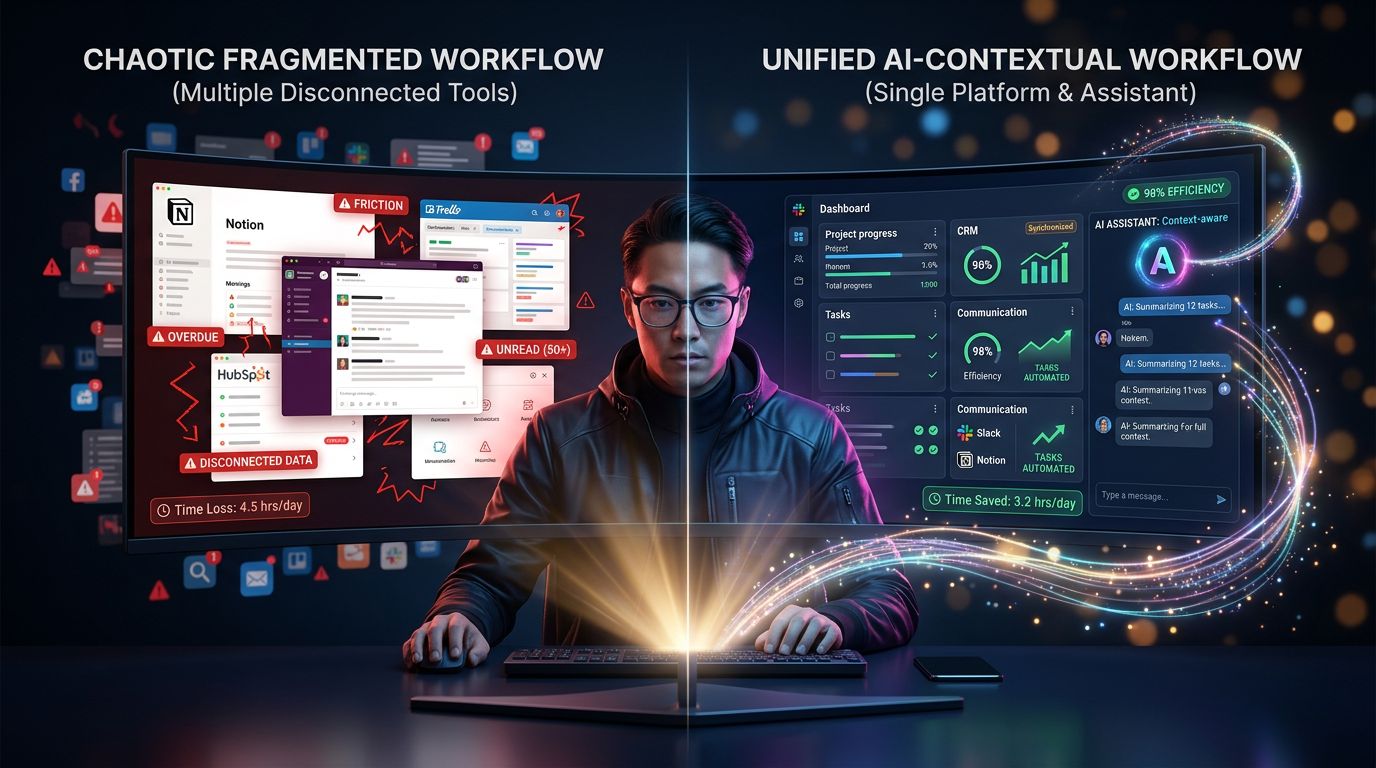
You ask a question about a client. You re-explain the context. You get a generic answer. You adapt. You lose 20 minutes. Multiply that by 15 daily interactions, and it’s 5 hours per week of constant re-contextualization.
Persistent memory isn’t a gimmick. It’s the delta between an assistant that actually helps and a sophisticated chatbot.
When your AI remembers that this client is in negotiation phase, that this project has a history of tight deadlines, that you prefer short answers in the morning and detailed analyses in the afternoon — it’s not saving you time on one task. It’s reducing the systemic friction of your entire day.
Concrete stack: pgvector for vector memory, MCP for connecting the assistant to your real data (CRM, tasks, files), granular time tracking coupled with analytics. Measured result: between 8 and 14 hours recovered per week depending on usage profile.
This isn’t magic. It’s engineering applied to your daily workflow.
Three Things to Measure Starting This Week
Experience has taught me that lasting changes always start with measurement, not with resolutions.
Measure your unbilled time at task level. Not just “admin” as a catch-all category. Each type of friction: information hunting, client coordination, tool updates, re-contextualization. You’ll be surprised by the granularity of what you find.
Measure your current stack’s cost in time, not euros. How many hours per week do you spend moving information between tools that don’t talk to each other? That’s your real subscription cost.
Measure your perceived cognitive load at end of day. Not for personal development — to identify patterns. Which days are exhausting without being productive? Which tasks drain disproportionately? This data is worth more than any external productivity audit.
“Clarity comes from data, not intuition.” — Reid Hoffman
What You Do With This Data Changes Everything
Having metrics isn’t enough. The loop must be closed: measure → analyze → decide → adjust → measure again.
Most freelancers stop at measurement. They know they’re losing time. They don’t know exactly where. And when they do know, they have no lever to change the system — because the system is a collection of unconnected tools that can’t be optimized together.
That’s exactly the problem a true integrated work tool solves. Not an aggregate of SaaS platforms linked by fragile integrations. A system where memory, tasks, CRM, analytics, and AI share the same context.
The difference between a €50k/year freelancer and a €120k one is almost never in professional skills. It’s in the ability to protect actual production time from systemic friction.
Start With the Diagnosis, Not the Tool
If you’ve read this far, you probably have a sense that your current organization costs more than it delivers. That intuition is probably correct.
The next step isn’t switching tools. It’s precisely quantifying what you’re losing, where, and why. One week of granular tracking will give you more useful information than six months of “I should get more organized.”
Nova-Mind integrates task-level time tracking, individual and team productivity analytics, well-being indicators, and an AI that knows your context — all in one coherent system starting at €39/month.
If you want to see what it looks like on your actual workflow, try Nova-Mind and measure the difference over 30 days. Not on faith from an article. On your own data.
What gets measured gets improved. What doesn’t get measured keeps costing you exactly what you think you’re saving.
Share this article
Social networks
Analyze with AI

Charles Annoni
Front-End Developer and TrainerCharles Annoni has been helping companies with their web development since 2008. He is also a trainer in higher education.