


The CRM You Never Had
Article Summary
📖 10 min readTraditional CRMs store data — your AI assistant actually knows your clients. Persistent memory, semantic search, frictionless pipeline: here's why client relationships become a competitive advantage when AI remembers on your behalf.
Key Points:
- A traditional CRM stores, an AI assistant memorizes: it retains that your client hates deliverables without a clear revision brief, or that an upsell too early in the relationship created tension that took six weeks to dissolve — data that fits in no form field.
- The hidden cost of memory friction is massive: a freelancer managing 12 clients loses an average of 83 hours per year — nearly €6,640 — reconstituting context before each client interaction.
- Semantic search (pgvector) changes everything: you ask a question in natural language and find the right client, even if the exact words appear nowhere in your notes.
- A pipeline nobody maintains is worth zero: integrated AI updates deals during a conversation, alerts you to opportunities with no activity for X days, and unifies the entire client history in one place.
- Differentiation in this market doesn't come from technology — it comes from institutional memory: an asset that grows every day and that your competitor, who re-explains context at every session, simply doesn't have.
Client Relationships Have a Structural Problem
Ask yourself this question honestly. How many times have you opened a call with a client frantically searching through your notes for who they are, what they asked you last time, why they were upset in March?
Too often.
This isn’t a human memory problem. It’s an architecture problem. Your tools aren’t designed to memorize — they’re designed to store. That’s not the same thing.
A traditional CRM stores. It waits for you to fill in fields, update statuses, manually log each interaction. It’s administrative work disguised as a solution. And most freelancers and small agencies end up abandoning it after three weeks because maintaining a CRM is a part-time job in itself.
Here’s where it gets interesting: AI fundamentally changes this contract. Not because it “automates” the CRM — but because it transforms the client relationship into something alive.
What “Knowing a Client” Really Means
There’s a difference between having data on a client and knowing them.
Having data means knowing their name is Marc Dubois, that he runs a communications agency in Lyon, and that his monthly budget is €3,000.
Knowing them means understanding that he always responds to emails on Sunday evening, that he hates deliverables without a clear revision brief, that his real pain point is managing subcontractors, and that the last time you proposed an upsell too early in the relationship, it created tension that took six weeks to dissipate.
This second category of information doesn’t fit in a form field. It lives in your exchanges, your quick notes, your meetings. And it systematically disappears into the noise of your daily life.
An AI assistant with persistent memory — the kind that stores each interaction in a vector database and can extract semantic context on demand — changes this equation. Not because it’s magic. Because it never sleeps, never loses the thread, and doesn’t bill its documentation hours.
“Memory is not a luxury in client relationships. It’s the infrastructure of trust.”

The Real Cost of Memory Friction
Let’s put numbers on it. Because “it takes time” isn’t an argument — it’s an intuition. Intuitions without data remain opinions.
Take a freelancer managing 12 active clients. Every start of the week, they review their projects. For each client, it takes them an average of 8 minutes to recover context: where the project stands, what the last decisions were, what was promised, what’s pending.
12 clients × 8 minutes = 96 minutes per week. That’s 1 hour 36 minutes of pure cognitive overhead, every week, just to avoid having to say “remind me where we were.”
Over a year: 83 hours. At €80/hour, that’s €6,640 in lost value from context reconstruction.
This isn’t a productivity problem. It’s a poorly architected distributed memory problem.
My obsession with detail has taught me one thing: the most costly time losses are always the ones we don’t see because they’re integrated into the normal workflow. We don’t account for them. We normalize them.
Semantic Search vs Keyword Search: The Difference That Changes Everything
Here’s where most tools miss the mark.
When you search for a client in a classic CRM, you type their name. Or their company. Or their sector. You do a keyword search — you have to know exactly what you’re looking for to find it.
Semantic search works differently. You ask a question in natural language: “Which client mentioned problems with their subcontractors?” or “Who had a website redesign project with a tight budget?” — and the system finds the relevant contacts even if those exact words appear nowhere in your notes.
That’s the difference between a filing cabinet and a collaborator. A filing cabinet retrieves what you put in it exactly where you filed it. A collaborator understands what you’re looking for.
This capability is built on pgvector — a PostgreSQL extension that transforms your data into mathematical vectors representing the meaning of information, not just its words. Technically precise. Concretely: your CRM becomes searchable like a conversation.

Deals, Opportunities and the Pipeline Nobody Maintains
Let’s talk about the sales pipeline. The topic everyone knows is important and nobody keeps updated.
Why? Because maintaining a pipeline requires administrative discipline in a context where your energy is entirely mobilized by production. You’re delivering a project for one client, responding to an emergency for another, and somewhere in that chaos, you’re supposed to update the status of a commercial opportunity you had two weeks ago.
It doesn’t happen.
What nobody tells you about CRM is that its utility isn’t in the functionality — it’s in reducing the cognitive load required to maintain it. A tool you don’t use is worth exactly zero, regardless of its features.
A CRM integrated into your AI assistant — which can update a deal during a conversation, remind you that an opportunity has had no activity for 14 days, contextually link a new contact with the full relationship history — is a CRM you actually use. Because it doesn’t ask you to do administrative work. It does it with you.
Three concrete tipping points:
- Contextual entry: you say “I had Marc on the phone, he’s interested in the website project but wants to wait until Q3” — the system updates the deal, notes the reason for the delay, schedules a reminder.
- Proactive alerts: a deal with no activity for X days surfaces automatically, with the context of the last interaction.
- Unified history: every email, note, task, file shared with this client is accessible from the contact record. No juggling between five tabs.
The Integration That Eliminates Tool Juggling
After analyzing the workflows of dozens of freelancers and agencies, I’ve identified a constant pattern: fragmentation kills continuity.
You have your CRM here, your task manager there, your files elsewhere, your client messaging in yet another tool. Every transition between tools is a micro-friction. Every micro-friction is an opportunity to lose the thread.
According to a RescueTime study, knowledge workers switch applications or windows an average of 566 times per day. This number isn’t a productivity stat — it’s a cognitive fragmentation stat.
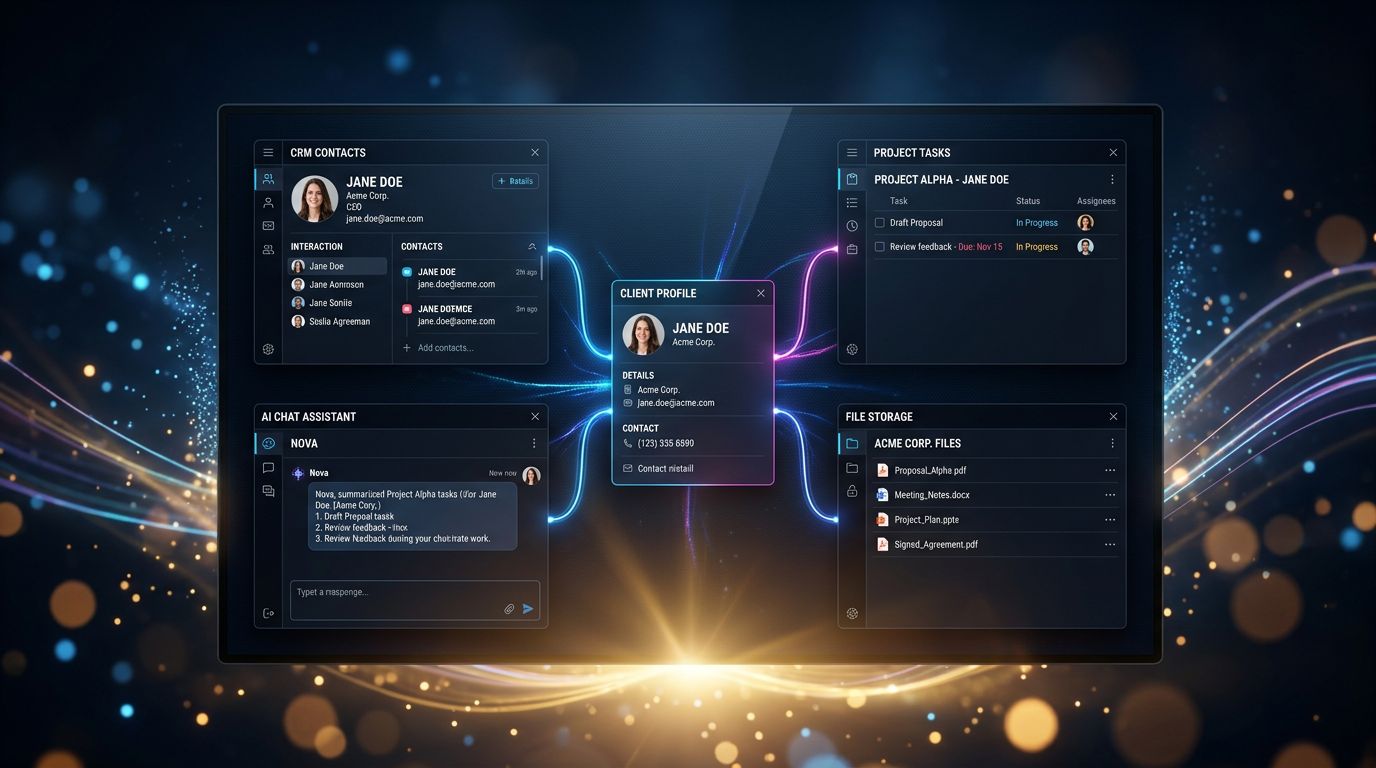
The real value proposition of an integrated tool — CRM + project management + AI assistant + file storage in the same environment — isn’t functional. It’s neurological. Your brain doesn’t have to reconstruct context with every tool switch. Continuity is maintained.
“A tool you leave to go find information is a tool that costs you more than it delivers.”
What This Changes in Real Client Relationships
Let’s flip it. Forget the features, forget the technical stack. What does this change for your client?
They perceive a professional who remembers. Who doesn’t need 10 minutes of “getting up to speed” at the start of every call. Who naturally references a conversation from three months ago because it’s relevant now. Who anticipates their needs because they have the pattern of their past behavior.
That’s the perceived value. Not the technology. The continuity.
A Salesforce study indicates that 76% of customers expect companies to understand their needs and expectations. And 66% say they’re willing to pay more for a better experience.
For a freelancer or small agency, this expectation is a massive opportunity. You can offer a level of personalization and relational continuity that a large agency with 50 clients per account manager can’t match. But only if your tools support you in that direction.
Three Actionable Insights to Transform Your Client Management
Start by documenting what you already know. Take your 5 main clients. For each one, note 3 communication preferences, 2 recurring friction points, and 1 unexploited opportunity. This 30-minute exercise becomes the starting point for your AI memory.
Treat every interaction as data. After every call, after every important email, after every delivery — 2 minutes to note what happened, the decision made, the client’s reaction. This isn’t documentation. It’s capitalization.
Measure your context reconstruction time. Actually time how long you spend “getting back up to speed” before each client interaction. This number is your baseline. It’s what you need to reduce.
Memory as a Competitive Advantage
If I were your strategist, here’s what I’d tell you: in a market where everyone is using the same generic AI tools, differentiation doesn’t come from technology. It comes from institutional memory.
An assistant that knows your 47 clients, their projects, their preferences, their decision history — that’s an asset. An asset that grows every day. An asset that your competitor who re-explains context to Claude at every session doesn’t have.
Client relationships have always been about trust. Trust is built on continuity. Continuity requires memory. For decades, this memory was human, fallible, unscalable.
Now it can be augmented. Persistent. Semantically searchable. Available at 3am when you’re preparing a proposal.
This isn’t digital transformation. It’s just a better work tool. And at €39/month, the math is simple.
Ready to stop re-explaining who your clients are? Nova-Mind integrates CRM, persistent memory and AI assistant in a single environment. Try it — your clients will notice the difference before you do.
Share this article
Social networks
Analyze with AI

Charles Annoni
Front-End Developer and TrainerCharles Annoni has been helping companies with their web development since 2008. He is also a trainer in higher education.