


Project Management: Is Your Tool Actually Working for You?
Article Summary
📖 9 min readTool fragmentation costs teams between 15 and 20 hours per month in context-switching — invisible on the P&L but very present in Friday evening fatigue. In 2025, the best project management systems don't just store: they memorize, anticipate, and work in your absence.
Key Points:
- 87% of projects exceed their initial deadline not from lack of method, but from invisible fragmentation: 3 to 5 hours of context-switching lost every week, totaling 15 to 20 hours per month per person.
- Classic all-in-one tools (Notion, Monday, ClickUp) centralize data but remain passive — they store without acting, without memory between sessions, and without proactive initiative.
- Context has become the scarcest resource in 2025: knowing *why* a task exists, *who* it concerns, and what decisions were made three weeks ago that nobody documented.
- The three pillars of a real project infrastructure: active persistent memory (not a manually maintained knowledge base), task management connected to reality, and proactive initiative that alerts before problems occur.
- The decisive selection criterion for any tool in 2025: 'Does it remember what I told it last week without me re-feeding it?' — if the answer is no, it's a pre-2024 tool.
The Broken Promise of Project Management Tools
87% of projects exceed their initial deadline. Not from lack of talent. From an excess of poorly connected tools.
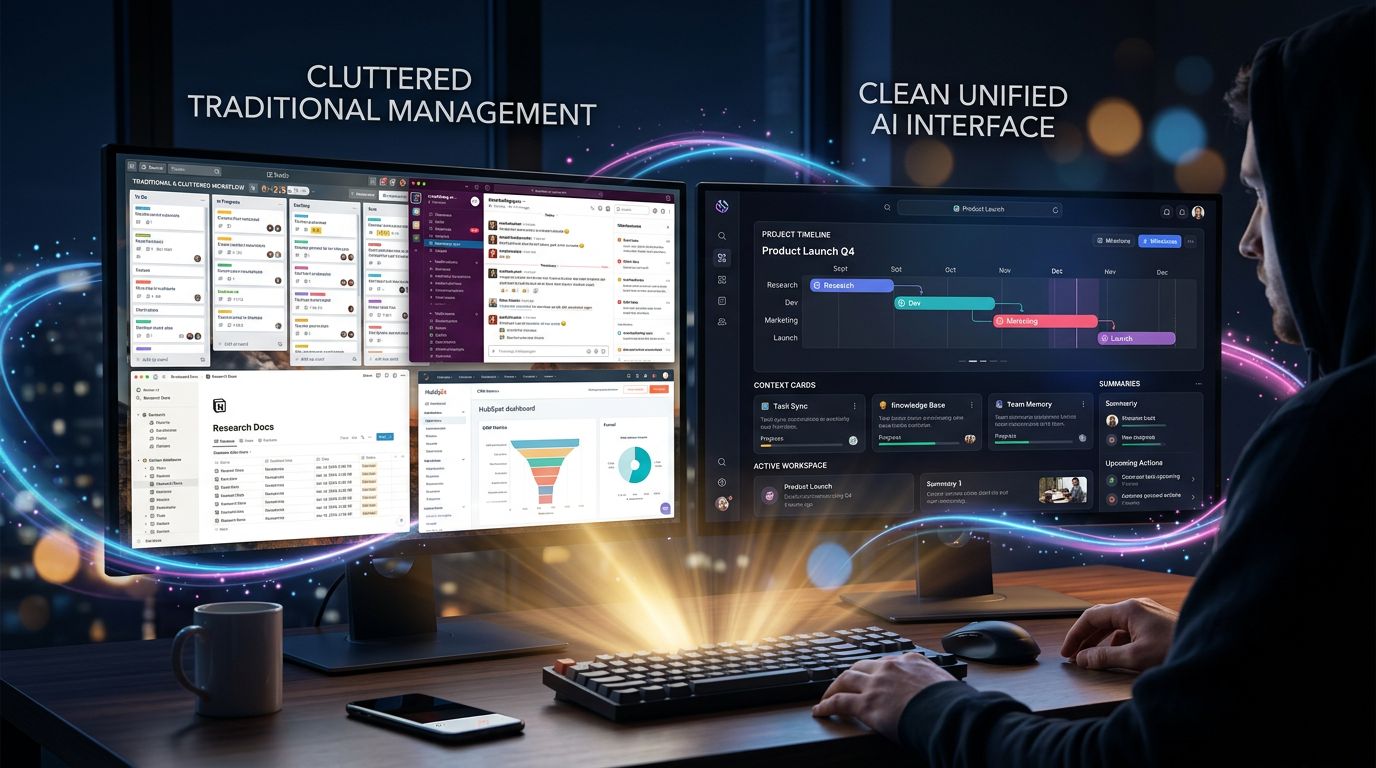
It’s the paradox we all live. The more apps we adopt to “get better organized,” the more time we spend feeding them. Trello for tasks. Notion for docs. Slack for communication. HubSpot for clients. And somewhere in the middle — you, manually making the connections between all of it.
Here’s where it gets interesting: most teams don’t suffer from a lack of organization. They suffer from invisible fragmentation that costs them between 3 and 5 hours per week — just in context-switching.
In 2025, project management has mutated. It’s no longer a question of method (Agile, Kanban, GTD — pick your religion). It’s a question of infrastructure. And most popular tools were designed for a pre-AI world.
What “Managing a Project” Actually Means Today
For 15 years, managing a project meant: break down a task, assign it, track it, deliver it. Simple. Clean. Repeatable.
That model is dead. Not dramatically — it collapsed in silence, task after task.
Today, a project involves real-time decisions, clients who change their minds, hidden dependencies between assignments, and a volume of contextual information that no longer fits on a Trello card. The real project manager in 2025 is someone permanently juggling between operational and strategic — often alone.
Context has become the scarcest resource.
Not time. Not budget. Context. Knowing why a task exists, who it concerns, what decisions were made three weeks ago that nobody documented.
That’s precisely where traditional tools break down. Asana tells you what to do. It doesn’t know why you’re doing it or what your client told you on the last call.
The Real Cost of Fragmentation
Let’s put numbers on what everyone feels but nobody actually calculates.
A RescueTime study on knowledge workers shows they switch applications on average every 3 minutes and 5 seconds. Each interruption costs an average of 23 minutes of complete cognitive recovery. Do the math over a week.
In practice, here’s what that looks like for a 3-person digital agency:
- 45 minutes/day searching for information that exists “somewhere”
- 30 minutes/week re-briefing the AI because it forgot the client context
- 2 hours/week manually synchronizing what’s happening between tools
- 1 unnecessary coordination meeting per week because nobody has the same view
Total: between 15 and 20 hours lost per month. Per person.
This isn’t a question of marginal efficiency. It’s a real cost item, invisible in your P&L, but very present in your Friday evening fatigue.
Why Classic “All-in-One” Tools Fail
Let’s flip the question. If fragmentation costs so much, why haven’t all-in-one solutions won?
Notion tried. Monday.com too. ClickUp pushed the concept to the absurd with its 1,000 features.
The problem isn’t functional completeness. It’s the absence of memory and initiative.
A classic all-in-one tool centralizes your data. Fine. But it stays passive. It waits for you to talk to it. It doesn’t know that client Dupont has been sensitive about deadlines since the failed project last March. It doesn’t detect that you have 14 overdue tasks and are at burnout risk. It doesn’t suggest reorganizing your week based on what just happened.
It stores. It doesn’t act.
AI has changed the definition of what a productivity tool should do. The bar is no longer “organize my data.” It’s “understand my context and work with me in real time.”
“Real artificial intelligence in business isn’t a chatbot that answers questions — it’s a system that knows your context well enough to anticipate your needs.” — Field observation, IndieHackers community, 2024

The Three Pillars of a Real Project Infrastructure in 2025
My obsession with detail has led me to break down what differentiates teams that consistently deliver from those who suffer through their projects. Three pillars. Always the same ones.
Persistent Memory
Not a knowledge base you maintain by hand. An active memory that captures context as work unfolds — conversations, decisions, client preferences — and automatically reinjects it when relevant.
The concrete difference: you never re-brief your assistant on who this client is. It knows. It has always known. Because everything you’ve exchanged about them is indexed, vectorized, and recalled at the right moment.
Task Management That Follows Reality
Projects aren’t linear. Tasks recur, nest together, shift in priority. A good project management system in 2025 must handle recurrence, time estimates, actual vs. planned tracking — and adapt when reality deviates from the plan.
Kanban is still useful. But it must be connected to everything else: clients, communications, files, time-spent metrics. Not an island in your ecosystem.
Proactive Initiative
This is the pillar nobody mentions because it didn’t exist before. A system that alerts you before you have a problem. That detects overload patterns. That suggests delegating or pushing back a non-critical task when your workload hits a critical threshold.
This is no longer organization. It’s real-time operational coaching.
What This Changes for Freelancers and Agencies
If I were your strategist, here’s what I’d look at first in your current stack.
For a solo freelancer: the main risk is scattered context. You have clients in your head, notes in Notion, emails in Gmail, and tasks in Todoist. Nothing talks to anything. Result: you lose time reconstructing context at every work session. The priority is centralized memory that connects clients, projects and tasks in a single view.
For a 3-to-10-person agency: the risk is silent desynchronization. Everyone has a partial view of the project. Decisions get made in meetings because there’s no shared source of truth in real time. The priority is contextual collaboration — project-specific spaces where communication, files and tasks coexist, with granular access rights.
In both cases: AI needs to know your clients. Not generically. By name, sector, preferences, and the history of your exchanges. That’s the difference between an assistant that answers questions and an assistant that works with you.
Three Actionable Insights to Apply This Week
1. Audit your switching cost. For two days, count how many times you switch applications to find a piece of information. Multiply by 5 minutes (a conservative estimate of cognitive cost). The number you get is your weekly “fragmentation tax.”
2. Centralize client context before changing tools. Before adopting a new solution, export what you know about your 5 main clients (history, preferences, ongoing projects) in a structured format. This corpus is your most valuable asset — and often the most neglected one.
3. Demand memory as a selection criterion. When evaluating a productivity tool, ask one simple question: “Does this tool remember what I told it last week without me re-feeding it?” If the answer is no, you’re evaluating a pre-2024 tool.

Project Management Is an Infrastructure Question, Not a Method Question
What nobody tells you in productivity articles: method accounts for 20% of the result. Infrastructure accounts for 80%.
You can be the world’s best practitioner of Agile or GTD — if your tools don’t communicate, if your AI forgets everything between sessions, if your CRM is separated from your projects, you hit a ceiling.
The good news: this infrastructure exists. It’s no longer reserved for teams with a six-figure IT budget. Solutions like Nova-Mind were designed precisely so freelancers and small agencies can access persistent memory, integrated project management, a connected CRM and proactive coaching — in a single tool, at an accessible price.
Fragmentation is a default choice. Integration is a deliberate one.
In 2025, the question is no longer “which project management tool do you use?” It’s “does your infrastructure work for you when you’re not there?”
If you want to see concretely what that looks like — persistent memory, tasks integrated with CRM, proactive coaching and an assistant that genuinely knows your clients — Nova-Mind is available from €39/month, with all features activated from day one. No truncated freemium. No surprises on the bill.
Your next project deserves better than an orphaned Kanban board.
Share this article
Social networks
Analyze with AI

Charles Annoni
Front-End Developer and TrainerCharles Annoni has been helping companies with their web development since 2008. He is also a trainer in higher education.