

The AI That Protects: From Wildlife to Your Digital Infrastructure
Article Summary
📖 9 min readThe same AI pattern that protects biodiversity with SpeciesNet also protects your digital infrastructure with Codex Security: detect, classify, alert.
Key Points:
- Google SpeciesNet identifies 35,000 animal species in open-source — democratizing protection tools to all organizations
- Codex Security applies the same detect/classify/prioritize pattern to cybersecurity, automating vulnerability surveillance
- The AI protection pattern (ingestion, classification, prioritization, learning) applies to any domain where human attention is limited
- Open-source accelerates adoption where it matters: small agencies and freelancers access the same surveillance capabilities as large enterprises
- AI protection becomes critical infrastructure—not a feature—to augment cognitive capacity and free time for high-value decisions
The AI That Protects: From Wildlife to Your Digital Infrastructure
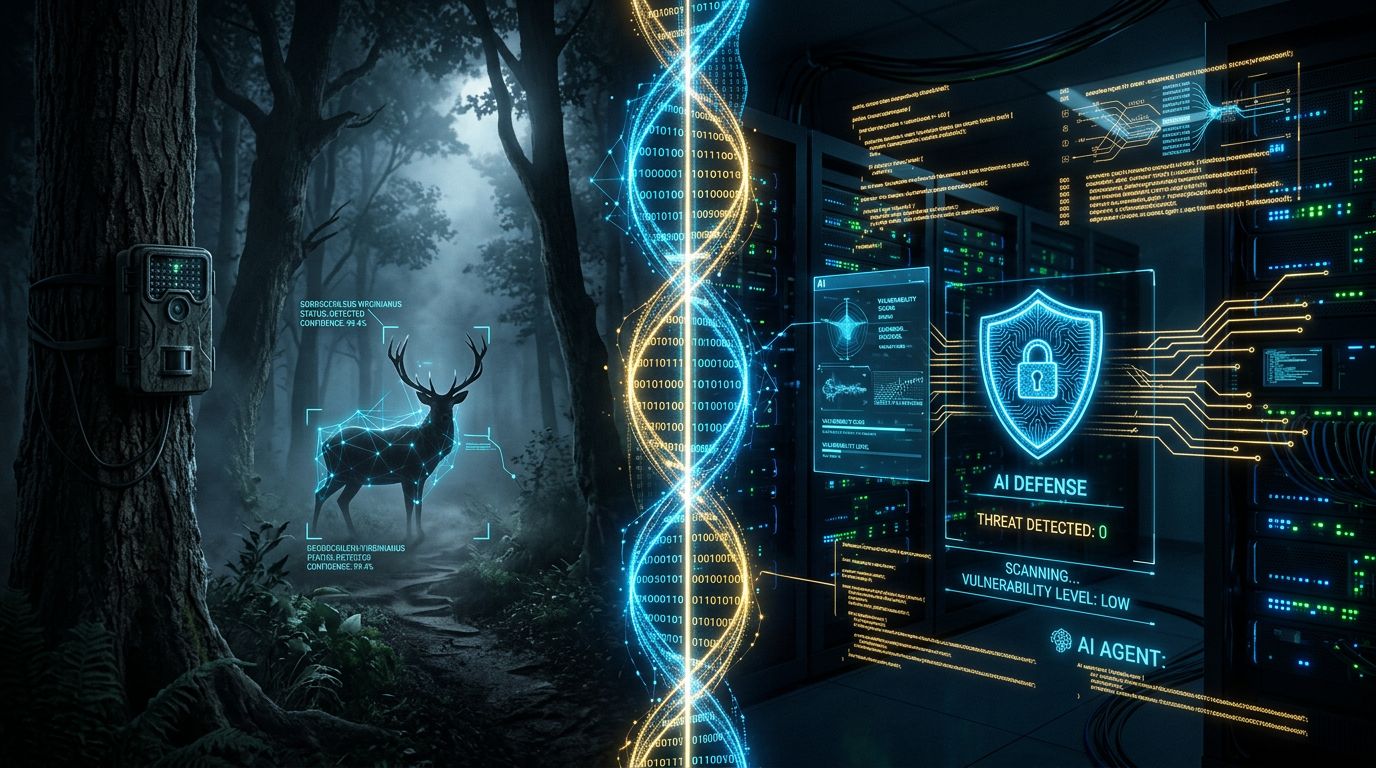
Two deer in a dense forest, a server running at 3 AM, a developer asleep. On the surface, nothing in common. Except the same technology — the same fundamental principles of detection, classification, continuous learning — is watching both. And this unexpected convergence says something important about what AI is really becoming.
Not a gadget. Not a text generator. A large-scale protection system.
When an Open-Source Model Learns to Recognize 35,000 Species
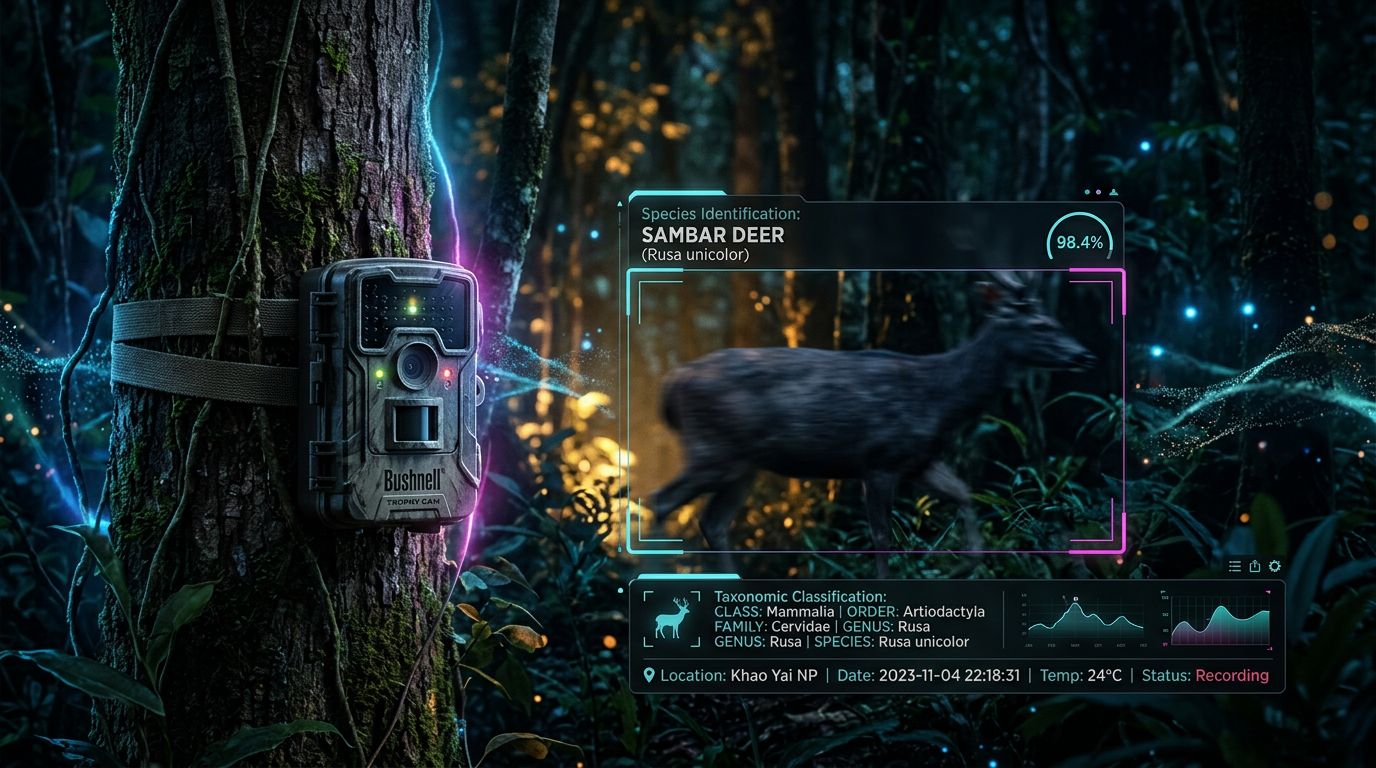
Here’s where it gets interesting: Google recently open-sourced SpeciesNet, a model capable of identifying over 35,000 animal species from camera trap photos. Millions of images. Thousands of hours of biologist work replaced — or rather augmented — by an algorithm running continuously.
Field biologists know it well: the bottleneck isn’t in the field. It’s in the processing. A network of 50 camera traps in a nature reserve can generate 10,000 images per week. Sorting that manually? Weeks of work. With SpeciesNet? A few hours.
“Biodiversity conservation has always suffered from the same problem: too much data, not enough hands to process it. AI doesn’t replace the biologist — it gives them back time for what really matters.”
What makes SpeciesNet particularly interesting is its open-source availability. Any NGO, any university, any researcher can use it, fine-tune it, adapt it to their local context. It’s exactly the distribution model that maximizes real impact: no prohibitive licensing, no single-vendor dependency.
The parallel with information security isn’t cosmetic. It’s structural.
Codex Security: The AI Hunting Vulnerabilities While You Sleep
Flip the situation. Same logic, different terrain.
Codex Security — developed by OpenAI — is an AI agent specialized in detecting vulnerabilities in code. It doesn’t just statically scan files: it reasons, tests, simulates attack vectors. It thinks like an attacker to defend like an expert.
The numbers speak for themselves. According to the Verizon Data Breach Investigations Report 2024, 68% of data breaches involve human error or negligence. Vulnerabilities lingering in code because nobody had time for a complete audit. Unpatched dependencies. Secrets exposed in environment variables.
A solo developer or small agency can’t afford a pentester each sprint. That’s where AI agents change the game: continuous protection, marginal cost, zero fatigue.
Here’s what no cybersecurity article tells you: the biggest risk isn’t the sophisticated attacker. It’s the mundane vulnerability nobody had time to fix. A known CVE from 6 months ago on an npm library. An SQL injection in a rarely-used endpoint. AI detects exactly these things — systematically, never dropping its guard.
The Common Pattern: Detect, Classify, Alert
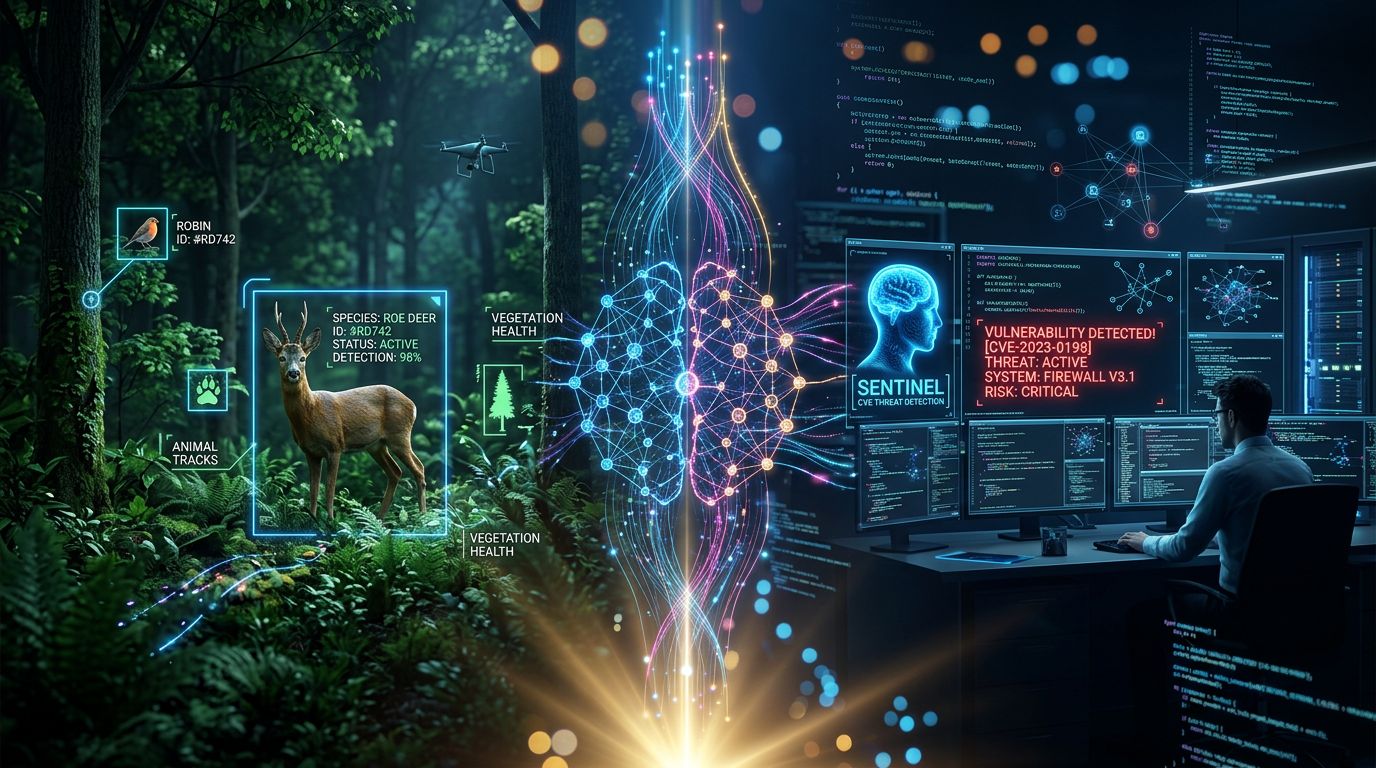
My analysis reveals an identical structure beneath these apparently opposite applications.
First step: ingesting raw data. Thousands of wildlife camera images on one side. Thousands of lines of code on the other. Volume too high for exhaustive human processing.
Second step: classification. SpeciesNet identifies the species, time, passage frequency. Codex Security identifies the vulnerability type, its criticality, the potential exploitation vector. Same taxonomy logic applied to radically different domains.
Third step: prioritization. Not all detections are equal. A snow leopard in a protected zone deserves immediate alert. A critical vulnerability in an authentication endpoint does too. AI sorts, weighs, prioritizes — freeing humans for high-value decisions.
Fourth step: continuous improvement. Both systems learn. Each validated correction refines the model. Each false alarm reduces future noise.
This pattern — ingestion, classification, prioritization, learning — is the backbone of what I call protection AI. And it applies to any domain where data volume exceeds human attention capacity.
What It Means Concretely for a Freelancer or Agency
Let’s be direct: you probably won’t use SpeciesNet tomorrow morning. But the principle it embodies — delegating continuous surveillance to AI to recover cognitive time — affects you directly.
Look at your current stack. How many things need your repeated attention without truly needing your judgment?
- Checking if a client hasn’t replied in 5 days
- Verifying project progress
- Reminding that a deadline is approaching
- Detecting that a deal is stalling in your pipeline
That’s exactly what Nova does in our stack: persistent memory that monitors, classifies, and alerts — without you having to re-explain everything each session. Gartner estimates that by 2026, over 80% of enterprises will have used generative AI APIs or deployed generative AI-enabled applications. Those who’ve built AI memory and surveillance infrastructure today will have structural advantage.
Protection AI isn’t reserved for large systems. It applies to your daily workflow.
Open-Source as a Democratization Lever
There’s a detail in the SpeciesNet story worth pausing on: Google chose to make it open-source. It’s as much a strategic choice as an ethical one.
Why does it matter? Because protection problems — whether biodiversity or cybersecurity — are distributed problems. They don’t get solved from a single command center. They get solved when tools are accessible to those on the ground.
A forest ranger in Kenya with a limited budget can today use the same model as a major American research lab. A small web agency can access vulnerability detection capabilities that were reserved for large consulting firms five years ago.
“Open-source isn’t altruism. It’s an adoption strategy. And in the domain of protection AI, it’s the only strategy that makes sense at global scale.”
This democratization logic — same tools access regardless of size — is precisely what guided me in building Nova-Mind. Not because it sounds nice. Because freelancers and small agencies have the same context management and continuous surveillance problems as large structures, without the teams to handle them.
3 Insights to Remember
1. Protection AI isn’t a vertical sector, it’s a horizontal pattern. The same fundamental algorithm — detect, classify, alert — applies to wildlife and source code. If you understand this pattern, you can apply it to any domain where human attention is a bottleneck.
2. The real ROI of surveillance AI is recovered cognitive time. Not “AI replaces humans.” Rather: AI processes volume, humans process exceptions. A biologist no longer sorting 10,000 photos spends time analyzing trends. A developer no longer doing manual audits spends time building.
3. Open-source accelerates adoption where it matters most. Distributed problems — biodiversity, SME security, context management for freelancers — get solved with accessible tools, not with closed platforms at €500/month.
Protection as Infrastructure, Not Feature
Here’s what I take from this convergence between SpeciesNet and Codex Security: we’re transitioning from AI that answers questions to AI that monitors continuously.
It’s a paradigm shift. The assistant that responds when you ask is useful. The agent that watches your code, your client pipeline, your ongoing projects — and alerts you when something deserves your attention — is infrastructure.
Not a feature. Infrastructure (I already see people screaming dystopia. Are they wrong?).
And like any infrastructure, it gains value over time. The more it knows your context, the more it detects relevant anomalies. The more it learns your patterns, the more precise its alerts become.
That’s exactly what I built into Nova: persistent memory via pgvector, automations that monitor your projects and CRM, 36 MCP tools so your assistant actually acts on your work environment — not just on text.
Wildlife and code. Nature and digital. Protected by the same pattern.
Want to experience concretely what an AI that monitors your business context looks like instead of forgetting it each session? Nova-Mind is available from €39/month. Private data, native desktop app, real memory. Discover Nova-Mind — and see the difference between an assistant that answers and an assistant that protects.
Share this article
Social networks
Analyze with AI

Charles Annoni
Front-End Developer and TrainerCharles Annoni has been helping companies with their web development since 2008. He is also a trainer in higher education.