
 Français
 English











- AI saves real time on repetitive tasks: the problem isn't the tool, it's what we do with the time saved.
- According to a BCG study published in Harvard Business Review in March 2026, productivity rises with a second AI tool, then drops from the third onwards.
- A UC Berkeley Haas study found that AI makes working days longer: people work through their breaks, in the evening, and on tasks they would never have taken on before.
- Optimising used to cost time, which forced us to stop. With AI, optimising becomes almost free, so nothing stops us.
- Three simple rules: measure what you ship rather than the method, let one tool go when another comes in, keep time you don't optimise.
A sentence lost you? Highlight it: I'll explain it.
I tried everything
I’m one of those people who have tried everything. Tim Ferriss’s books, and every book he recommends. The Pomodoro technique, its 25 minutes and its tomato-shaped timer. To-do lists colour-coded by priority, days carved into time blocks, habit-tracking apps. With every new method came the same promise: this time, I’ll finally have everything under control.
Then AI arrived, and I did what people like me do: I went further. I didn’t just use assistants. I built my own. An AI that knows my projects, reads my emails, organises my tasks, prepares my invoices and codes with me. Her name is Nova, and today she is a product I sell.
So I’m not going to write an article against productivity. That would be dishonest. But I am going to share what I learned by going all the way down that road. Because at the end of the road, there was a question I had never asked myself.
What really works
Let’s start with what’s true: AI saves an enormous amount of time.
A client follow-up that used to take me a quarter of an hour goes out in two minutes, proofread and corrected. An invoice gets prepared while I’m doing something else. A web page that would have taken me a day is built in an hour. Bank reconciliation, meeting notes, sorting emails: all that repetitive work that eats up a week without anyone noticing, a well-configured AI takes care of.
Studies point the same way. A Boston Consulting Group survey of 1,488 American employees, published in Harvard Business Review in March 2026, found that when AI takes over repetitive tasks, burnout can even go down.
And I’m not guessing. On 11 November, I added a counter to Nova Stellaris. Every action Nova carries out for me, an email sent, a web page created, a quote, an invoice, is logged with the time it would have taken me by hand. Two weeks later, the counter shows 207 hours and 58 minutes saved. At my hourly rate of 90 euros, that comes to €18,717.
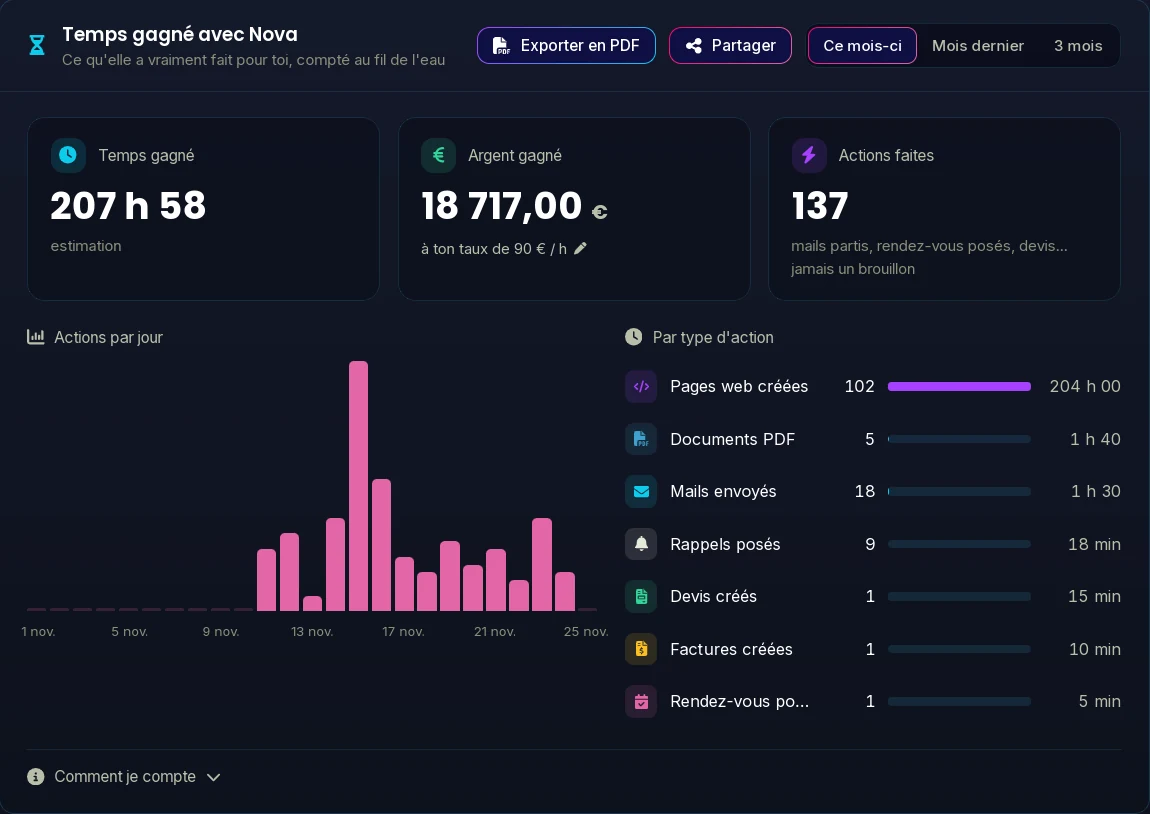
It’s an estimate, but it’s based on real actions, counted one by one. So yes, it works. The problem lies elsewhere.
The tipping point
There comes a moment, hard to spot, when tuning your tool becomes the work itself.
You spend an evening reorganising your to-do list instead of doing the tasks. You switch methods every year, because the new one looks more efficient than the old one. You install an app to track your habits, then another one to track the first. You automate a ten-minute task, and the automation takes three hours to get right.
Each decision, on its own, is reasonable. It’s the sum of them that isn’t. At the end of the week, you’ve optimised a lot, and you’d be hard pressed to say what you actually shipped.
That’s the only question that matters, and it’s the most uncomfortable one: what did I ship? Not how many tasks I ticked off, not how many hours I tracked. What exists today that didn’t exist yesterday, for a client, for my business, for me?
The BCG study offers a figure that struck me. Employees who go from one AI tool to two become noticeably more productive. With the third, the gain shrinks. Beyond that, productivity declines. The researchers even gave this fatigue a name: “brain fry”, the frazzled brain you get from using and supervising AIs. 14% of employees who use AI say they have already felt it. And those who supervise a lot of AI report 12% more mental fatigue and 19% more information overload.
I recognised myself in that portrait. It’s mostly the early adopters, the people juggling several tools and several agents, who suffer from it the most.
The trap that’s specific to AI
Before AI, optimising was expensive. Setting up a new method, building a tracking spreadsheet, writing a script: all of it took time. That cost played a role nobody noticed. It forced us to stop.
With AI, that cost has almost disappeared. A new automation takes one sentence to request. A custom tool gets built in an afternoon. Nothing stops us any more, so we don’t stop.
And the time saved doesn’t turn into free time. It turns into more work. Researchers at UC Berkeley Haas followed 40 employees of a 200-person tech company for eight months. Their findings, published in February 2026, describe exactly what I went through:
- people take on tasks that used to belong to someone else, or that they would never have attempted before;
- they work during breaks, early in the morning and late at night, because starting a task no longer takes any effort;
- they keep AI running in the background during a meeting or a review, so they never really have just one thing on their mind.
My own counter shows it, and it was by looking at it closely that I understood. Of those 208 hours, 204 come from 102 web pages created in two weeks: mock-ups, website pages, working documents. Without AI, I would never have made that many. So a good part of this “time saved” was never freed-up time. It’s work I wouldn’t have done at all. And 208 hours in two weeks is more than the time I spent at my screen over the same period.
The company they studied didn’t force anyone to use AI. The employees did it on their own, enthusiastically. That’s exactly the trap: nobody pushes us. We push ourselves.
What it cost me
I’m going to be honest, since that’s the subject.
This year, I worked about 70 hours a week. Not because a client demanded it, but because everything went faster, so I did more. Every hour AI saved me went straight into a new project. I felt more efficient than ever, and that was true. I was also more tired than ever.
This summer, I went all the way to burnout.
The most ironic part is what I did next. With Nova, I built a safeguard: a feature that keeps an eye on my working hours and my late nights, and suggests a break when I go too far. So I built a tool to protect me from my tools.
The safeguard works. It suggested a fifteen-minute break again this afternoon. But it doesn’t replace the real answer, which isn’t technical.
Three rules I keep
I have no miracle method to sell. That would be the height of irony at the end of this article. I just have three rules that I try to stick to.
- Measure what I ship, not the method. At the end of the week, I no longer look at how many tasks I ticked off. I look at what is finished and useful to someone.
- A tool only comes in if another one goes out. After two or three AI tools, each new tool costs more than it brings. The BCG figures say so, and so does my experience.
- Keep time you don’t optimise. A meal without a screen, a walk without a podcast at double speed, a weekend without “just one little thing”. That time isn’t wasted. It’s the time we wanted to save time for.
The Berkeley researchers suggest the same idea for teams: break work into phases, protect focus time, and keep human check-ins instead of routing everything through the machine.
For the owner of a small business
If you run a small business, AI can genuinely give you back hours every week. Take them. But decide in advance what you’ll do with them, or your calendar will decide for you, and it will always choose more work.
That’s what I’m trying to do with Nova today: an AI that saves time, and also knows when to say stop. The goal was never to fill every minute. It was to free up a few of them to live.