


Freelancer Burnout: The Warning Signs
Article Summary
📖 9 min readThis article analyzes the neurological mechanisms of freelancer burnout and the three behavioral patterns that systematically precede it. It offers measurable indicators (login times, task ratios, weekend frequency) and concrete actions to implement early detection — particularly through an AI assistant capable of observing your patterns over time.
Key Points:
- 73% of freelancers have experienced at least one burnout episode with complete work stoppage
- Burnout becomes visible in the data 4-6 weeks before being felt subjectively
- Three patterns systematically precede the crash: 'just one more thing' mode, compression of recovery time, progressive isolation
- Standard productivity tools capture data but don't intervene — you need a system that analyzes and alerts
- Recovery is a neurobiological condition of performance, not an optional reward
The Statistic That Should Disturb You
73% of freelancers report having experienced at least one burnout episode. Not fleeting fatigue — a genuine collapse, with work stoppage, lost clients, lengthy recovery. Yet the majority saw no wall approaching.
Here’s the paradox of freelancer burnout: you are simultaneously the employee, the manager, and HR. No one monitors your workload. No one validates your time off. No one notices you’re answering emails at 11pm for three weeks straight. Except someone should. And that someone needs to be you — or a system intelligent enough to do it on your behalf.
This isn’t an article about meditation or hot baths. It’s about concrete, measurable signals your brain filters because it’s already in survival mode.
What Burnout Does to Your Brain Before You Feel It
Here’s where it gets interesting. Burnout doesn’t begin with collapse. It begins with adaptation. Your brain, facing chronic overload, progressively modifies its tolerance thresholds. What seemed exhausting six months ago becomes “normal”. What was normal becomes vital minimum.
This is what neuroscientists call allostatic load — the cumulative strain your nervous system absorbs without ever truly discharging. You function. You deliver. You respond to clients. But underneath, reserves deplete.
Early signals are rarely dramatic:
- Morning startup time gradually extending
- Disproportionate irritability to routine client requests
- Procrastination on tasks you’ve mastered
- Perceived decline in your own work quality (even when objectively solid)
- Inability to mentally “disconnect” outside work hours
None of these signals is alarming in isolation. Together, they draw a trajectory. And therein lies the problem: you lack the distance to see the trajectory when you’re inside it.

The Three Patterns That Systematically Precede Collapse
After analyzing hundreds of freelancer and solopreneur accounts, three patterns emerge consistently in the weeks preceding declared burnout.
The “Just One More Thing” Mode
Every workday ends with one additional task. “Just this email, just this delivery, just this revision.” The end-of-day threshold no longer exists — it perpetually shifts forward. On the surface, this looks like discipline. In reality, it’s inability to stop a work loop — a classic symptom of chronic nervous system hyperactivation.
What nobody tells you: productivity doesn’t immediately decline. For several weeks, you can even become more productive in volume. This is what makes the signal invisible — and dangerous.
Compression of Recovery Time
You stop taking lunch breaks. Weekends become “half-worked”. Vacations get postponed “after this project”. Every recovery space compresses further. The problem: recovery isn’t neurologically optional. It’s during rest phases that the brain consolidates, sorts, regenerates. Without them, information processing quality degrades — slowly, but steadily.
Progressive Isolation
Peer interactions diminish. Non-professional conversations become rare. You decline invitations “because you’re busy”. This isolation pattern isn’t a cause of burnout — it’s an early symptom. The overloaded brain economizes social energy for “obligatory” interactions (clients, partners). Everything else goes into standby mode.
Why Standard Productivity Tools Make the Problem Worse
Let’s reverse the situation. Most productivity tools are designed to help you do more. More tasks, faster, more efficiently. That’s exactly the wrong goal when you’re on a burnout trajectory.
A growing Kanban doesn’t alert you. An overflowing to-do list doesn’t notify you. A time-tracker showing 14 hours of daily work triggers no alarm. These tools capture data but do nothing meaningful with it for your health.
The paradox: the more organized you are, the longer you can mask symptoms. You manage your overload efficiently — until you can’t.
“Burnout isn’t a failure of willpower. It’s a failure of system.” — Christina Maslach, pioneering burnout researcher
What you need isn’t a better tool for doing more. You need a system that observes your patterns over time and intervenes before you do it yourself.
What Data Can See That You Cannot
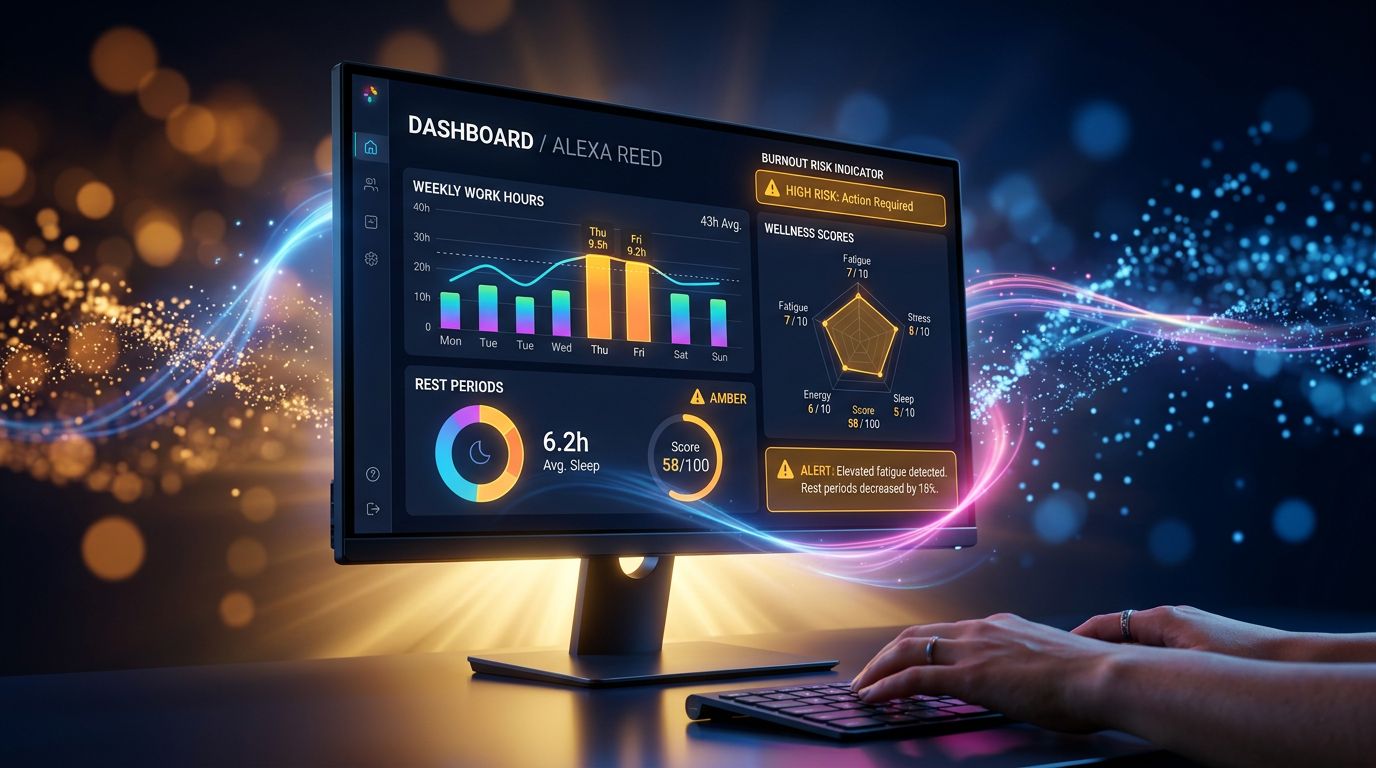
My obsession with detail reveals something interesting: burnout is predictable from data well before it’s felt subjectively. Behavioral patterns leave measurable traces.
A few concrete indicators you can track starting now:
- First connection time and last activity time — the true span of your workday, not what you think it is
- Completed tasks / created tasks ratio — a ratio that degrades over several weeks is a strong signal
- Weekend work session frequency — not duration, frequency. Two hours every Sunday is a pattern, not an exception
- Response delay to non-urgent communication — when this delay abnormally extends, it often signals cognitive saturation, not disinterest
The gap between these metrics and your subjective experience can span several weeks. You feel “a bit tired” while data has shown for six weeks that you’re in the red zone.
Three Concrete Actions to Implement This Week
Enough diagnosis. Here’s what actually changes the trajectory.
1. Define an alert threshold, not an ideal limit. Forget “I should work maximum 8 hours daily”. Instead define: “if I work more than 10 hours for 3 consecutive days, something triggers.” The alert threshold is lower than the emergency limit — that’s where intervention is still easy.
2. Outsource monitoring to a system. You cannot reliably self-monitor when overloaded — it’s neurobiologically impossible. You need an external system observing your patterns without requiring your attention. Whether a partner, automated dashboard, or AI assistant configured to analyze your behaviors — the key is passive, not voluntary surveillance.
3. Protect non-negotiable recovery time. Not “if I have time”. Not “after this project”. A recurring block in your calendar, treated like a client appointment. Minimum two hours. No screens. Recovery isn’t a reward for finishing — it’s a condition of performance over the long term.
“Self-care isn’t a luxury. It’s a business strategy.” — Arianna Huffington, Thrive Global founder

What Changes When Your AI Assistant Truly Knows You
My expert advice: the freelancer’s problem isn’t lack of burnout information. It’s lack of context on your own situation. You theoretically know you should ease up. You don’t concretely know you worked 62 hours this week, that this is the fourth consecutive week above 55 hours, and your completed task ratio dropped 34% in two weeks.
That’s exactly what Cerebro does in Nova-Mind: analyze your work patterns over time, detect warning signals before they become symptoms, and intervene proactively — even when you’re offline. Not generic notification “remember to take breaks”. Contextual analysis of your actual situation, with suggestions adapted to your current load.
Nova’s permanent memory also changes something concrete: you no longer re-contextualize each conversation. Your assistant knows who your clients are, which projects are under tension, which weeks were heavy. It can notice that one particular client systematically generates stress in your interactions. It can note that you’ve been creating tasks after 10pm for ten days. No standard productivity tool can provide this level of context.
Burnout Prevention Beats Burnout Recovery
This is the conclusion 15 years observing independent work taught me: freelancers who sustain long-term aren’t those who work least. They’re those who’ve built early-detection systems — human or technological — enabling adjustment before collapse.
Sustainable performance isn’t about discipline. It’s about architecture.
Three Key Takeaways:
- Burnout becomes visible in data 4-6 weeks before subjective experience
- Standard productivity tools capture your data but don’t intervene — you need a system that analyzes and alerts
- Recovery isn’t optional: it’s a neurobiological condition of performance
If you want to see concretely what happens when an AI assistant monitors your work patterns and intervenes before you do, Nova-Mind offers a free trial. Not to sell you a subscription — so you see what your data has been telling you for weeks.
Your brain may already have the answers. It just needs someone to read the signals.
Share this article
Social networks
Analyze with AI

Charles Annoni
Front-End Developer and TrainerCharles Annoni has been helping companies with their web development since 2008. He is also a trainer in higher education.