


GMP: The Underutilized Project Management and Quality Lever
Article Summary
📖 9 min readThis article reveals how Good Manufacturing Practices (GMP), often perceived as a regulatory constraint, are in reality a powerful project management and quality management tool. It explains how fully embracing them can transform failure prevention and operational performance.
Key Points:
- More than 85% of pharmaceutical product recalls stem from avoidable process failures, highlighting a critical need for robust management tools.
- Good Manufacturing Practices (GMP) constitute an integrated quality management system, offering traceability, risk management, and continuous control.
- Far from being a mere regulatory constraint, GMP represent the most robust internal architecture you can give a production project.
- GMP application extends to facilities, equipment, personnel, documentation, production, and quality control, ensuring comprehensive compliance.
- Despite varying sector-specific frameworks (pharmaceutical, food, medical), the GMP philosophy universally rests on written procedures, traceable execution, and systematic verification.
What Nobody Tells You About Production Quality
87% of pharmaceutical product recalls are avoidable. Not accidents. Process failures. The question isn’t “how did this happen?” — it’s “why did the system let this slip through?”
Here’s where it gets interesting: Good Manufacturing Practices (GMP) are not just a regulatory checklist to tick off before an audit. For a project manager who knows how to read them, they are a complete quality management system — with traceability, risk management, and continuous control natively built in.
My analysis reveals a recurring paradox in manufacturing, pharmaceutical, and food sectors: teams treat GMP and project management as two separate silos. Project managers “do their scheduling.” Quality teams “do their compliance.” The two only intersect during audits. Too late.
Let’s flip the script.
GMP: A Technical Definition, No Sugarcoating
GMP stands for Good Manufacturing Practices. The term is regulatory — it covers all the procedures, controls, and documentation that ensure a product is manufactured consistently, according to defined quality standards.
In practice, GMP covers:
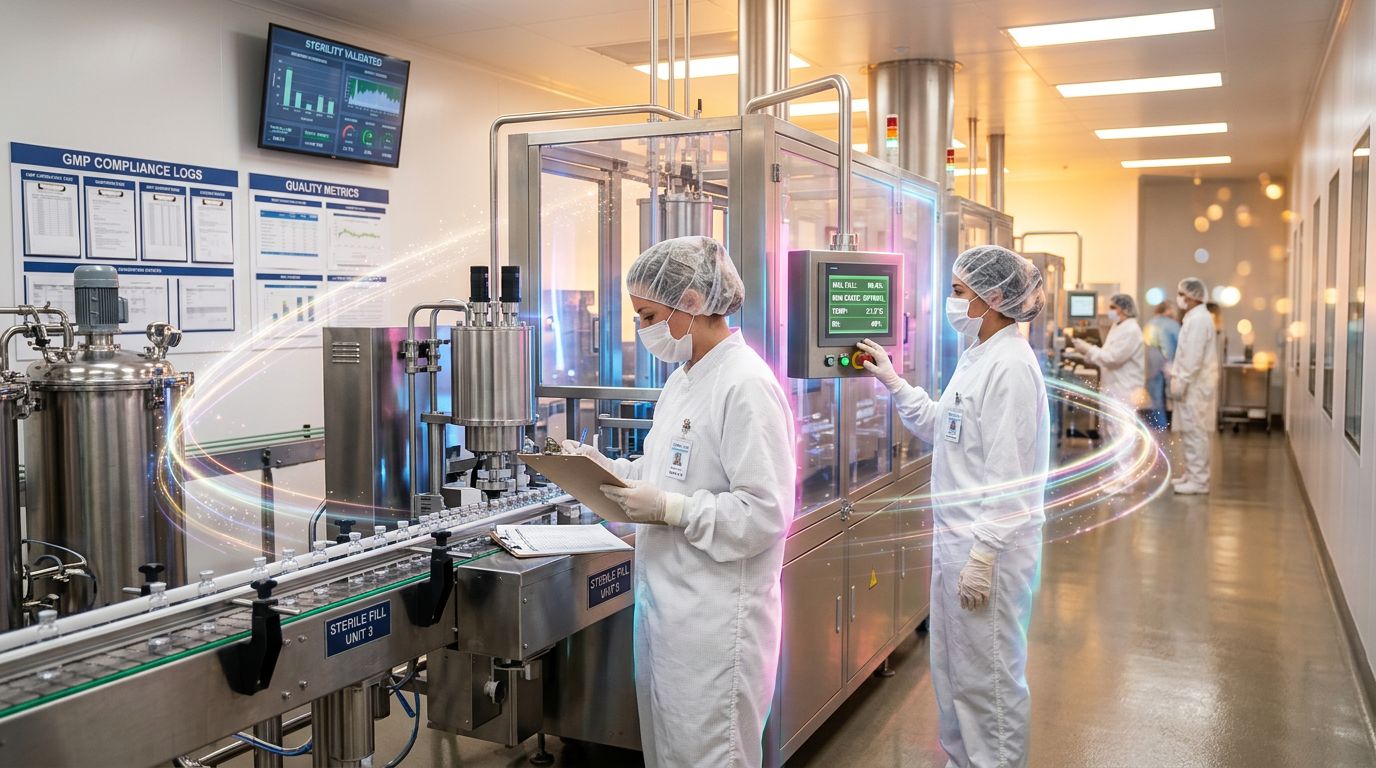
- Facilities and equipment (qualification, maintenance, cleaning)
- Personnel (training, authorizations, hygiene)
- Documentation (procedures, records, traceability)
- Production (in-process controls, deviation management)
- Quality control (testing, batch release, non-conformance management)
Reference frameworks vary by sector — ICH Q10 and EU GMP directives for pharmaceuticals, the FDA’s CGMP regulations in the US, Regulation (EC) No 852/2004 for food, ISO 13485 for medical devices. But the logic is identical everywhere: written procedures, traceable execution, systematic verification.
What no one ever tells you: this logic is exactly that of a mature project management system.
Project Management and GMP: The Convergence Nobody Formalizes
After analyzing dozens of industrial projects in drift — exploded timelines, rejected batches, catastrophic audits — I identified a constant pattern. Teams manage GMP and project management as two separate silos. Project managers “do their scheduling.” Quality teams “do their compliance.” The two only intersect during audits. Too late.
The ground reality is different. GMP inherently impose disciplines that every good project manager should integrate from the scoping phase:
Total Traceability = Real-Time Project Visibility
Every operation documented in a GMP-compliant system generates a complete audit trail. Who did what, when, with which equipment, according to which version of a procedure. For a project manager, this is raw exploitable data: actual progress vs. planned, bottleneck identification, drift detection before it becomes a crisis.
Deviation Management = Proactive Risk Management
GMP formalize a deviation process: every non-conformance is recorded, analyzed (root cause), addressed (CAPA — Corrective and Preventive Action), and closed with proof of effectiveness. This is structured risk management, applied in real time on production. Not a post-mortem retrospective.
Validation and Qualification = Rigorous Project Milestones
IQ, OQ, PQ — Installation Qualification, Operational Qualification, Performance Qualification. These equipment validation phases are full project milestones in their own right, with defined acceptance criteria, documented tests, and formal approvals. No ambiguity about the definition of “done.” Project managers who discover this model never go back to their vague milestones.
“Quality is not an act, it is a habit.” — Aristotle, cited in virtually every industrial quality manual. And for good reason.
What GMP Reveal About Your Blind Spots as a Project Manager
Let’s look at this from another angle. If you manage projects in a regulated environment and you don’t sleep well before audits, the problem probably isn’t the regulation. It’s the absence of a system.
GMP reveal three classic blind spots:
First blind spot: after-the-fact documentation. In many teams, production happens first, then documentation follows. In GMP, documentation is concurrent with the action — it is proof that the action took place correctly, per the procedure, at the right time. This shift in posture transforms documentation from a chore into a steering tool.
Second blind spot: assumed training. GMP require training traceability: who is authorized to do what, with which version of a procedure, since when. In classic project management, resources are assumed to have the necessary skills. In GMP, it’s proven. The difference shows during ramp-ups or emergency replacements.
Third blind spot: improvement without evidence. The GMP CAPA (Corrective and Preventive Action) is not just a bug ticket. It’s a complete process: identification, root cause analysis, action plan, implementation, effectiveness verification, closure. If your team retrospective doesn’t generate this level of rigor, your recurring problems will recur. Guaranteed.

Implementing GMP Logic in Your Project Management: Where to Start
If I were your strategist on this topic, here’s what I would prioritize — without waiting for the next audit.
Map Your Critical Processes
Start by identifying the stages in your project or production where a failure has significant regulatory, safety, or commercial consequences. These stages deserve a written procedure, an in-process control, and systematic traceability. The rest can stay agile.
Structure Your Documentation Around Evidence
No documentation for documentation’s sake. Every record must answer a specific question: “Can we prove that this operation was carried out correctly, by the right person, at the right time?” If the answer is no, the documentation is insufficient.
Formalize a Lightweight but Real Deviation Process
You don’t need a full quality system to start. A simple deviation register — incident, impact, root cause, corrective action, owner, deadline, verification — radically changes team culture. Problems are named, addressed, closed. They don’t accumulate as invisible technical debt.
Integrate Validations as Non-Negotiable Project Milestones
If your project involves equipment, software, or processes subject to qualification, these phases are not optional or compressible. Integrating them into the planning from the scoping phase, with their acceptance criteria, avoids last-minute negotiations with quality teams.
“A robust quality system is not a constraint on innovation — it is what enables you to industrialize it.” — A perspective shared by the majority of experienced quality directors in the pharmaceutical industry.
What project training never tells you: teams that master GMP are generally those with the most predictable timelines. Not the shortest — the most predictable. The difference is crucial for commercial planning.
Three Actionable Insights to Take Away
Insight 1 — Treat documentation as an asset, not a burden. In GMP, every record is proof of value: it protects the company during audits, enables reconstruction in the event of an incident, and feeds continuous improvement. Calculate the cost of a rejected batch or a product recall — your perspective on documentation will change immediately.
Insight 2 — CAPA is your best retrospective. Adapt the CAPA process to your project context. Systematic root cause analysis, verified actions, formal closure. Five minutes per incident handled correctly saves hours of recurrence.
Insight 3 — Predictive compliance is a competitive advantage. Companies that embed GMP into their project DNA don’t suffer through audits — they anticipate them. The result: fewer regulatory delays, more reliable time-to-market, stronger client confidence. In the pharmaceutical sector, it’s often the difference between a partnership and a lost contract.
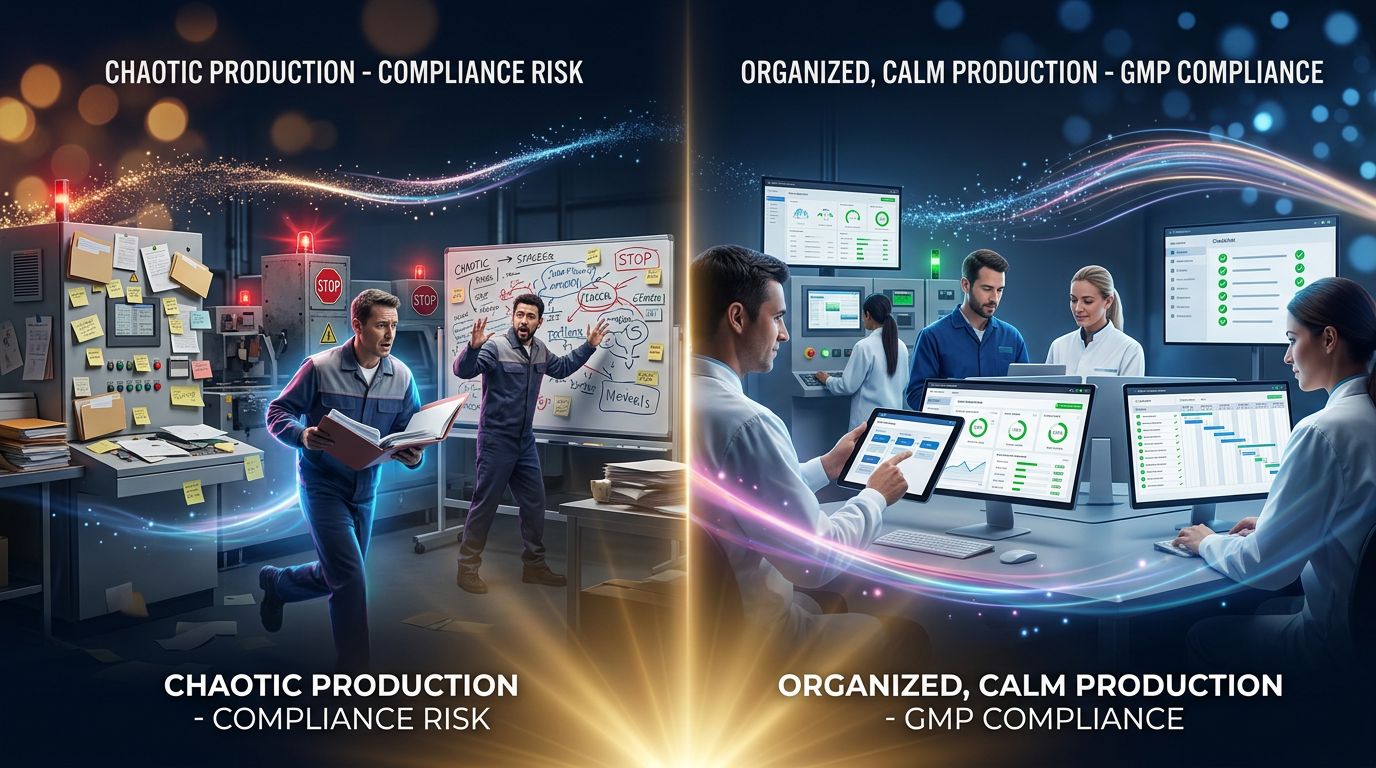
Quality Is Not a Department — It’s a Way of Working
But beware of the trap: GMP are not implemented by decree. The biggest failure I observe in compliance projects is the “we deploy the procedures and people follow” approach. Wrong. GMP only work if teams understand why — not just what.
Training is not an administrative prerequisite. It is the primary lever. A team that understands that an improperly followed cleaning procedure can contaminate a batch destined for patients approaches that procedure differently than a team that follows it “because it’s mandatory.”
For further reading on GMP frameworks applicable to your sector, the resources of the ANSM for pharmaceuticals in France and the FDA for the US market are the reference sources. For food, European Regulation No 852/2004 remains the essential foundation.
The conclusion is simple. Good Manufacturing Practices are not a regulatory constraint to endure — they are a mature, proven quality management system, directly transposable into your project management logic. Teams that make this mental shift stop suffering through audits. They start managing.
Do you manage projects in a regulated environment and are looking for a system to centralize tracking, documentation, and compliance? Nova-Mind integrates project management, AI memory, and time tracking in a single tool — designed for teams that no longer want to juggle ten applications to stay compliant. Discover Nova-Mind and see how €39/month can transform your project stack.
Share this article
Social networks
Analyze with AI

Charles Annoni
Front-End Developer and TrainerCharles Annoni has been helping companies with their web development since 2008. He is also a trainer in higher education.