


Why Your AI Works Better While You Sleep
Article Summary
📖 9 min readCounter-intuitive. Almost insulting. And yet — this is exactly what productivity data shows for freelancers and teams using properly configured AI systems.
Key Points:
- Why your AI works better while you sleep than when you're there Counter-intuitive
- And yet — this is exactly what productivity data shows for freelancers and teams using properly configured AI systems
- Not AI you interrogate
- Here's where it gets interesting: most people use their AI assistant like an enhanced search engine
- They ask a question, they get an answer, they close the tab
Counter-intuitive. Almost insulting.
And yet — this is exactly what productivity data shows for freelancers and teams using properly configured AI systems. Not AI you interrogate. AI that acts.
Here’s where it gets interesting: most people use their AI assistant like an enhanced search engine. They ask a question, they get an answer, they close the tab. Interaction over. Context lost. Tomorrow, you start from scratch again.
This model has a name. It’s called reactive AI. And it’s robbing you of 80% of the real value AI can generate.
The Problem with Reactive Mode — and Why Everyone Stays Stuck There
Think about your last week of work. How many times did you open Claude, ChatGPT, or another assistant to explain the context of a project? “My client is a communications agency, they have a tight budget, their tone is formal, they hate buzzwords, their CMS is WordPress, their deadline is Friday…”
You typed that again. And again. Just like the week before.
This isn’t an AI problem. It’s an architecture problem. Consumer AI assistants are designed for isolated sessions — not continuous, contextual work. Every conversation starts from zero. Every context gets lost. Every minute spent re-briefing is time billed against your own cognitive energy.
Experience has taught me that this invisible cost is one of the most underestimated in a freelancer’s or small team’s workflow. We never measure it because it dissolves into the day. But it accumulates: studies on cognitive load at work consistently show that interruptions and re-contextualizations can account for up to 40% of lost productive time.
Forty percent. Not in a worst-case scenario — on average.

What Proactive AI Actually Changes
Let’s flip the situation.
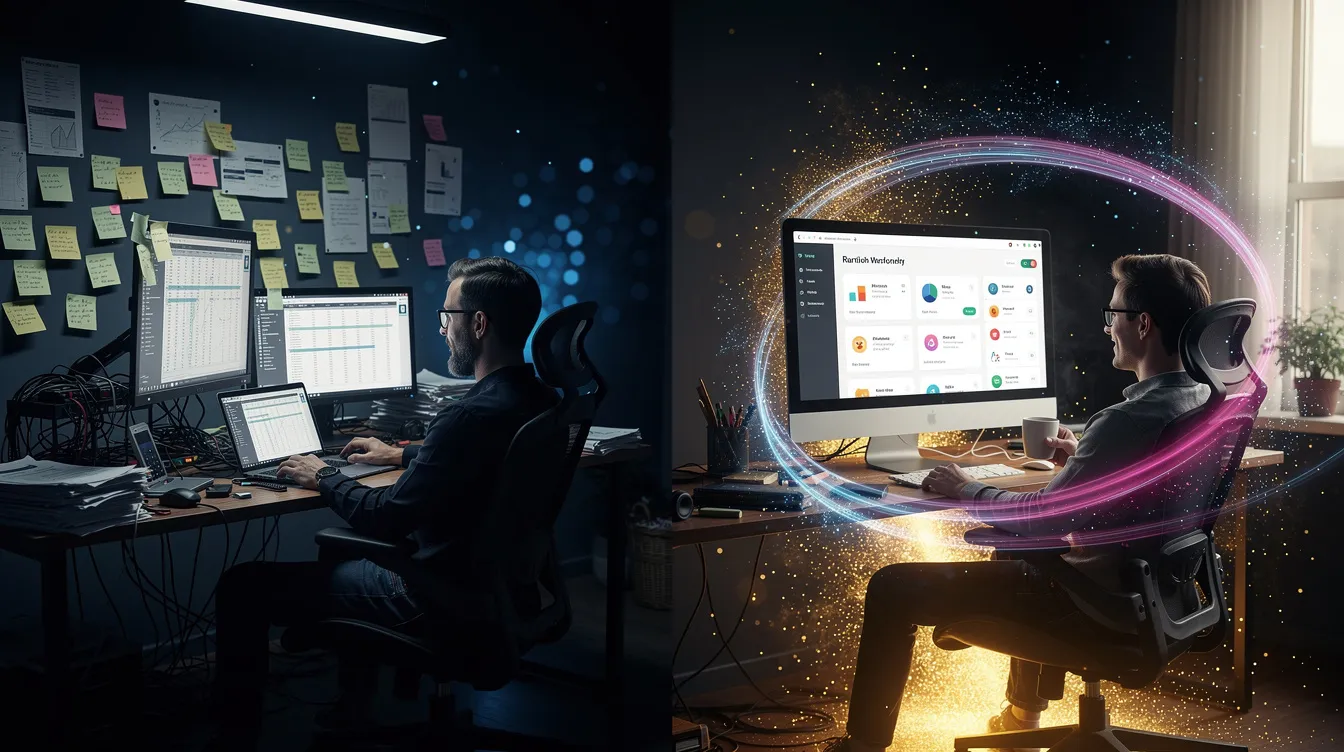
Instead of waiting to be asked a question, a proactive AI monitors, analyzes, anticipates. It knows your clients. It knows your work patterns. It knows you tend to underestimate deadlines on Monday mornings, that your client Dupont always replies late at the end of the month, that your productivity dips on Thursday afternoons.
And it acts on that information — even when you’re not there.
Here’s what that looks like concretely in a workday:
In the morning, before your first meeting. Your AI has analyzed overdue tasks, cross-referenced your calendar, and presents a realistic day plan — not an optimistic one. It’s also detected that a deal in your pipeline hasn’t had a follow-up in 12 days and suggests a personalized message for that specific client, with their history and context included.
Mid-day. You’ve spent 3.5 hours on a task estimated at 1 hour. Your AI takes note. Not to make you feel guilty — to refine future estimates and alert you if you’re exceeding your usual load threshold.
At night, while you sleep. Your system monitors your RSS feeds, identifies relevant content for your industry watch, generates blog article drafts according to your editorial guidelines, schedules social media posts for the week ahead, and syncs everything with your publishing tools.
You wake up with work already done. Not approximate work — work calibrated to your voice, your clients, your standards.
Memory: The Component Nobody Mentions
My obsession with detail reveals something that most AI tool comparisons completely ignore: memory isn’t just another feature. It’s the foundation of all real value.
Without persistent memory, your AI is brilliant but amnesiac. It can write a perfect email — if you explain who the recipient is, what your history with them looks like, what tone is appropriate, what the project constraints are. Every. Single. Time.
With vector memory (pgvector, typically), it’s different. The AI stores not raw data, but semantic representations of your information. It can retrieve “that client who prefers PDF deliverables and has an annual budget of €15k” without you having to specify those exact terms — because it understands meaning, not just words.
What nobody tells you in pop-science AI articles: the difference between keyword search and semantic search is the difference between a filing cabinet and a collaborator. One gives you what you asked for. The other gives you what you need.

Proactive Coaching: When AI Anticipates Burnout
Here’s a dimension that few tools dare to address head-on.
Freelancers and solopreneurs burn out. Not because they lack discipline — often because they lack feedback. When you’re working alone, nobody tells you that you’ve worked 67 hours this week. Nobody notices that you skipped lunch four times. Nobody correlates the drop in your Thursday work quality with your Monday workload.
An AI system that monitors your work patterns can play that role. Not intrusively — contextually. A subtle alert when your task time consistently exceeds your estimates. A break suggestion when your activity crosses a critical threshold. A weekly analysis showing where your energy is actually going.
The link between cognitive overload and decision-making quality is well-documented: beyond a certain load threshold, decision quality drops sharply — even when you feel like you’re “holding it together.” AI doesn’t replace you. But it can see you where you can no longer see yourself.
That’s the difference between a tool and a system. A tool waits. A system watches.
Why Execution Autonomy Changes the ROI Calculation
If I were your strategist, I’d ask you this: how many recurring tasks in your week could be delegated to a system — but aren’t, because you haven’t had time to configure that system?
The honest answer, for the majority of freelancers I observe: between 8 and 15 hours per week. Industry monitoring, content writing, social scheduling, CRM follow-ups, reporting, tool synchronization.
Not high-value tasks. Necessary but time-consuming tasks that occupy exactly the time you should be spending on your real work.
The math is simple. If your daily rate is €400 and you reclaim 10 hours per week, that’s €2,000 in freed productive capacity — every week. Not “boosted.” Freed. Real time, on real tasks, that you can bill or invest elsewhere.
A system at €39/month that delivers this has a 5,000% ROI. This isn’t marketing rhetoric — it’s arithmetic.
What It Requires on Your End
Honest about the limits. Because that’s my rule.
A proactive AI system doesn’t configure itself in ten minutes. It requires an initial investment: describing your clients, structuring your projects, defining your editorial guidelines, setting your well-being thresholds, recording your recurring workflows. Expect between 3 and 8 hours depending on the complexity of your activity.
That’s time you may not feel like spending. It’s time that will be returned tenfold in the weeks that follow.
The real question isn’t “is it worth it?” — it’s “am I ready to work on my system rather than in my system?” The distinction comes from Michael Gerber in The E-Myth: freelancers who stagnate work in their business. Those who scale work on their business.
A well-configured AI system is the modern version of this principle. Not delegation to a person — delegation to an infrastructure.
Three Things to Remember Before You Close This Article
1. Reactive mode costs you more than you think. Every re-contextualization, every re-explanation, every recurring task done manually — that’s time you’ll never get back. Measure it for one week. The numbers will surprise you.
2. Persistent memory is not a detail. It’s the architectural difference between a tool that responds and a system that works. Without it, you’re condemned to start over. With it, every interaction builds something.
3. Overnight autonomy is the real test. If your AI can’t produce value while you sleep, you don’t have an assistant — you have a sophisticated keyboard shortcut.
Move from Reactive to Proactive Mode
Nova-Mind is designed exactly for this. Permanent memory of your clients and projects via pgvector. Proactive coaching that analyzes your patterns and intervenes before the problem. Automatic content generation while you sleep. Integrated CRM with semantic search. All in a single tool, at €39/month.
Not a gadget. A daily work system with memory, initiative, and personality.
If you’ve spent more than 30 minutes this week re-explaining context to your AI — that’s 30 minutes too many.
Try Nova-Mind. Configure it once. Let it work.
Share this article
Social networks
Analyze with AI

Charles Annoni
Front-End Developer and TrainerCharles Annoni has been helping companies with their web development since 2008. He is also a trainer in higher education.