


AI Rewrites the Rules of Reality—From Electric Bills to Black Holes
Article Summary
📖 10 min readGoogle commits to limiting AI's energy impact while OpenAI pushes the boundaries of quantum physics. A telling duality: the same AI tools operate simultaneously on the ultra-concrete (electricity bills) and the ultra-abstract (quantum gravity). How this tension shapes AI's future and why context becomes your competitive weapon.
Key Points:
- Google signs an energy commitment at the White House, acknowledging that AI growth has real externalities on ordinary consumers' electricity bills
- OpenAI uses AI to extend graviton amplitude calculations, pushing the frontier of what scientific computation is possible
- General AI is fundamentally different from previous technologies: it can be applied to any formalizable domain
- Regulatory pressure on data center energy efficiency will intensify over the next 18-36 months
- True AI power lies in context: a model without memory, without access to your actual data, remains a generic tool
- Nova-Mind demonstrates that transformative AI requires persistent memory, integrated CRM, and permanent client context
When AI Rewrites the Rules of Reality—From Electric Bills to Black Holes
There’s something strange about watching the same tech companies sign energy commitments at the White House in the morning and solve quantum gravity equations in the afternoon.
It’s not scattered priorities. It’s strategy.
Tech giants are no longer playing on a single field. They’re operating simultaneously on two radically different fronts: concrete impact on our daily lives, and exploration of the universe’s deepest mysteries. And AI is the common tool for both.
Here’s what that reveals about where this industry is really heading.
Google Faces Reality: Energy Has a Human Cost
Let’s start with the concrete. The brutal part.
The data centers running your favorite LLMs consume mind-boggling quantities of electricity. According to the International Energy Agency, global data center consumption could double by 2026, reaching over 1,000 TWh annually—roughly equivalent to Japan’s total energy consumption.
This isn’t abstract. These are electricity bills rising for households who’ve never opened Claude or Gemini in their lives.
It’s precisely this context that makes Google’s White House commitment significant: a formal pledge to responsible energy growth, with explicit attention to consumer protection—the “ratepayers,” as Americans say, meaning households and businesses paying regulated rates.
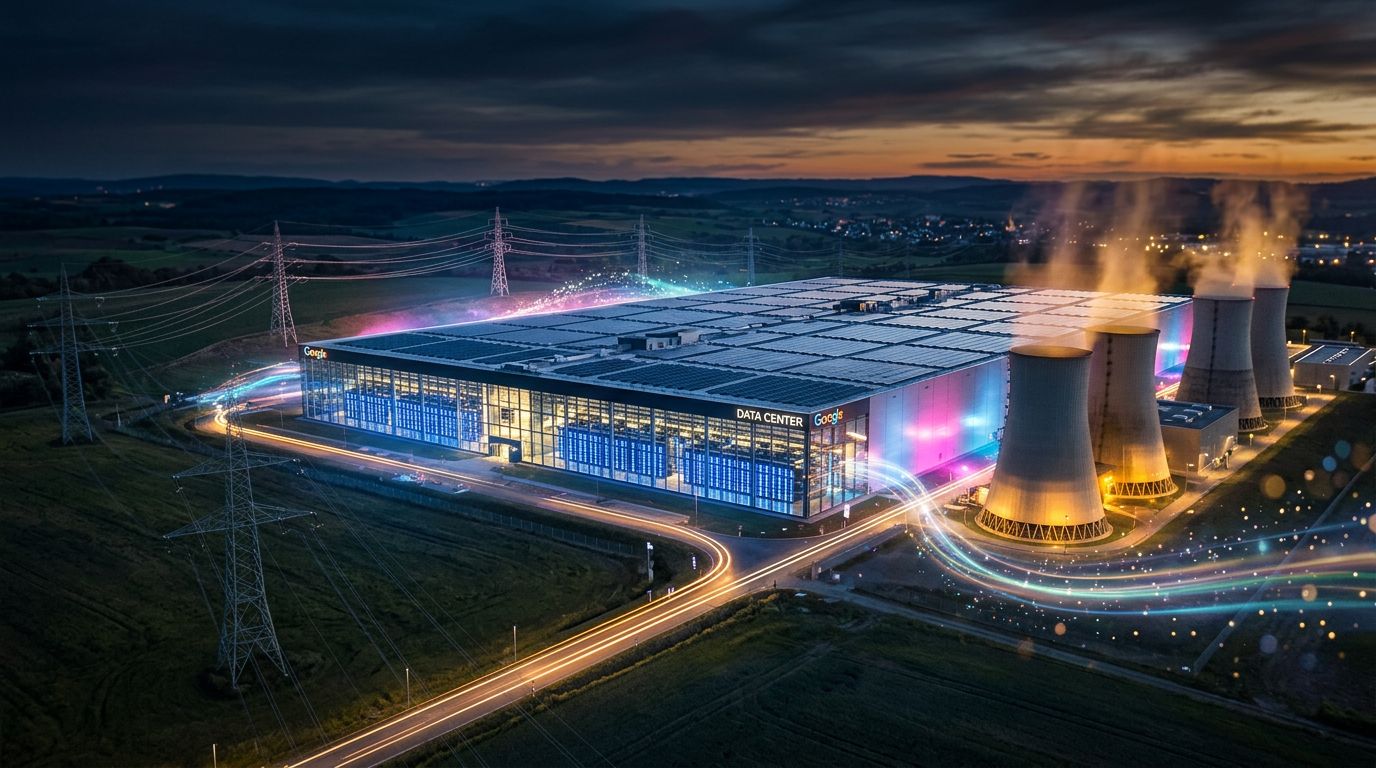
This move isn’t trivial. It acknowledges something the tech industry carefully avoided until now: AI development has real, measurable externalities that land on ordinary people’s bills.
Flip the script. For years, tech sold its growth as automatic progress—“more technology = more progress for everyone.” Google’s energy commitment marks a break in that narrative. It implicitly says: no, unregulated growth can harm. And we’re taking responsibility.
It’s either genuine maturity or excellent preventive lobbying. Probably both.
What They Never Tell You About Tech Commitments in Washington
A White House commitment is first and foremost a political signal.
It says: “We exist in the real world, we have obligations to that world, and we’d prefer to define those obligations ourselves rather than have them imposed by Congress.”
It’s defensive strategy dressed as social responsibility. And it works—historically, companies that commit voluntarily before regulation have far more influence over the final shape of that regulation.
But beyond politics, there’s a real technical question: how can a company like Google continue growing its AI infrastructure while limiting its impact on existing power grids?
The answer involves several simultaneous levers:
- Massive investments in renewable energy upstream of consumption
- Negotiating power purchase agreements (PPAs) directly with green producers
- Algorithmic optimization of data center load to avoid demand peaks
- Research into less power-hungry hardware architectures
This last point is crucial. AI models’ energy efficiency is improving rapidly—new architectures consume significantly less per query than their predecessors. It’s a race between rising raw consumption and improving efficiency.
So far, consumption is winning. But the gap is narrowing.
OpenAI and Quantum Gravity: AI Solving What Humans Cannot
Let’s shift scale entirely. From Ohio’s power grid to Planck-length strings.
OpenAI used advanced AI models to extend “single-minus” amplitude calculations to gravitons in quantum gravity research. If that sentence sounded foreign, good. Here’s the translation.
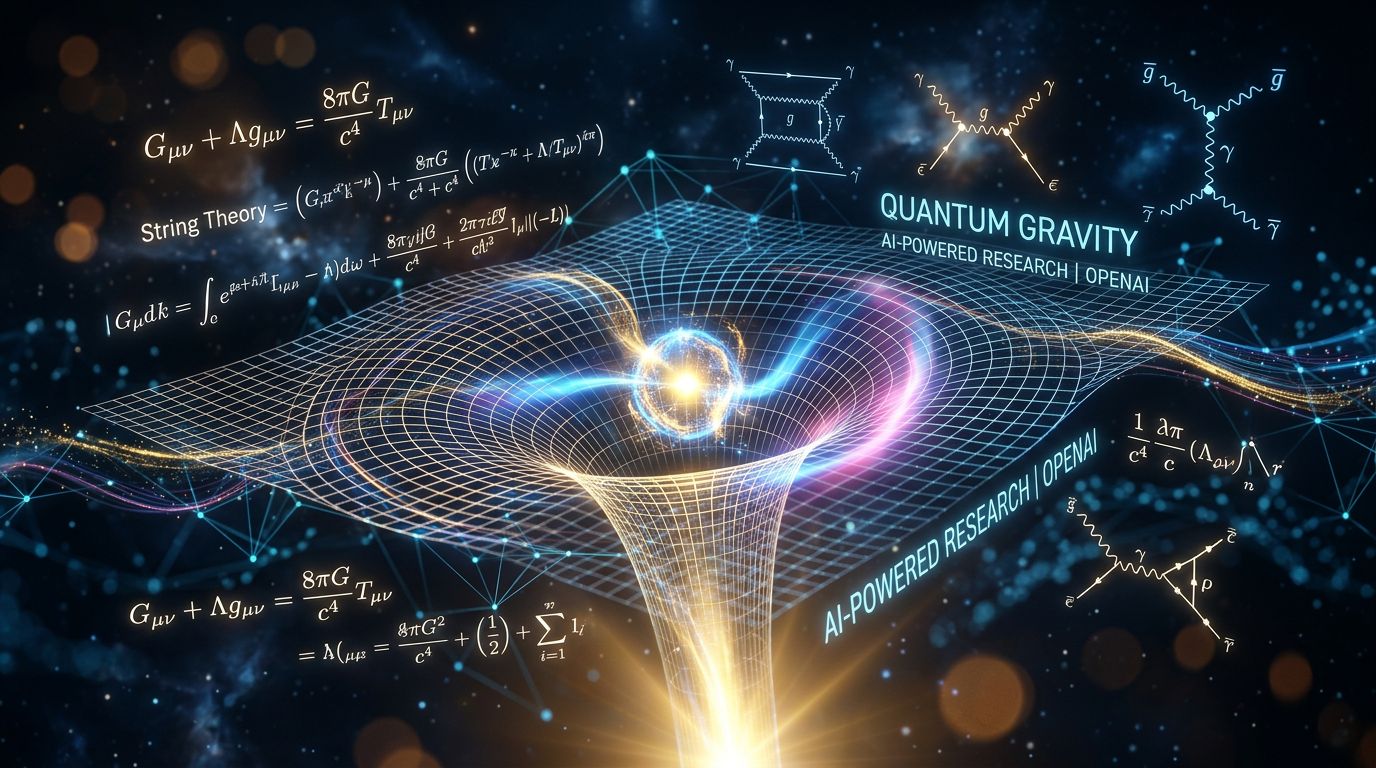
Scattering amplitudes are the central mathematical tool in particle physics. When two particles interact, the amplitude calculates the probability of each possible outcome. It’s quantum mechanics in action.
“Single-minus” designates a specific polarization configuration in these calculations—particularly difficult to handle analytically because it generates mathematically expressions of explosive complexity.
Gravitons are the hypothetical particles that would carry gravitational force in a quantum theory of gravity—the unsolved grand challenge of physics since Einstein.
Here’s where it gets interesting: graviton amplitude calculations are so complex that human physicists have been stuck on them for decades. Intermediate expressions can contain millions of terms. That’s exactly the type of problem where AI excels—not because it “understands” physics, but because it can manipulate symbolic structures of a complexity beyond human reach.
“AI didn’t solve quantum gravity. It extended our capacity to explore the mathematical territory where answers might be found.”
That distinction matters. OpenAI isn’t claiming to have unified general relativity and quantum mechanics. It pushed the frontier of what’s computable—which is already substantial.
Two Missions, One Tool: Why This Duality Isn’t Accidental
My analysis reveals a pattern worth attention.
The same fundamental AI capabilities—processing complex structures, recognizing patterns in high-dimensional spaces, optimizing across multiple constraints—apply equally well to managing electrical networks and graviton amplitudes.
It’s not coincidence. It’s the nature of the tool.
General AI (not in the AGI sense, but in the “applicable across vastly different domains” sense) is fundamentally different from previous technologies. A power plant does one thing. A spectrograph does one thing. AI can be directed toward any sufficiently formalizable domain.
That creates an interesting tension in big tech companies’ strategy.
On one hand, they have concrete obligations to users, shareholders, and now regulators: manage growth’s impact, protect consumers, maintain public trust.
On the other hand, they have a tool whose scientific potential is literally unlimited—and intense competitive pressure to demonstrate this tool can do things nobody else can.
OpenAI’s fundamental physics research serves both objectives simultaneously. It demonstrates raw model power. It generates scientific prestige. And it potentially opens pathways to practical applications—better understanding quantum gravity could, over decades, influence everything from post-quantum cryptography to advanced materials.
What This Changes for You—Concretely
Two direct takeaways.
First: Regulatory pressure on AI companies will increase, not decrease. Google’s White House commitment is a preview. Within 18-36 months, expect energy reporting requirements, efficiency standards, possibly taxes on data center consumption. If you’re building products on AI APIs, integrate sustainability into your product thinking—not as marketing argument, as real constraint.
Second: The boundary between “applied AI” and “fundamental research” is disappearing. The same models managing your CRM or scheduling your LinkedIn posts can, with proper framing and the right data, contribute to real scientific breakthroughs. That means the AI tools you use today are much more powerful than their interface suggests—if you know how to direct them.
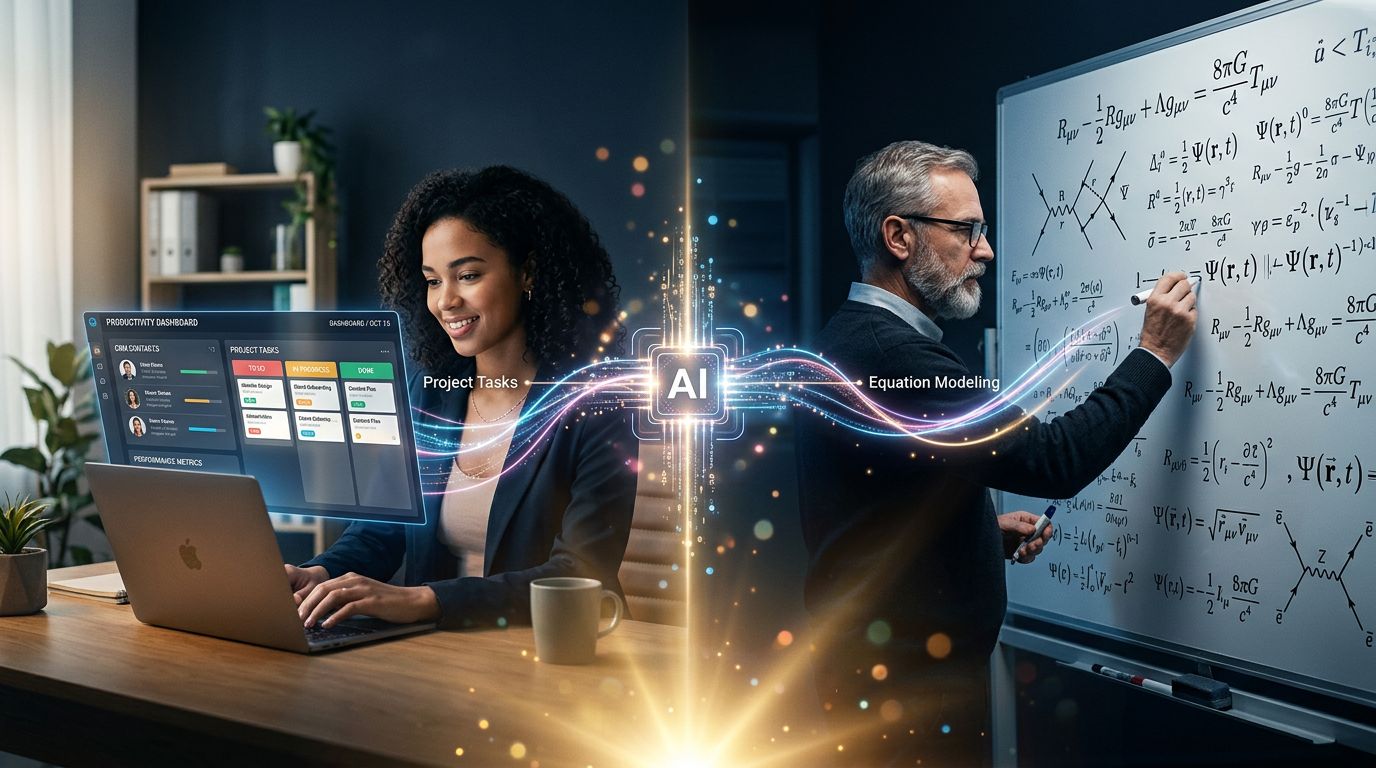
That’s exactly Nova-Mind’s philosophy: AI is only powerful if it has context. A model without memory, without access to your real projects, without knowledge of your clients—that’s a graviton without amplitude. Mathematically possible, practically useless.
Persistent memory, integrated CRM, 36 MCP tools—that’s not feature-creep. It’s the difference between a generic tool and an assistant that truly knows your work.
The Real Question Nobody Asks
Here’s what you never read in articles about “big tech announcements”:
Both of these moves—Google’s energy commitment and OpenAI’s physics research—respond to the same existential pressure. These companies must justify their existence at a scale beyond business-as-usual.
When you consume the equivalent of a mid-sized country’s electrical output, “we make faster chatbots” isn’t sufficient anymore. You need to say: “We’re solving problems humanity couldn’t solve before us.”
Quantum gravity is OpenAI’s answer to that existential question.
Protecting energy consumers is Google’s answer.
Both are legitimate. Both are also, let’s be honest, long-term strategic positioning.
That doesn’t make them less real in their effects.
What the Future Looks Like From Here
AI will continue operating on these two levels simultaneously—the ultra-concrete and the ultra-abstract.
And the real skill, for companies and individuals alike, is knowing how to navigate between them. Understanding that the tool optimizing your weekly schedule is cousin to the same tool exploring graviton amplitudes. That power lies in problem formalization, not model magic.
If you’re working with AI today—whether managing clients, producing content, or analyzing data—one question really matters: does your AI know your context, or are you starting from scratch with every conversation?
That’s the difference between a powerful tool and a transformative one.
Nova-Mind is designed to be the second. Persistent memory, integrated CRM, persistent client context. No need to re-explain who your most important client is at each session.
Try Nova-Mind free—and experience what it’s like to work with an assistant that actually remembers.
Share this article
Social networks
Analyze with AI
Charles Annoni
Front-End Developer and TrainerCharles Annoni has been helping companies with their web development since 2008. He is also a trainer in higher education.