


From ChatGPT to the super app: what AI democratization really changes for your productivity
Article Summary
📖 8 min readThis article analyzes what the massive democratization of ChatGPT reveals: mature users who now demand memory and continuity. It breaks down the super app model and explains why only a contextual intelligence layer can turn a collection of tools into a genuine work assistant.
Key Points:
- 60% of new ChatGPT users are over 35: AI has crossed the threshold of mainstream familiarity.
- The adoption plateau effect shifts users from wonder to demanding memory, continuity, and consistency.
- The average freelancer juggles 6 tools and loses roughly 2.5 hours per day switching context and recreating information.
- Persistent memory via vector databases (pgvector) saves 10 to 12 hours per week once operational.
- Three AI maturity stages: experimentation, occasional integration, orchestration — moving to stage 3 requires a different infrastructure than a simple chatbot.
AI is no longer a geek thing
60% of new ChatGPT users are over 35. Accountants, marketing directors, independent consultants, agency project managers — profiles who, three years ago, found AI “interesting in theory.” Today, they use it every day.
That number is worth pausing on. Not to congratulate ourselves on a “digital revolution” (you’ve been warned about that kind of hype). But because it reveals something deeper: AI has crossed the threshold of familiarity.
And when a technology becomes familiar, expectations change. Radically.
What user maturity reveals
Here’s where it gets interesting.
When a tool is massively adopted by non-technical users, two things happen in parallel. First, users discover the real power of the tool. Then — and this is the critical point — they discover its limitations with surgical precision.
The 40-year-old who’s been using ChatGPT for six months is no longer impressed. They’re frustrated. Frustrated by having to re-explain context at the start of every conversation. Frustrated by juggling five different tools to complete a single task. Frustrated by the lack of memory, continuity, and consistency.
“The true measure of a technology’s maturity is when its users start demanding more from it.” — Field observation.
This phenomenon has a name in the industry: the adoption plateau effect. We move from “wow, it’s magic” to “OK, now do it really well.” And this transition is exactly what forces companies to rethink their product approach.

The super app: solution or new problem?
Disney understood this before many others. The company is actively working to consolidate its services — streaming, parks, merchandise, experiences — into a unified ecosystem. One app, one account, one experience.
The super app model isn’t new. WeChat in China laid the groundwork over a decade ago. But what’s changing now is the convergence with AI. Today’s super apps don’t just bundle features — they learn, adapt, and anticipate.
What mainstream articles never tell you: a super app without an intelligence layer is just an aggregation of functions. Convenient, sure. Transformative? No. It’s contextual memory — the ability to connect information across interactions — that makes the difference between a glorified dashboard and a genuine work assistant.
Let’s flip the question. The real issue isn’t “how many features can we stack?” but “how do we eliminate cognitive friction for the user?”
Fragmentation: the real enemy of productivity
After analyzing the workflows of dozens of freelancers and agencies, the verdict is clear.
The average freelancer today juggles:
- A task management tool (Notion, Todoist, Asana)
- A CRM (HubSpot, Pipedrive, or worse, an Excel file)
- A client communication tool (Slack, email, WhatsApp)
- An AI assistant (ChatGPT, Claude, Gemini)
- A content creation tool
- A social planning tool
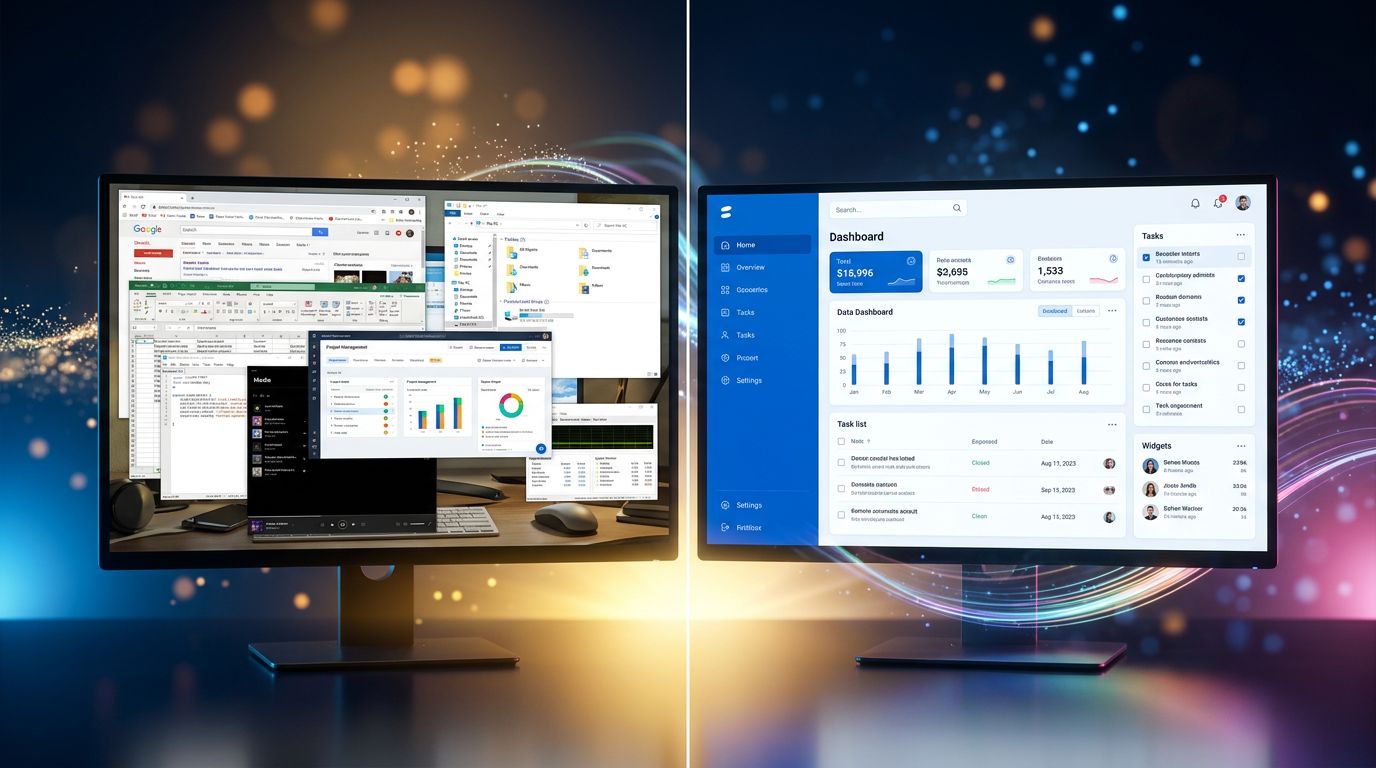
Six tools. Six different contexts. Six interfaces to learn, maintain, and synchronize. And above all: six information silos that don’t talk to each other.
The result? An average of 2.5 hours lost per day switching between tools, recreating context, copy-pasting information from one place to another. This isn’t a discipline or organization problem. It’s an architecture problem.
Persistent memory: the missing link
One pattern shows up consistently: what users resent most about their AI tools is amnesia.
You explain to Claude who your client Dupont is. You close the conversation. You come back the next day. Dupont? Never heard of him.
This isn’t a minor UX detail. It’s a fundamental break in the value proposition. An assistant that forgets isn’t an assistant — it’s a conversational search engine. Useful, but not transformative.
Persistent memory via vector databases (pgvector, to be precise) changes this equation. The assistant knows your 47 clients. It remembers that the Legrand project has specific budget constraints. It knows you prefer deliverables in PDF rather than Google Docs. It doesn’t need to be re-briefed — it builds, conversation after conversation, an accurate representation of your working context.
This is exactly what Nova does in Nova-Mind. No magic involved: pgvector + MCP architecture + Supabase. A precise technical stack, a measurable benefit. Users report an average of 10 to 12 hours recovered per week once contextual memory is operational.
From adoption to integration: the three AI maturity levels
Experience has taught me that there are three distinct stages in a professional’s relationship with AI.
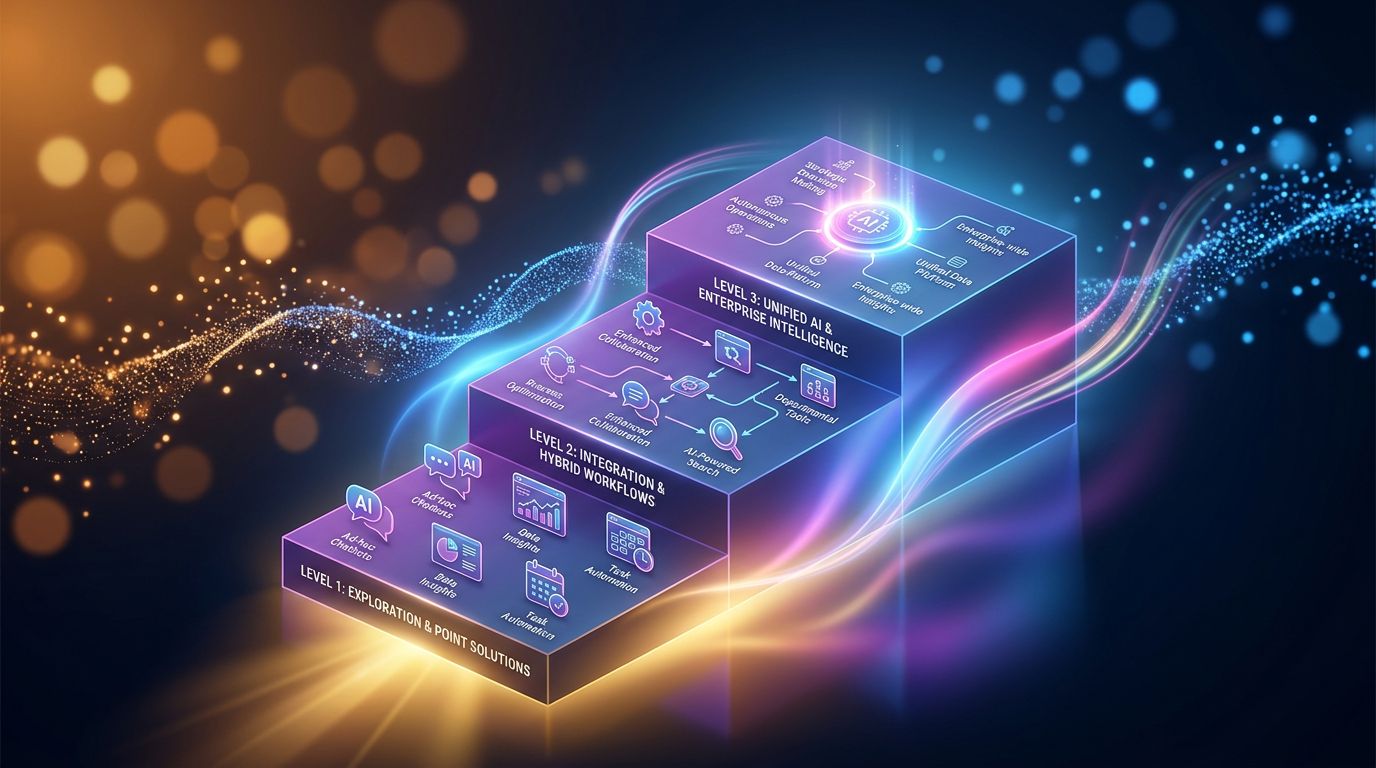
Stage 1 — Experimentation
The user is testing. They ask questions, generate text, explore the capabilities. AI is a sophisticated toy. Real time saved: marginal. Satisfaction: high (novelty effect).
Stage 2 — Occasional integration
AI enters the workflow for specific tasks. Writing emails, summarizing meetings, generating first drafts. The user has their favorite prompts. Real time saved: 1 to 3 hours per week. Growing frustration: the lack of context starts to sting.
Stage 3 — Orchestration
AI is at the center of the work system. It knows the projects, the clients, the priorities. It acts — not just reacts. It flags overload risks before they hit, generates content autonomously, synchronizes information across tools. Real time saved: 8 to 15 hours per week.
The vast majority of current ChatGPT users are at stage 2. The current wave of democratization creates the critical mass needed to move to stage 3 — but that transition requires a different infrastructure than a simple chatbot.
What this concretely changes for agencies and freelancers
Let’s look at this from another angle.
AI democratization doesn’t benefit everyone equally. In reality, it widens the gap between two categories of professionals.
Those who stay at stage 2 continue using AI as an occasional accelerator. They save time on isolated tasks, but their cognitive load stays high. They’re still juggling their six tools. They remain reactive.
Those who move to stage 3 build a durable competitive advantage. Their assistant knows their clients better than a new hire would. Their content generates while they sleep. Their projects move forward even when they’re in meetings. They shift into proactivity.
A McKinsey study estimated that companies reaching advanced AI integration outperformed competitors by 40% on operational productivity. That gap keeps widening.
For a 5-person agency, the difference between stage 2 and stage 3 potentially represents the equivalent of one full-time team member — without the payroll overhead.
Three takeaways
1. Contextual memory is not a luxury. It’s the prerequisite for moving from an AI assistant to a genuine digital collaborator. Without it, you stay in experimentation mode.
2. Tool consolidation reduces cognitive friction, not just the number of subscriptions. The issue isn’t financial — it’s neurological. Fewer context switches = more deep work.
3. AI democratization creates a short window of opportunity. Professionals who reach stage 3 now are building advantages that will be hard to catch up with.
The next step: building your ecosystem
But watch out for the trap.
The super app isn’t a magic solution. A platform that consolidates mediocre tools stays mediocre. What matters is the quality of the underlying intelligence — the ability to learn, to remember, to act proactively.
Nova-Mind was built precisely for this transition from stage 2 to stage 3. Permanent memory of your clients and projects. CRM, task management, content creation, social scheduling — in a single tool. Proactive coaching that detects burnout risks before they hit. MCP protocol to orchestrate everything from Claude Desktop if you prefer your current workflow.
€39/month. Native desktop app for macOS/Windows/Linux. Data on your private Supabase instance.
If you’re at stage 2 and fragmentation is starting to cost more than it delivers, try Nova-Mind — onboarding takes 20 minutes and contextual memory is live from day one.
AI has become familiar. Now make it truly work for you.
Share this article
Social networks
Analyze with AI

Charles Annoni
Front-End Developer and TrainerCharles Annoni has been helping companies with their web development since 2008. He is also a trainer in higher education.