


Freelance Burnout: The Signals Your Brain Is Sending (That You're Ignoring)
Article Summary
📖 8 min readFreelance burnout doesn't happen overnight — it builds over weeks through specific signals that most people dismiss. This article breaks down the behavioral patterns that signal exhaustion and offers three concrete actions to build a detection system before the crisis hits.
Key Points:
- 87% of freelancers report having experienced at least one episode of severe burnout in the past 12 months
- Three early warning signals: sudden procrastination on your favorite tasks, accumulating micro-errors, disproportionate irritability
- Burnout peaks often hit after 90 days of launch, when the adrenaline drops and routine sets in
- Beyond a variable load threshold, client-perceived quality drops — even when you're working more
- Three concrete actions: audit your week with real numbers, define your personal alert threshold, automate friction to make overstepping harder than respecting your limits
You Think You’re Just Tired
87% of freelancers report experiencing at least one episode of severe burnout in the past 12 months. Not normal tiredness — real exhaustion. The kind that makes you question your decisions, your clients, sometimes yourself.
And yet most of them keep shipping. Keep answering emails at 11pm. Keep saying “I’m fine, just a bit swamped.”
That’s exactly where the trap snaps shut.
Freelance burnout doesn’t look like corporate burnout. No HR department to catch it. No colleague knocking on your door. Just you, your stack, your deadlines — and a brain that has started sending alarm signals you’ve trained yourself to ignore.
What Your Brain Is Trying to Tell You
Here’s where it gets interesting: burnout doesn’t arrive overnight. It builds gradually, over weeks, sometimes months. And it talks — if you know how to listen.
Sudden Procrastination on Your Favorite Tasks
You used to love coding. Writing. Designing. Now even opening the file feels like a mountain. This isn’t laziness — it’s your nervous system refusing to engage with something that no longer gives it energy in return.
Mounting Micro-Errors
A client’s name misspelled. A brief misread. A deadline forgotten while you were “focused.” When cognitive load exceeds processing capacity, the brain starts cutting corners on details. These are the first visible signs of an overloaded system.
Disproportionate Irritability
A client sends a routine message and you feel a surge of unjustified rage. Your emotional response is no longer calibrated to the actual situation — it’s calibrated to your internal reserve. Which is at zero.
All three signals together? That’s the beginning of the end if you don’t change something.

The Paradox of Freedom That Imprisons
My obsession with detail reveals a recurring pattern among high-performing freelancers: the better you are, the more work you take on. The more work you take on, the less you sleep. The less you sleep, the worse you perform. And instead of easing up, you work even harder to compensate.
That’s the freedom trap.
An employee has set hours. Meetings that force breaks. A time card to punch. The freelancer has total freedom — and that freedom, without structure, becomes an invisible prison.
“Freedom without structure doesn’t liberate — it exhausts.” — Cal Newport, Deep Work
Let’s flip the perspective: what if the real productivity of a freelancer wasn’t about working more, but about working with intelligent limits?
What no one tells you is that the most profitable freelancers I know aren’t the ones grinding 80 hours a week. They’re the ones with systems — for working, but also for stopping.
The Patterns the Data Reveals
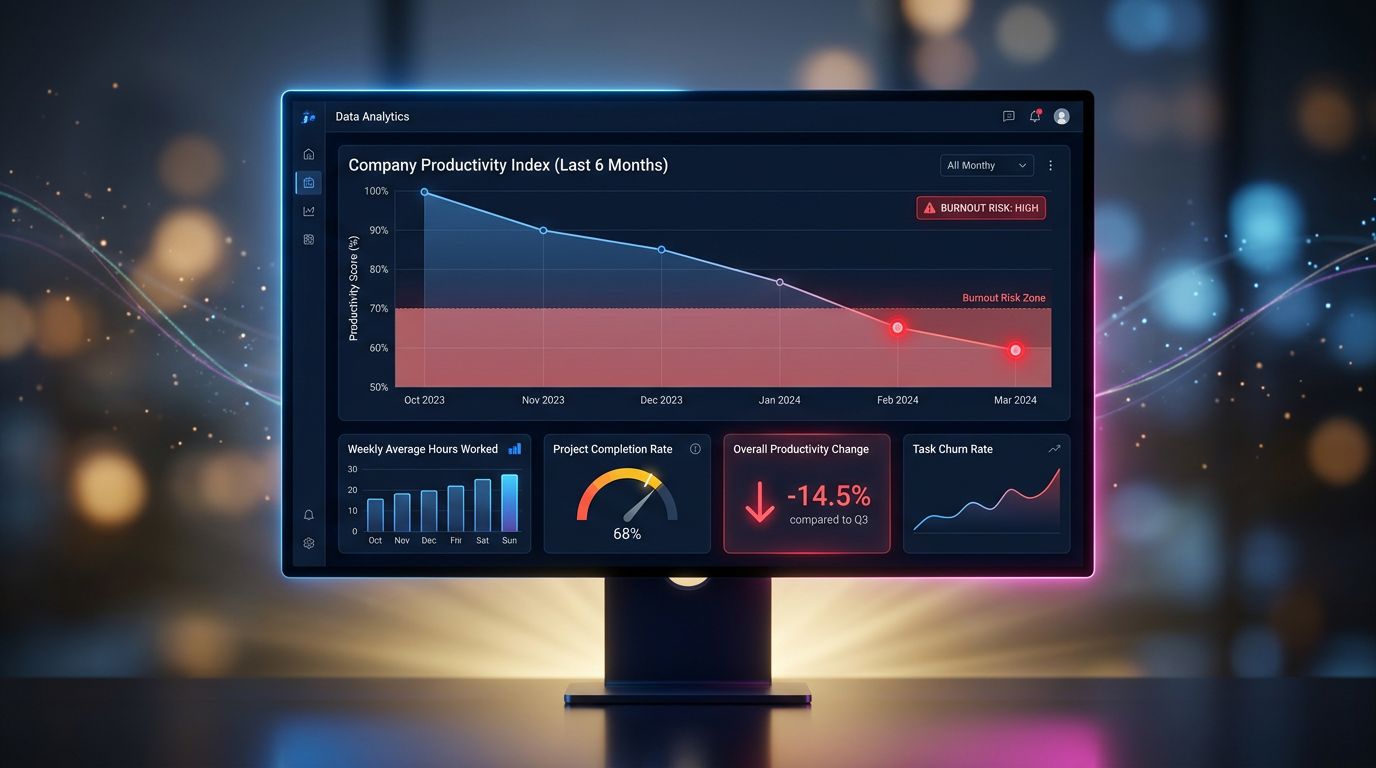
After analyzing productivity behaviors over several months, clear trends emerge. Burnout episodes are not random. They follow predictable cycles.
The Month 3 peak. It’s often after 90 days of launch (new project, new client, new venture) that accumulated fatigue crystallizes. The startup adrenaline has worn off. Routine has set in. And with it, the attrition.
The Sunday evening syndrome. Monday anxiety that starts Sunday at 5pm. Impossible to disconnect. The upcoming week invades the weekend that was supposed to recharge you. Result: Monday morning, you’re already exhausted before you’ve started.
The load/quality correlation. Beyond a certain workload threshold — variable per person, but always there — client-perceived quality drops, even when you’re working more. It’s counterintuitive, but the data is unambiguous.
What an Intelligent System Does in Your Place
If I were your strategist, here’s what I’d put in place immediately.
First, a proactive detection system. Not a checklist you fill out when you remember — a system that observes your work patterns and intervenes before you’re in the red. The number of tasks created vs. completed over 7 days. Time spent on each project vs. initial estimates. Late-night activity spikes (after 9pm) that are piling up.
These indicators, combined, give a far more reliable signal than your own gut feeling — because your gut feeling, when you’re burning out, is biased. You underestimate your fatigue. It’s physiological.
Then, contextual intervention. Not a generic email saying “remember to take breaks.” A precise alert: “You’ve worked 6 consecutive evenings on the Dupont project. Your average time per task has increased by 34%. It’s time to make a decision.”
The difference between a tool that reacts and a system that anticipates. That’s where everything is decided.
That’s exactly what Cerebro — Nova-Mind’s proactive coaching engine — does in the background. It analyzes work patterns, detects warning signals, and intervenes with contextual suggestions. Even when you’re not logged in. Because burnout doesn’t take breaks.
Three Concrete Actions to Implement Right Now
My expert advice, distilled into three actionable steps:
1. Audit your last week with real numbers. Not your impression — the numbers. How many hours actually worked? How many evenings past 8pm? How many breaks longer than 30 minutes? If you don’t have this data, that’s the first problem to solve. Systematic time tracking by task is not optional — it’s the baseline.
2. Define your personal alert threshold. For some, it’s 45 hours a week. For others, it’s 3 consecutive evenings or 2 weekends worked back-to-back. Identify your threshold — the one beyond which your work quality drops and your mood degrades. Write it down. Share it with someone if possible.
3. Automate friction. The freelancer’s problem is that stopping requires an active decision. Work on making overstepping harder than respecting your limits. A tool that notifies you when you cross your threshold. A calendar that blocks evenings. A system that makes visible what was invisible.
“What gets measured gets managed.” — Peter Drucker
Experience has taught me that the freelancers who last — the ones still here after 5, 10, 15 years — aren’t the ones with the greatest endurance. They’re the ones with the best systems.

The Real Question to Ask Yourself
How many times have you thought “I’ll ease up next week” — and next week never came?
Freelance burnout is a systems problem, not a willpower problem. You don’t need more discipline. You need an environment that works for you, not against you.
Tools that remember your clients while you breathe. Systems that track your workload while you sleep. An assistant that flags the drift before it becomes a crisis.
That’s the core principle behind Nova-Mind: not another AI gadget, but a daily work tool with memory, initiative — and enough knowledge of you to tell you when you’re going too far.
Because lasting is the real ROI of freelancing.
If you want to see concretely how Cerebro detects burnout risks and how task-level time tracking can transform your view of your workload, Nova-Mind is available from €39/month — with a trial period to test with no commitment. Your data stays private, on your own Supabase instance.
Your brain is sending signals. It’s time to start listening — with the right tools.
Share this article
Social networks
Analyze with AI

Charles Annoni
Front-End Developer and TrainerCharles Annoni has been helping companies with their web development since 2008. He is also a trainer in higher education.