


Autonomous AI agents: boost productivity
Article Summary
📖 9 min readThis article explores the impact of next-generation autonomous AI agents, such as GPT-5.5, on enterprise productivity from 2026 onwards. It distinguishes these agents from chatbots and explains the converging technologies making this revolution possible, marking a genuine qualitative leap in the automation of complex tasks.
Key Points:
- More than 70% of repetitive business tasks are already automatable with current AI technologies, unlocking an immense productivity potential.
- An autonomous AI agent differs from a chatbot by its ability to act, plan, execute complex objectives and handle errors, rather than simply responding.
- The emergence of autonomous agents is made possible by the convergence of advanced reasoning models (e.g. GPT-5.5), standardized tool access protocols, and operational guardrails.
- These agents can break down a high-level objective into sub-tasks, choose the right tools, execute them sequentially, and produce actionable results without constant human intervention.
- The year 2026 is identified as the tipping point where autonomous AI agents will cease to be a concept and become an operational reality transforming enterprise productivity.
2026: the year autonomous AI agents stop being a concept
Here is a number that should give pause: according to McKinsey, 70% of repetitive business tasks could be automated with today’s technologies. Not in 2035. Now. And yet, most teams still spend their mornings copy-pasting data between tools, rephrasing briefs that have already been explained three times, searching for a file “sent two weeks ago by someone.”
Everyone says AI will change the way we work. What if the change was already here, but we were looking in the wrong direction?
The arrival of models like GPT-5.5 — capable of coding, analyzing complex datasets, and reasoning across multiple steps in parallel — marks a real turning point. Not just another iteration. A qualitative leap. These models no longer just answer questions: they execute tasks. They make decisions. They integrate into real workflows with access to real tools.
Welcome to the era of autonomous agents.
What sets an AI agent apart from a simple chatbot
Let’s lay the groundwork, because misuse of language is rampant in this industry.
A chatbot responds. An agent acts.
The difference is fundamental. A chatbot generates text in response to a prompt. An autonomous agent, on the other hand, receives an objective — “prepare the weekly client report, send overdue follow-ups and update the CRM” — and breaks that objective into sub-tasks, selects the appropriate tools, executes them in the right order, handles errors along the way, and produces an actionable result.
What makes this possible in 2025-2026 is the convergence of three elements:
- Reasoning models powerful enough to plan across multiple steps (GPT-5.5, Claude 3.7, Gemini Ultra)
- Standardized tool access protocols — Anthropic’s MCP protocol is the most mature example
- Operational guardrails: human validation for critical actions, decision logging, rollback capability
Without these three components aligned, you get impressive demos. With them, you get agents ready for production.

The business processes agents will tackle first
My analysis reveals a clear pattern: autonomous agents don’t go after the most complex tasks first. They start with those that offer the best effort-to-volume ratio.
Incoming information processing. Emails, support tickets, client requests, supplier reports — everything that arrives needs to be read, categorized, and routed. A well-configured agent does this better than a human and doesn’t tire at 5pm. Measured gains on support teams: 60 to 80% of triage time recovered.
Structured content generation. Not creative articles — performance reports, meeting minutes, project briefs, sales proposals from a template. GPT-5.5 with access to your internal data produces a usable first draft in 90 seconds. What a junior employee used to take 3 hours to complete.
Monitoring and proactive alerts. An agent that watches your KPIs, detects anomalies, and alerts you before the client calls — this is the use case that wins over finance departments. Not magic: conditional logic powered by a model that understands context.
Here’s where it gets interesting: these three categories represent, according to sector studies, between 35 and 45% of working time in a typical agency or SMB. Automating 70% of that means reclaiming the equivalent of one full-time employee for a team of five.
The problem nobody is solving: memory
Let’s flip the perspective. Much is said about the capabilities of new models. Little is said about their most crippling structural flaw: they forget everything.
GPT-5.5 is impressive. But without persistent memory, it doesn’t know that your client Dupont prefers deliverables in PDF, that the Orion project was put on hold in March, or that you never take meetings before 9am.
With every session, you re-explain. With every session, you lose time.
This is exactly the problem Nova-Mind solves with its pgvector architecture. Memory is not simulated — it is vectorized, persistent, and semantically queryable. When Nova discusses client Dupont with you, it has access to the full history: projects, preferences, exchanges, past decisions. Without you having to re-explain anything.
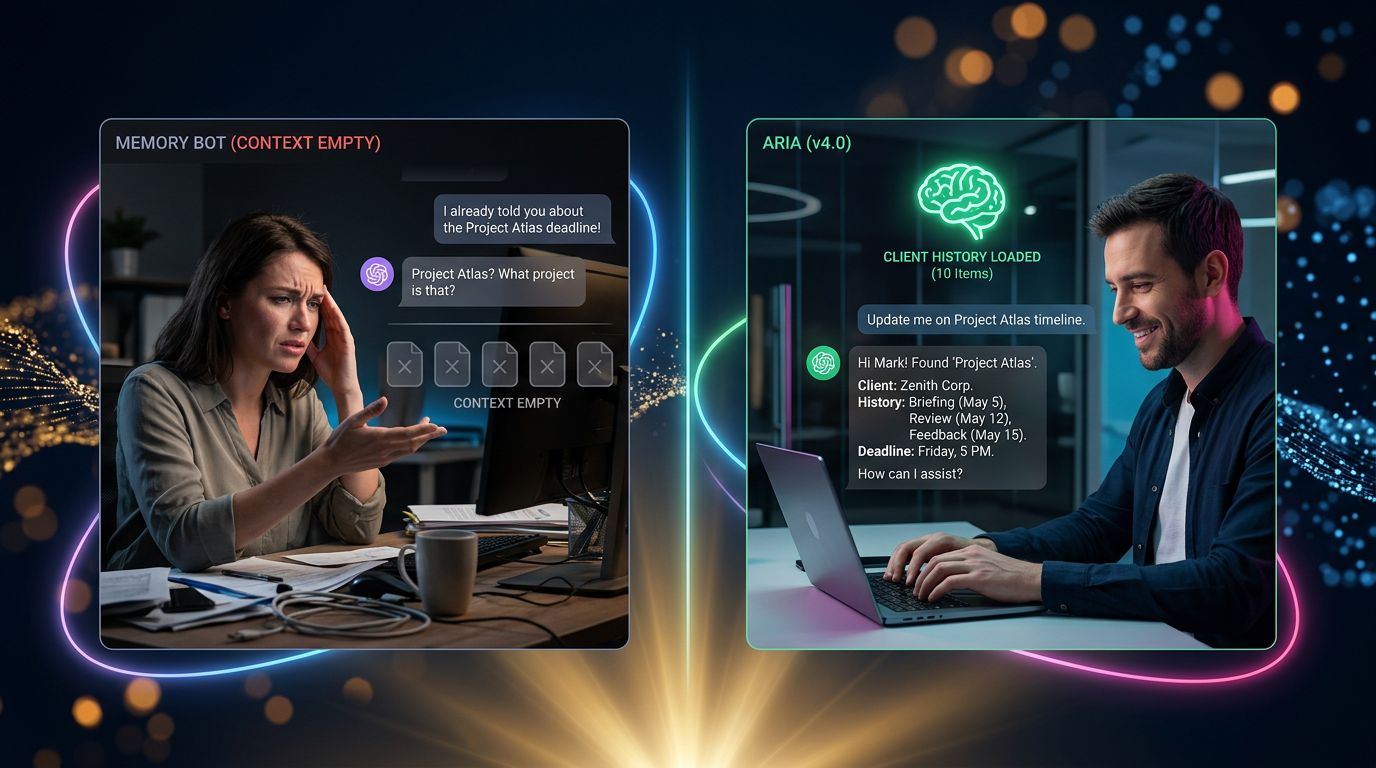
This is not a UX detail. It is the difference between a tool you use for a week and a tool that becomes indispensable.
Guardrails: the topic nobody wants to discuss
After analyzing enterprise agent deployments over the past 18 months, one conclusion stands out: failures almost never come from the model. They come from the absence of guardrails.
An autonomous agent with access to your CRM, email, and billing system can cause damage. Not because it is “malicious” — because it optimizes for the given objective without understanding the political, relational, or legal implications of an action.
Mature guardrails in 2026 look like this:
Graduated human validation. Low-risk actions (create a task, generate a draft) → automatic execution. Medium-risk actions (send an email, modify client data) → one-click validation. Critical actions (delete, invoice, publish) → explicit confirmation with impact summary.
Complete logging. Every agent decision is logged with its reasoning. Not for technical debugging — for human auditability. You must be able to answer “why did the agent do that?” at any moment.
Operational rollback. If the agent makes a mistake, the previous state must be restorable. Not theoretically — practically, in under 2 minutes.
What you are never told: teams that deploy agents without these three mechanisms end up disabling them after the first incident. Not because AI is bad — because trust was not built correctly.
What 2026 will concretely accelerate
Experience has taught me that technology predictions are often right on the what and wrong on the when. This time, the signals are converging.
By the end of 2026, autonomous agents will normalize three structural changes:
Asynchronous work will dominate. When an agent can execute tasks while you sleep — preparing quotes, updating the sales pipeline, generating weekly reports — synchronous presence loses its value. This is not remote work. It is augmented work.
The “prompt engineer” role will disappear. Next-generation models understand intent, not just instruction. Crafting the perfect prompt will become as obsolete as knowing how to type machine code. What will matter: knowing what to delegate and how to verify the result.
Team sizes will be recalculated. Not in the sense of “mass layoffs” — but in the sense that a team of 5 with well-configured agents can deliver what a team of 12 used to. Agencies that understand this in 2025 will have a massive competitive advantage in 2026.

Three actionable insights to avoid missing this shift
1. Start with one process, not a transformation. Choose a repetitive task you perform at least 3 times a week. Document it in detail. Deploy an agent on it. Measure. Then scale. Projects that try to “automate everything at once” all end up as abandoned POCs.
2. Invest in memory before capabilities. A less powerful model with a rich context almost always outperforms an ultra-powerful model with no memory. Knowledge of your clients, projects, and preferences is the real productivity lever — not the number of model parameters.
3. Build trust before autonomy. Start by deploying in “suggest and wait for validation” mode. Progressively increase autonomy as you understand the agent’s limits and strengths. Sustainable adoption speed matters more than initial deployment speed.
The moment to decide
Autonomous agents are no longer a question of “if.” They are a question of “who deploys them first in your sector.”
Models like GPT-5.5 have solved the multi-step reasoning problem. Protocols like MCP have solved the tool access problem. What remains to be solved is memory, trust, and integration into real workflows — and this is precisely where tools like Nova-Mind exist.
If you manage clients, projects, and a team, and you still spend more than 2 hours a day on tasks you have done a hundred times before — that is the signal.
Intelligent automation is not reserved for large enterprises with data teams. It is available, at €39/month, for freelancers and agencies who want to work less and deliver more.
The question is not whether you will adopt autonomous agents. It is whether you will do so before or after your competitors.
→ Discover how Nova-Mind integrates persistent memory and autonomous agents in a single tool — and reclaim the first hours starting this week.
Share this article
Social networks
Analyze with AI

Charles Annoni
Front-End Developer and TrainerCharles Annoni has been helping companies with their web development since 2008. He is also a trainer in higher education.