


Agentic commerce: digital marketing faces AI buyers
Article Summary
📖 9 min readThis article unpacks agentic commerce — a world where autonomous AI agents become the direct buyers, bypassing traditional customer journeys entirely. It makes the urgent case for digital marketing to adapt by prioritising structured data and objective signals over human-focused tactics.
Key Points:
- Agentic commerce refers to the purchase of goods and services by autonomous AI agents without direct human intervention, marking a clean break from traditional e-commerce.
- Unlike humans, AI agents are not swayed by emotional or visual marketing tactics — they respond to structured data and objective criteria.
- Emerging protocols like Anthropic's Model Context Protocol (MCP) and Google's standards already let AI agents plug into external tools and execute real transactions.
- Marketers must urgently rethink their playbook to target AI buyers by optimising product data and objective signals — or risk making their entire strategy obsolete.
- Ignoring the rise of agentic commerce means preparing to sell into the void, because tomorrow's autonomous buyers will not follow today's conversion funnels.
When your next customer won’t be human
87% of online purchase decisions already involve some form of AI — recommendations, filtering, ranking. Now picture AI no longer advising the buyer. It is the buyer.
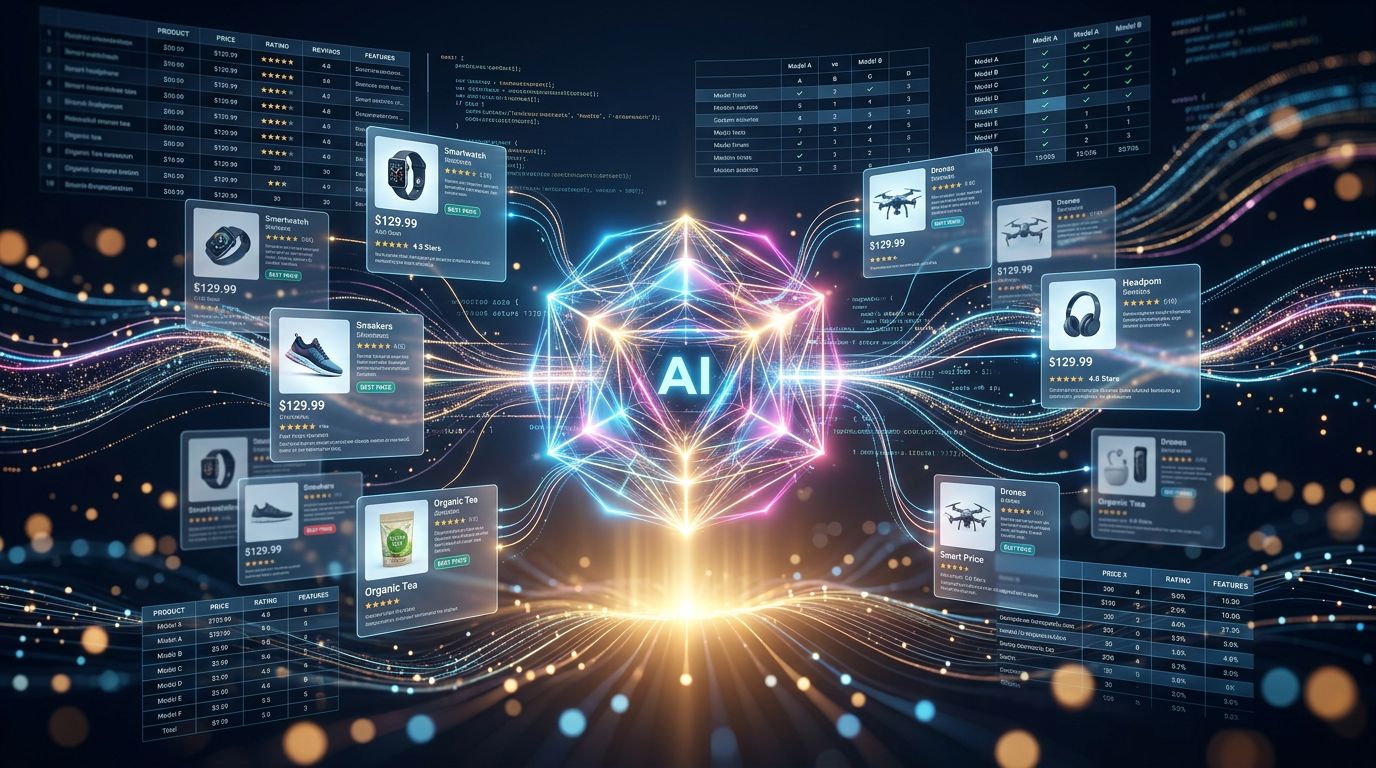
That’s agentic commerce. Not a fuzzy 2040 trend. A reality being built right now, inside OpenAI’s labs, at Anthropic, across the product teams at Shopify and Amazon. Autonomous agents that receive a brief — “buy me the best trail running shoes under €150, delivered by Thursday” — and execute. Solo. Without ever touching your human-optimised conversion funnel.
This isn’t an evolution of e-commerce. It’s a break.
And if you don’t rethink your digital marketing now, you’ll be selling into the void.
What agentic commerce really is — and why it changes everything
An autonomous AI agent is a program capable of perceiving an environment, making decisions, and taking action to reach a goal. In a commercial context, that means: an agent receives a budget and a set of criteria, scans the web, compares offers, negotiates if possible, and finalises the transaction. All of it, without human input at the moment of purchase.
The protocols are emerging fast. Anthropic’s Model Context Protocol (MCP) already lets agents like Claude connect to external tools and perform real actions. Google is pushing its own standards. AI-driven headless browsers can now fill out forms, validate carts, and interact with APIs.
Here’s where it gets spicy: these agents don’t behave like humans. They aren’t moved by a beautiful product photo. They don’t feel the urgency of a “only 2 left in stock” countdown. They read structured data, evaluate objective signals, and optimise against precise criteria.
Your current marketing is designed to trigger emotion. Agents don’t have any.
The fundamental problem: you’re talking to the wrong entities
For 20 years, digital marketing has refined one science: capturing human attention. Emotional copy, persuasive design, social proof, FOMO. All of it works on brains that feel.
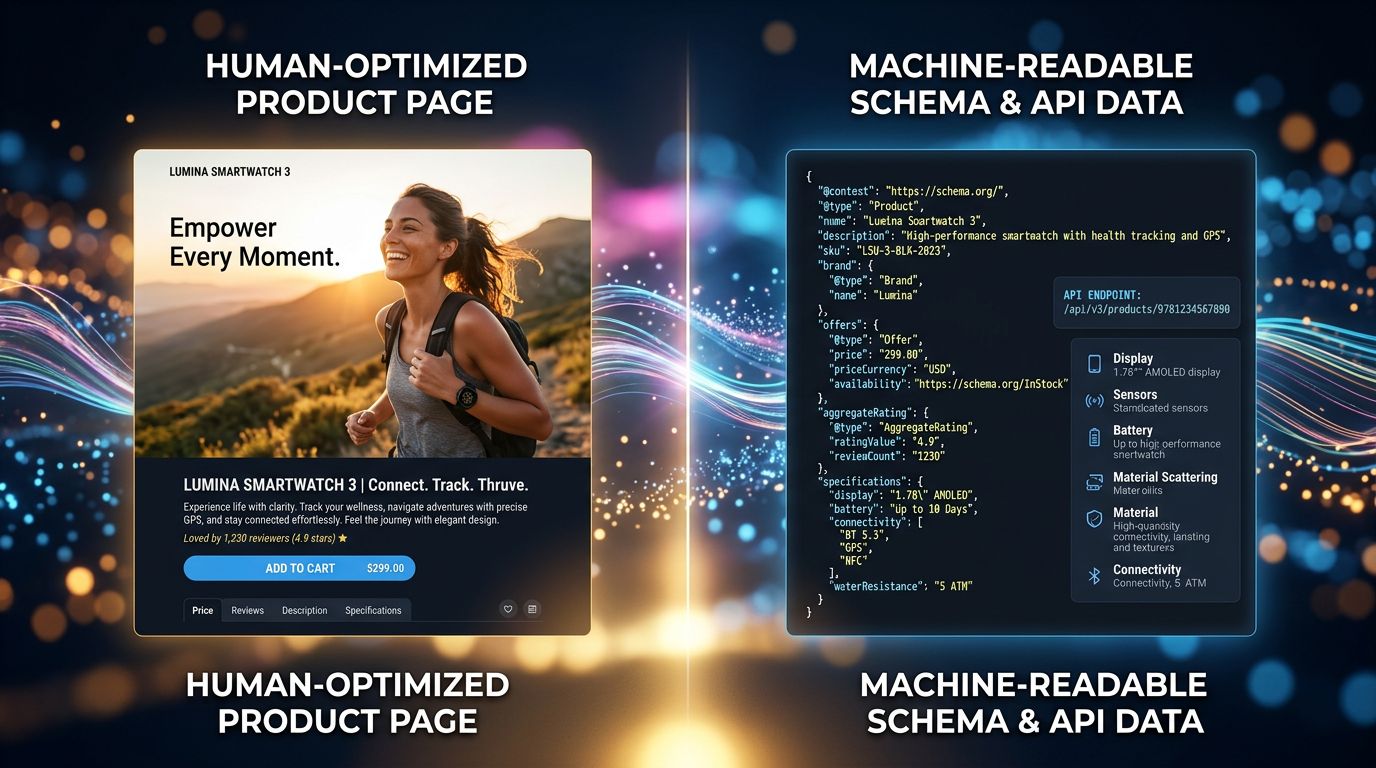
An AI agent reads your product page differently. It’s looking for:
- Structured data (schema.org, JSON-LD)
- Precise, unambiguous technical specs
- Verifiable trust signals (authenticated reviews, certifications, guaranteed lead times)
- Accessible APIs to complete the transaction
- Consistency between what’s displayed and what’s deliverable
Here’s what they never tell you in e-commerce courses: your human conversion rate can be excellent while your “agentic conversion rate” sits at zero. Because the agent tried to hit your product API, got a 403 error, and walked straight to your competitor.
The question isn’t “is my landing page converting?” anymore. It’s “is my infrastructure readable by a decision-making machine?”
Rethinking the marketing stack for an agentic world
My analysis points to three non-negotiable transformation axes.
Structure product information like a database, not like content
Classic SEO optimises for Google. Agentic SEO optimises for agents that consume structured information. That means rigorously implementing data schemas — Product, Offer, Review, Availability — with precise values, updated in real time, and consistent across every channel.
A product description written to move a human has zero value to an agent trying to find out whether the product is compatible with a specific format, in stock for next-day delivery, and returnable within 30 days. That information needs to be accessible programmatically, not buried inside a paragraph of copywriting.
Open transactional entry points for agents
Agentic commerce requires your system to accept transactions initiated by non-humans. That means documented REST or GraphQL APIs, authentication protocols suited to agents (not only human users), and potentially adopting emerging standards like Shopify’s Agent Commerce APIs or the open protocols taking shape inside the MCP ecosystem.
It’s a technical undertaking. But it’s also a massive competitive edge for whoever moves first.
Rethink trust signals
A human trusts a brand they recognise, reviews that reassure them, a design that feels serious. An agent evaluates reliability differently: data consistency across sources, verifiable delivery history, third-party certifications accessible via standardised endpoints.
According to a Gartner study, by 2028 AI agents will account for a significant share of B2B transactional traffic. Agentic trust signals are becoming as much of a strategic battleground as brand reputation is today.
What this concretely changes for your strategy
Flip the script: agentic commerce isn’t a threat if you reposition correctly. It’s an opportunity to eliminate friction.
An agent buying on behalf of a human user will do it with a precision the user wouldn’t have had on their own. It compares faster, overlooks fewer relevant data points, and makes a more rational decision. If your product is objectively the best for the given criteria, you win. Not because your ad was prettier. Because your data was better.
Three actionable insights to implement now:
1. Audit your structured data. Run Google’s Rich Results Test and validate every product page. This is the baseline. If your data isn’t readable by Google today, it won’t be readable by agents tomorrow.
2. Document your product API for non-human consumers. Even if you don’t yet expose a public API, start treating your catalogue like a dataset. What information would an agent need to make a purchase decision? Make it accessible programmatically.
3. Separate your content from your data. Your copywriting can stay emotional for humans. But factual data — prices, stock, lead times, tech specs — must live in distinct structured fields, not inside free-text blocks.
Tomorrow’s marketing: convincing entities that never see your ads
Agentic commerce raises an existential question for the advertising industry: what’s the point of a Meta campaign if the buyer is an agent with no Instagram feed?
The answer isn’t “ads are dead.” It’s more nuanced. The human user experience still matters — the human is the one configuring the agent, defining its criteria, and trusting it to act on their behalf. Your brand still has to exist inside that human’s mind so they tell their agent “I want Patagonia, not a generic alternative.”
But between the human’s decision to delegate a purchase task to an agent and the finalisation of the transaction, your traditional marketing is sidelined. What matters at that stage is your data infrastructure.
Experience has taught me that major tech transitions always reward those who prepare the infrastructure before demand explodes. Mobile e-commerce took off between 2012 and 2016 — sites that were responsive-ready in 2011 caught the wave. Agentic commerce follows the same logic.

Act now, not when everyone else does
Agentic commerce isn’t a hypothetical scenario. Agents buying online already exist. Protocols are standardising. Major e-commerce platforms are investing heavily to welcome them.
The question isn’t “will this happen?” but “when will this account for a non-trivial share of my transactions?”
Here’s what I’d do if I were your digital strategist today:
Start with the structured data audit — it’s fast, free, and it’s the foundation for everything else. Then map out the critical information needed for a purchase decision in your vertical, and make sure it’s accessible programmatically. Finally, keep a close eye on the emerging standards: MCP, the commerce APIs from the major platforms, the work coming out of the IEEE and W3C on agentic protocols.
Marketing that sells to AI isn’t less human. It’s more rigorous. More honest. More factual. And frankly? That’s good news for everyone.
At Nova-Mind, we build workflows that anticipate exactly this kind of shift. Our AI assistant with permanent memory, our integrated CRM and our automations are designed so you don’t absorb tech transitions — you capitalise on them. If you want to see how Nova can help you prepare your stack for the agentic era, start your trial at €39/month. No BS, no long-term commitment. A tool that works for you even while you sleep.
Share this article
Social networks
Analyze with AI

Charles Annoni
Front-End Developer and TrainerCharles Annoni has been helping companies with their web development since 2008. He is also a trainer in higher education.