

Freelance Automation: Understand First, Retain Better
Article Summary
📖 9 min readThis article reveals why most freelancers fail at automating their workflows and end up harming client retention. It proposes a strategic process-mapping method before any automation is implemented, allowing you to distinguish between tasks to automate, tasks to assist with AI, and tasks to protect in order to strengthen the human relationship.
Key Points:
- Most freelancers automate without any prior strategy, which leads to tool abandonment and a degraded client experience.
- Understanding and mapping your processes step by step is fundamental before implementing any automation or AI solution.
- Process mapping allows you to classify tasks into three distinct categories: those to automate (repetitive), those to assist with AI (codifiable technical tasks), and those to protect (strategic relational touchpoints).
- 68% of clients leave a service provider not because of the quality of work, but because of a feeling of indifference — well-designed automation combats precisely this risk.
- Prioritizing an understanding of your workflows over tool acquisition is the key to effective and sustainable automation as a freelancer.
The trap nobody tells you about
87% of freelancers who automate their workflows quit within the first 6 months. Not because the tools are bad. Because they automated the wrong problem.
Here’s where it gets interesting: most solopreneurs equip themselves first and think later. Zapier before strategy. n8n before reflection. The result? Automations running in the void, and clients who feel treated like support tickets.
Poorly designed automation doesn’t save you time. It industrializes your mistakes.
But let’s flip the situation. What if understanding your processes before automating was exactly what allowed you to free up time for what truly retains clients: the human relationship?
Understand before you automate: the rule that tools will never teach you
My obsession with detail has taught me one thing: a vague process that gets automated stays a vague process. Just faster.
Before touching a single tool, the question is simple and blunt: do you actually understand what you do, step by step?
Not in theory. In practice. Who does what? When? Why does this step exist? What happens if it gets skipped?
This mapping work — known as process mapping in the jargon — is tedious, thankless, and absolutely fundamental. It’s what reveals three categories of actions in your daily work:
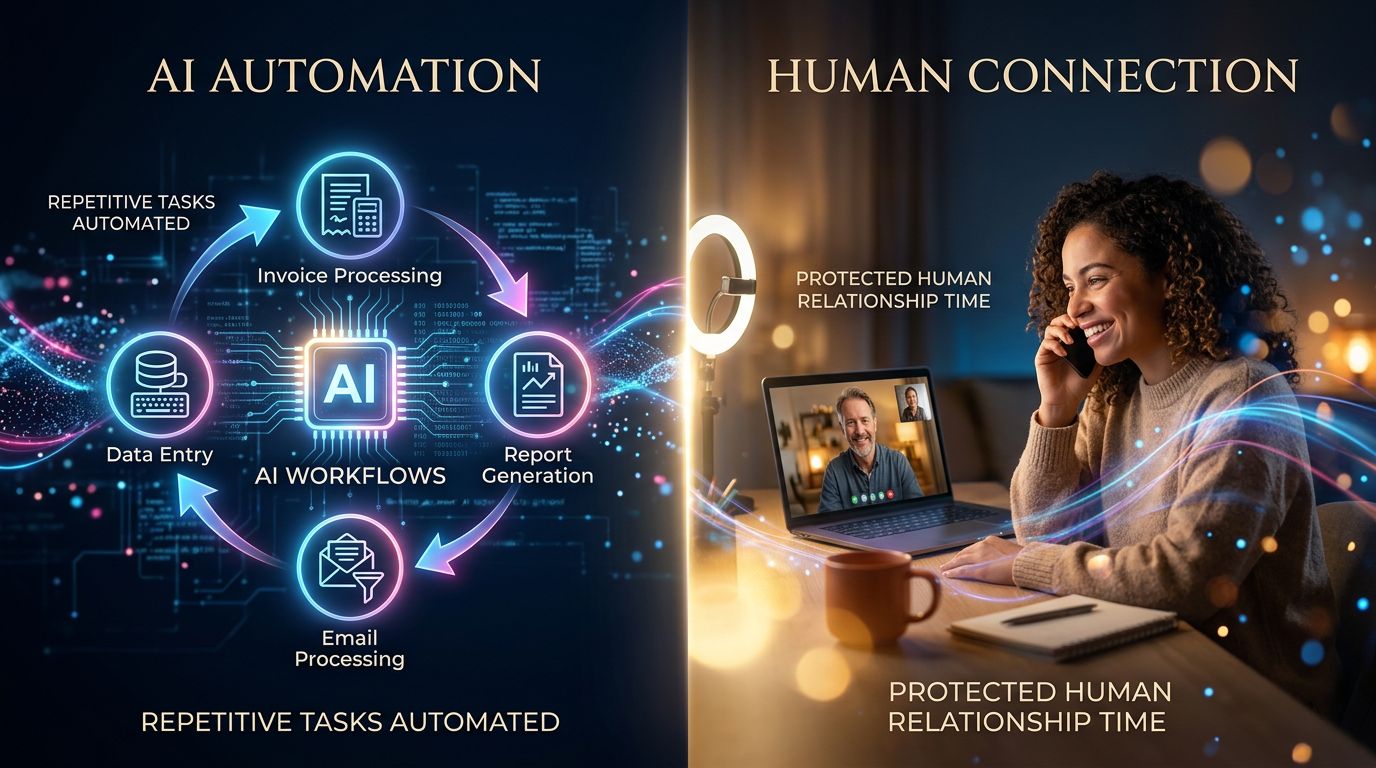
Repetitive, low-value tasks (sending invoice reminders, updating a project status, archiving a file). These: automate without mercy.
Technical but codifiable tasks (drafting a first brief, generating a progress report, qualifying an inbound lead). These: assist with AI.
Relational and strategic tasks (discovery calls, sensitive feedback, negotiation). These: protect. They are your differentiating value.

What nobody tells you: most freelancers accidentally automate the third category. They send generic client follow-up emails through automated sequences, then wonder why their renewal rate is collapsing.
Relationship marketing: what automation must protect, not replace
“People will forget what you said, people will forget what you did, but people will never forget how you made them feel.” — Maya Angelou
This is the ground truth of freelance marketing in 2025. In a market saturated with AI assistants, automated cold emails, and mass-generated content, authentic relationships have become the only real competitive advantage.
Relationship marketing isn’t just another strategy. It’s your moat. It’s what makes a client come back, refer you, and accept your rate without negotiating.
But here’s the paradox most solopreneurs miss: building this quality of relationship takes time and attention. Time you don’t have if you’re drowning in admin work.
That’s exactly where strategic automation — the kind that comes after understanding your processes — becomes a retention lever.
The equation is simple:
Smart automation of low-value tasks → Freed time → Investment in client relationships → Retention and word-of-mouth
This isn’t magic. It’s operational logic.
Building your automation stack without sacrificing the human element
Let’s look at this from a different angle. How do you concretely structure an automation that reinforces — rather than erodes — your relationship marketing?
Map first, tool later
Take one week. Write down every task, every interaction, every friction point. Use a simple table: task / frequency / time spent / perceived client value. This table will shock you. Most freelancers spend 40 to 60% of their time on tasks with near-zero perceived client value.
Identify your relational “moments of truth”
These are the touchpoints where your client feels your presence: the personalized meeting summary, the congratulatory message when their project takes off, the proactivity on a risk you spotted before they did. These moments cannot be automated. They are protected by automating everything else.
Automate in layers, not all at once
Start with pure admin: invoicing, follow-ups, archiving, standard reports. Only then move up in complexity toward AI assistance on repetitive cognitive tasks. This progression prevents fragile automations that break on the first edge case.
Give your AI memory
This is the point most tools completely miss. Effective automation for relationship marketing requires context. Your AI assistant needs to know that this client prefers morning meetings, that their budget was tight this quarter, that their last project had a deadline issue they took badly.
Without this contextual memory, your AI generates generic content. With it, it generates personalized content — and that’s the difference between an email that strengthens the relationship and one that erodes it.
What “understand before you automate” concretely changes
My analysis reveals a recurring pattern among freelancers who succeed at automation: they all did the unglamorous upfront mapping work.
Concretely, what does it change?
ROI becomes measurable. When you know that a task costs you 3 hours per week and it can be automated, you can calculate exactly what you get back. Not “more time” in the vague — 3 precise hours, every week, reinvested wherever you decide.
Implementation errors drop drastically. The majority of automation bugs come from a poor understanding of the original process. If you’ve documented every step and every exception before coding your workflow, you anticipate edge cases instead of discovering them in production.
Your client doesn’t see the mechanics — they see the result. A client who receives a structured progress report, at a fixed time, with information organized exactly the way they like — they don’t know it’s automated. They just know you’re reliable and attentive. That’s exactly the effect you want to create.
According to a HubSpot study on CRM trends, 68% of clients leave a service provider not because of the quality of work, but because of a feeling of indifference. Well-designed automation combats precisely this feeling — by making you more present, not less.
The 3 mistakes that turn automation into a client repellent
What nobody tells you in automation tutorials: tools are not neutral. Used incorrectly, they actively damage your reputation.
Mistake #1: automating the first contact. Mass automated cold email is detectable from a mile away. It doesn’t build a relationship — it generates spam. The first contact must remain human, personalized, and contextualized.
Mistake #2: using the same automation for all clients. An enterprise client and a micro-entrepreneur don’t have the same expectations, rhythms, or communication codes. Segment your automations. A tool that truly knows your clients lets you personalize at scale — without spending 3 hours doing it manually.
Mistake #3: automating without human checkpoints. Any automation that touches client relationships must have a human validation point for sensitive cases. An invoice follow-up message that fires automatically on the day your client is going through a crisis? You’ve just lost the relationship in one email.
Three actionable insights to start right now
If I were your operational strategist, here’s exactly what I’d tell you to do this week.
1. Run the 40% audit. For 5 days, write down every task and how long it takes. Identify those that represent 40% of your time with no direct client value. That’s your first automation target.
2. Define your “untouchables”. List the 5 client contact moments you will never give to automation. Protecting them explicitly means prioritizing them. And prioritizing them means improving them.
3. Choose a tool with contextual memory. The difference between a generic AI assistant and one that knows your clients is abyssal in terms of relationship quality. Look for solutions that maintain persistent context per client and per project — not just a chat interface that resets to zero with every session.

Automation in service of the human, not in place of it
Here’s the truth that 15 years of observing independent work have taught me: the freelancers who last and thrive are not those with the best technical stack. They’re the ones who found how to use technology to amplify their humanity, not replace it.
Understanding before automating isn’t a constraint. It’s a competitive advantage. Because while your competitors are frantically clicking “integrate,” you’re building a machine that works for you — and that reinforces, with every interaction, the trust your clients place in you.
Strategic automation frees up time. That time, invested in an authentic and attentive client relationship, generates retention. Retention generates referrals. Referrals generate growth without paid acquisition.
That’s the virtuous cycle nobody sells you because it’s not sexy to market. But it’s the one that actually works.
Ready to build automation that truly works for you?
Nova-Mind is designed exactly for this: an assistant with permanent memory of your clients and projects, automations integrated into your workflow, and a proactive coaching system that detects what’s holding back your productivity before you feel it. Discover how Nova-Mind can transform your freelance stack — no bullshit, no overselling, with concrete numbers.
Share this article
Social networks
Analyze with AI
Charles Annoni
Front-End Developer and TrainerCharles Annoni has been helping companies with their web development since 2008. He is also a trainer in higher education.