
Claude, Spotify, Uber: The Hyper-Personalized Marketing Revolution
Article Summary
📖 9 min readClaude AI's integration with everyday apps like Spotify and Uber marks a major turning point for marketing. It unlocks access to passive behavioral data, paving the way for hyper-personalized ad campaigns and customer interactions.
Key Points:
- Claude AI's integration with mainstream apps like Spotify and Uber finally makes hyper-personalized marketing achievable.
- These direct connections unlock unprecedented access to passive behavioral data, revealing what users actually do every day.
- Unlike declarative data, insights from Spotify or Uber offer unrivaled targeting granularity — from specific listening habits to mobility patterns.
- This evolution represents a fundamental shift in the type of data available to marketers, far beyond a simple increase in data volume.
- Marketing teams can now understand audiences with near-intimate precision, enabling campaigns of multiplied relevance and impact.
Hyper-personalized marketing wasn’t possible before. Now it is.
For years, digital marketers have dreamed of the same Holy Grail: knowing their audiences as well as a close friend. Not just age and location — real behaviors. What people listen to at 11pm. How they move on Friday nights. What they order when it rains.
The data existed. It was just scattered across inaccessible silos.
Here’s where it gets interesting: Claude has just crossed a threshold nobody truly anticipated. Anthropic’s AI can now connect directly to everyday apps — Spotify, Uber, and others. And for marketing teams, that changes everything.
What “connecting to apps” actually means in practice
Forget the gadget integrations shown in demos that never get used. What we’re talking about here is structured access to behavioral data through applications your audiences use every day — multiple times a day.
Spotify has 600 million active users. Their playlists, favorite genres, listening habits by hour and day. Uber captures mobility patterns that reveal entire lifestyles: neighborhoods frequented, schedules, occasions (night out, airport, medical appointment).
My analysis reveals something important here: this isn’t just “more data.” It’s a fundamentally different type of data.
Declarative data (what people tell you in your forms) — you already have that. Passive behavioral data — what people do without thinking about it — that’s where the truth lies. And that’s exactly what these integrations unlock.
The difference between knowing a customer “likes music” and knowing they listen to lo-fi jazz every Monday morning for 45 minutes. That’s not the same granularity. That’s not the same targeting power.

Audience segmentation enters a new era
For ten years, segmentation has been refined in successive layers. First demographic (age, gender, geo), then psychographic (declared interests), then behavioral (purchase history, pages visited).
Each layer added precision. But each layer stayed within the same logic: segmenting groups.
What nobody tells you at marketing conferences: groups are an approximation. Your “persona” of urban 28-35-year-old sports enthusiast covers radically different profiles. One gets up at 5:30am to run, the other watches sports on TV while eating chips. Same segment, opposite behaviors.
Claude’s access to app data changes the equation. We’re no longer talking about segments — we’re talking about individuals.
Let’s look at this from another angle: imagine being able to build campaigns that adapt not to a fixed profile, but to a person’s current behavioral state. She listened to intense music this morning? She’s probably in “performance” mode. He took an Uber to an airport last night? He’s traveling. These contextual signals, intelligently cross-referenced by AI, enable advertising relevance that third-party cookies could never have approached.
“The best marketing doesn’t feel like marketing.” — Tom Fishburne, Marketoonist. And to not look like marketing, you need to be so relevant that the message seems obvious.
Hyper-personalization: from theory to operational practice
The term “hyper-personalization” is overused. Everyone talks about it, few actually implement it. Often because the technical complexity was prohibitive.
Concretely, what does Claude + app integrations enable today?
Dynamic content based on real behaviors. A user who primarily listens to music on weekday mornings receives a different message from one who listens on weekend evenings. Not just “Hello [First Name]” — content designed for their actual life context.
Intelligent send timing. Send an email when someone is receptive, not when your automation arbitrarily decided to. Spotify patterns reveal attention windows. Uber patterns reveal travel moments (and therefore mobile availability).
Contextual offers. A customer who frequently moves toward restaurant areas in the evening — the promotional offer for a partner restaurant becomes relevant, not intrusive.
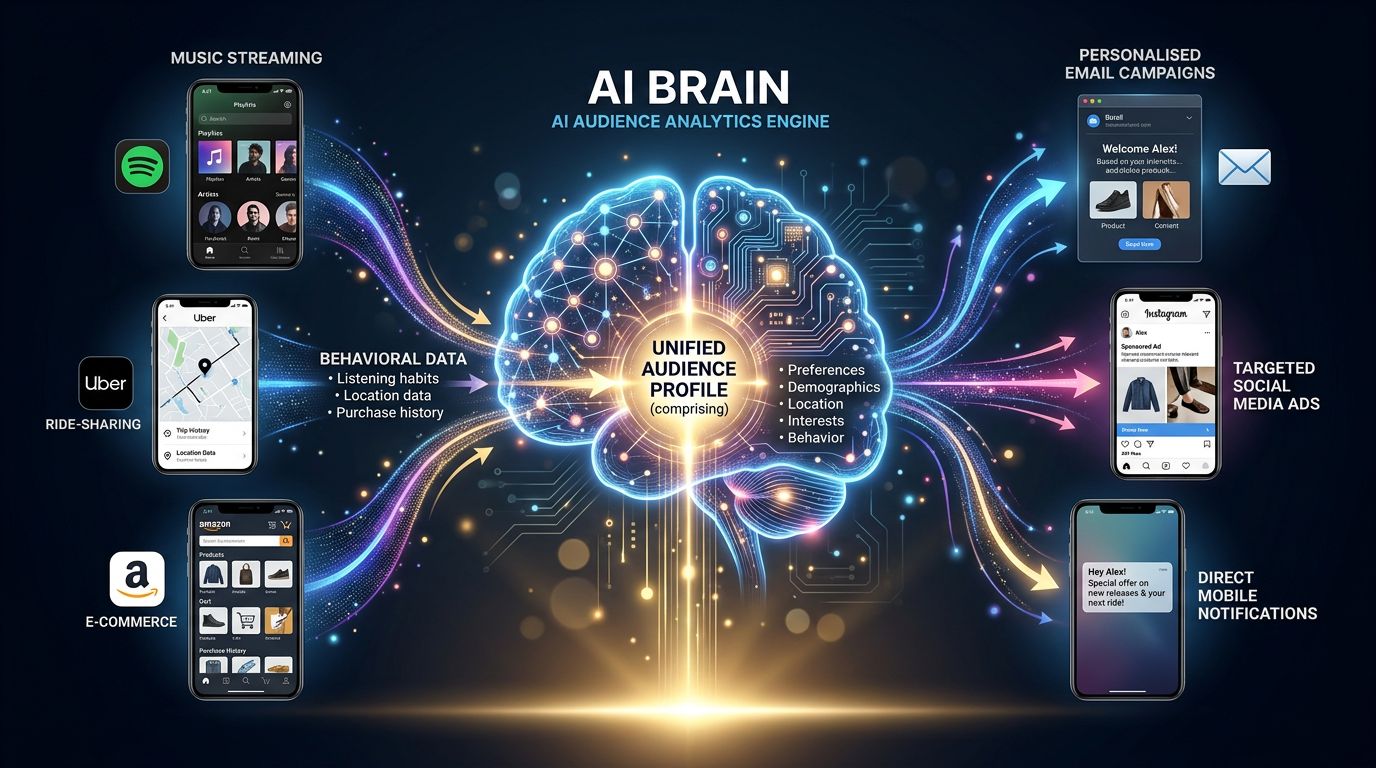
Let’s flip the perspective: Claude isn’t doing the marketing work for you. Claude is eliminating the friction layer between data and decision. You remain the strategist. The AI becomes your real-time data analyst, available 24/7.
The implications for your marketing stack
15 years observing marketing teams have taught me an uncomfortable truth: most “AI” tools we adopt add to complexity instead of reducing it. New dashboard, new training, new friction.
Claude’s native integrations into existing apps reverse this logic.
Your audience already uses Spotify. They already use Uber. You don’t have to convince them to adopt a new behavior to generate useful data. The signals are already there — it just lacked the intelligence layer to interpret and activate them.
What nobody tells you in martech pitch decks: the value of data depends on your ability to connect it to other data. An isolated Spotify data point is anecdotal. Cross-referenced with Uber data, purchase history, and seasonal context — it becomes predictive.
That’s exactly what Claude does: aggregate, cross-reference, infer. Not like a simple query tool — like an analyst who understands context.
For teams already using tools like n8n for their automations or who have integrated AI assistants into their workflow, this evolution fits into a logical continuum. The MCP (Model Context Protocol) that Anthropic is developing for Claude — and that Nova-Mind natively leverages — is precisely designed for this type of multi-source integration.
“Data is the new oil, but like oil, it needs to be refined to be valuable.” — Clive Humby, mathematician and data scientist. The refinery is now AI.
What this means for personal data
It’s impossible to address this topic without talking about GDPR. And that’s legitimate.
Access to behavioral data through third-party applications raises real questions of consent and transparency. This isn’t a legal detail to settle with your DPO — it’s a question of trust with your audiences.
My expert advice: the marketers who will get the most out of these new capabilities will be those who build an explicit trust relationship with their audiences. Not those who exploit permissions buried in unreadable terms of service.
Personalization perceived as intrusive generates rejection. Personalization perceived as useful generates loyalty. The line between the two is informed consent and real value delivered in exchange for data.
Resources like the CNIL guidelines on AI and personal data remain essential for framing these practices correctly.
Technology moves fast. Regulation follows. Your ethics must precede both.

3 concrete actions to get ahead of this shift
What’s expected of you now isn’t to revolutionize everything tomorrow. It’s to make three strategic decisions before your competitors do.
Audit your current behavioral data sources. Which apps do your audiences already use? Which ones have exploitable APIs? Where are your blind spots? This mapping takes a day. It conditions your next 12 months.
Test Claude with your existing data. Before even integrating Spotify or Uber, connect Claude to your current CRM and analytics data via the MCP protocol. Measure the quality of insights produced. Calibrate your expectations against reality, not demos.
Build your consent framework now. Not when integrations are operational — now. Define what data you collect, why, and what value you offer in exchange. This upfront work saves you from trust crises downstream.
Tomorrow’s marketing is built today
Claude’s integration with Spotify, Uber, and other everyday apps isn’t one more feature in a changelog. It’s a paradigm shift in the relationship between AI, behavioral data, and marketing personalization.
The teams that will dominate their markets in 18 months won’t be those with the biggest media budget. They’ll be those who have built the most intelligent data pipelines, the smoothest AI workflows, and the most solid trust relationship with their audiences.
The competitive advantage window is open. It won’t stay that way indefinitely.
If you want to see how Nova-Mind leverages these capabilities — persistent memory on your clients, native MCP integration, and automated marketing workflows — explore the platform. Not to sell you another tool. To show you what “AI that truly knows your business” actually means in practice.
Share this article
Social networks
Analyze with AI
Charles Annoni
Front-End Developer and TrainerCharles Annoni has been helping companies with their web development since 2008. He is also a trainer in higher education.