


Freelance: Ready for the SaaS Tools Consolidation?
Article Summary
📖 9 min readThe rapid consolidation of collaborative tools by software giants is directly reshaping how freelancers work with their clients. This article explores the economic drivers behind the trend and offers practical ways to turn what could be a challenge into a competitive advantage.
Key Points:
- 47% of companies plan to reduce their SaaS stack by 2026, signalling a major shift for external contractors.
- Enterprise tool rationalisation is driven by cost reduction, improved security, and lower operational friction.
- Freelancers must anticipate this trend by adapting to their clients' consolidated platforms to stay relevant and efficient.
- Centralising tools can generate substantial savings and better regulatory compliance for client organisations.
- Mastering integrated software ecosystems is becoming an essential competitive edge for solopreneurs facing evolving market expectations.
The market is concentrating. Your clients are adapting. Are you ready?
47% of companies plan to reduce the number of SaaS tools in their stack by 2026. That’s not a footnote. It’s a weak signal that will directly impact how your clients work — and therefore how you need to work with them.
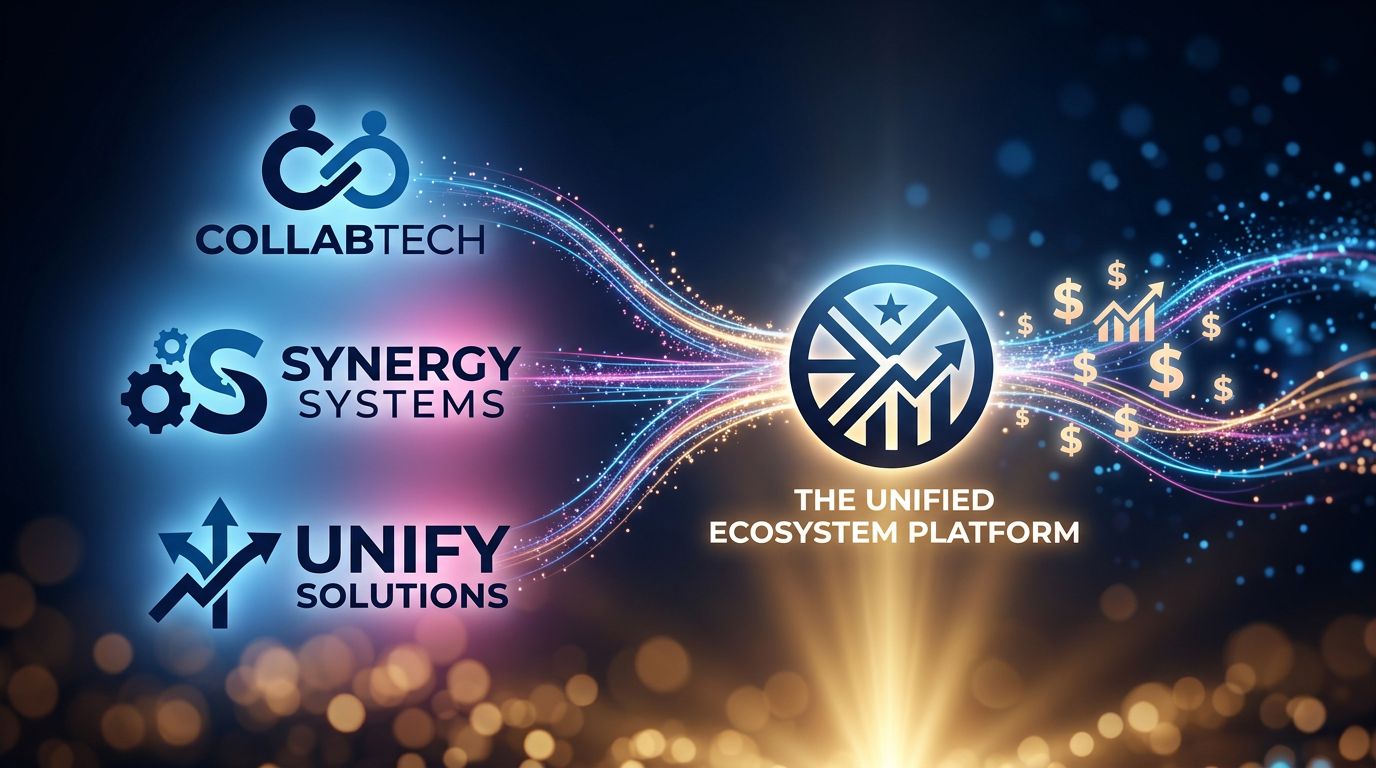
The collaborative software market consolidation is accelerating. Salesforce absorbs Slack. Microsoft integrates Teams into Office 365. Notion acquires Cron. Atlassian unifies Jira, Confluence, and Trello. Every quarter, a major player swallows a standalone tool your clients were using. This deep structural movement isn’t just a market-share war between vendors. It’s a transformation of the operational expectations of the teams you serve.
As a freelancer or solopreneur, you’re not a spectator of this trend. You’re one of its first victims — or one of its first beneficiaries. It all depends on what you do now.
Why large enterprises are consolidating their stack
Here’s where it gets interesting. The rationalisation of collaborative tools isn’t driven by a sudden love of simplicity. It’s driven by three very concrete economic factors.
Cost. A 200-person company paying for 12 different SaaS tools for collaboration spends on average 40 to 60% more than a company that centralises everything on 3 integrated platforms. CFOs have done the maths.
Security and compliance. Each additional tool = an additional attack surface = one more audit. GDPR, NIS2, SOC2 — regulatory pressure naturally pushes towards data centralisation.
Operational friction. Switching between Slack, Notion, Asana, Google Drive, and Zoom five times an hour amounts to roughly 2.1 hours lost per employee per day, according to McKinsey. CIOs have had enough.
The result? Your enterprise and mid-market clients are migrating to integrated suites. They’re abandoning point solutions. And they expect their external contractors — you — to adapt.
What this concretely changes for you as a freelancer
What nobody tells you: the real question isn’t “which tool will I use?” It’s “in which ecosystem will my clients invite me to work?”
Let’s look at the practical implications.
You’ll increasingly be invited into their environment
Gone are the days of sending your client a Notion link or a Trello board. Today, large enterprises have a standardised collaborative environment — Microsoft 365, Google Workspace, or an in-house suite — and they expect their contractors to connect directly into it. Teams guest access, SharePoint file sharing, Jira tickets assigned to an external account.
If you can’t navigate these environments, you create friction. Friction costs contracts.
Project management becomes a selection criterion
Flip the situation. It’s no longer just your domain expertise that matters. Your ability to integrate cleanly into their workflow has become a differentiator. A freelancer who manages deliverables directly in the client’s own tool, who documents in real time, who doesn’t impose their own system — that freelancer has a genuine competitive advantage.
Mastering the client’s tools = reduced onboarding cost = longer contracts.
Shared context expectations are exploding
Here’s the real issue. When a company works within an integrated suite, everyone sees everything in real time: decision history, project status, comments. When you arrive as an external contractor with your own tools, you create a blind spot.
Clients are starting to ask — implicitly or explicitly — that their contractors don’t need to be “brought up to speed” at every meeting. They want shared access to information, not a weekly email summary.

The strategic response: adapt your own stack
My analysis reveals two classic mistakes when facing this trend.
The first: multiplying tools to “cover every case”. You end up with 8 subscriptions, no coherence, and you lose track of your own projects.
The second: staying locked into your current stack because “it works for me”. It works for you. Not necessarily for your client.
The right approach is surgical.
Level 1 — Master the dominant client environments. Microsoft 365 and Google Workspace together account for more than 70% of enterprise collaborative environments. Being able to navigate them is not optional. You don’t need to be an expert — just operational.
Level 2 — Centralise your own operations. Your internal stack must be consistent and memorable. One tool for your projects, one tool for your CRM, an AI assistant that knows your clients. Not twelve.
Level 3 — Invest in bridge-building tools. The best tools for freelancers in 2024–2025 are those that integrate cleanly into client environments and centralise your internal management. Bidirectional sync, webhooks, native integrations — these are no longer bonus features. They’re selection criteria.
“Productivity is not about speed. It’s about friction. Reduce the friction, and speed follows.” — Jason Fried, co-founder of Basecamp
The over-integration trap
But watch out for the trap. Tool consolidation has a dark side that few freelancers anticipate.
When you centralise all your work inside your client’s environment, you lose portability. If the contract ends, where is your work history? Your templates? Your documented processes? If everything lives in their Notion or their Teams, you leave empty-handed.
The rule I apply: everything that is a deliverable goes to the client. Everything that is a process stays with me.
Concretely: documents, files, deliverable tasks — in their environment. My client context notes, my estimates, my conversation histories, my proposal templates — in my own system, with persistent memory.
This separation isn’t just an organisational matter. It’s a matter of professional sovereignty.

Three concrete actions to implement right now
Experience has taught me that major market trends always translate into daily micro-decisions. Here are the three I recommend.
Action 1 — Audit your last 5 clients. In which environment did they want you to work? Which tools were they using? Was there friction because of your tools? Answering these three questions honestly will give you more signal than any market study.
Action 2 — Choose an AI assistant with contextual memory. The number one problem for freelancers working with multiple clients: context gets lost. Between two projects, between two meetings, you re-explain. Choose a tool that remembers — your clients, their preferences, the history of their projects. That’s exactly what we built in Nova-Mind: persistent per-client memory via pgvector, so you never have to start from scratch again.
Action 3 — Position your adaptability as a skill. In your business proposals, explicitly mention your ability to work within the client’s environment. It’s not a given for everyone. It’s a differentiator. “I integrate into your existing workflow” is often worth more than a list of certifications.
What market consolidation reveals about the future of freelancing
Let’s look at this from another angle. The consolidation of collaborative tools is not a threat to freelancers. It’s a filter.
Contractors who remain rigid — “I only work with my own tools” — will find themselves excluded from client ecosystems that are closing in on themselves. Contractors who adapt intelligently — mastering client environments without sacrificing their own organisation — will on the contrary become more valuable.
Because a freelancer who understands the consolidation stakes, who speaks the same operational language as their client, who adds no friction — that freelancer is rare. And rarity commands a premium.
The real skill of tomorrow for an independent professional won’t be mastery of a specific tool. It will be the ability to navigate shifting ecosystems without losing their own operational effectiveness.
Adaptability + data sovereignty + contextual memory. That’s the winning triangle.
Your stack should work for you, not against you
Market consolidation is underway. Your clients will increasingly work in integrated environments, with high expectations around fluidity and shared context. You can let this trend happen to you — or you can get ahead of it.
If you’re looking for a tool that centralises your project management, your CRM, your AI assistant with persistent memory, and integrates into your existing workflows via MCP and webhooks — that’s exactly what Nova-Mind does. For €39/month, you get an assistant that knows your 47 clients, remembers every project, and works for you even while you sleep.
Discover Nova-Mind — and stop re-explaining context.
Share this article
Social networks
Analyze with AI

Charles Annoni
Front-End Developer and TrainerCharles Annoni has been helping companies with their web development since 2008. He is also a trainer in higher education.