

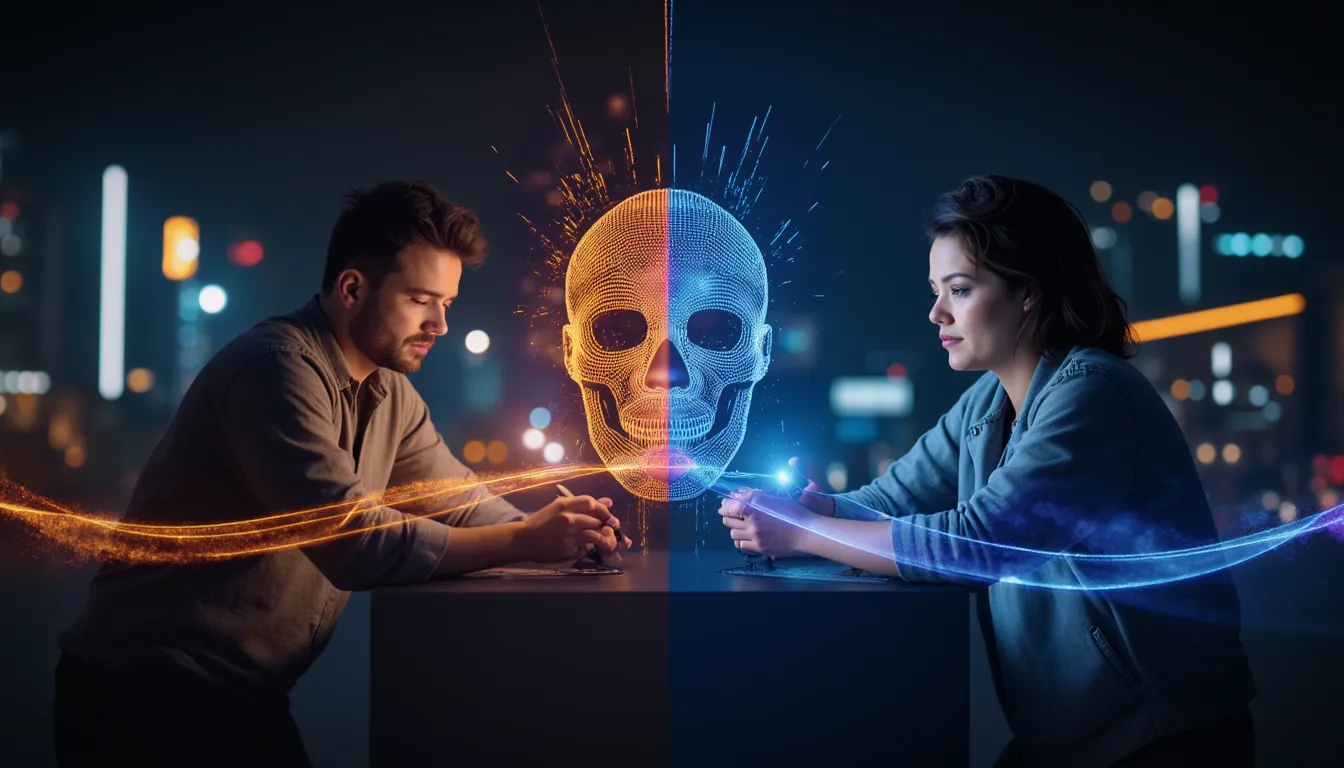
AI: Speed, Power, and What the Numbers Actually Reveal
Article Summary
📖 7 min readThis article explores public perception of AI, particularly the fear that its development is moving too fast. It argues that this concern is not irrational, but may reflect a deep understanding of the challenges posed by artificial intelligence, despite its growing adoption.
Key Points:
- A majority of 72% of Americans believe AI is evolving too quickly for society to adapt properly, according to Pew Research.
- Distrust of AI does not reflect irrational fear, but rather a legitimate concern about the pace of its societal integration and governance.
- The people most informed about AI systems are often those who express the most concern about its biases and side effects.
- Fear of AI can be a sign of a deep understanding of its implications, prompting reflection on the regulation and adaptation needed.
- Concrete adoption of AI in critical fields, such as healthcare, is happening simultaneously with growing public distrust, highlighting the complexity of technological progress.
72% of Americans Are Worried. Are You?
72% of Americans believe AI is advancing too fast. Not a fringe alarm — a broad majority, measured by Pew Research. Meanwhile, AdventHealth is deploying OpenAI to treat real patients in real clinical settings. Two simultaneous realities, seemingly contradictory. Not actually contradictory at all.
Here’s what I understood after analyzing both: the fear is not irrational. And adoption doesn’t mean abandoning common sense.
What the Numbers on AI Distrust Really Say
Polls on AI all look the same — until you dig deeper.
The 72% figure isn’t a stat about “AI in general.” It’s a response to a specific question: is technology evolving too fast for society to adapt properly? That’s not the same thing as “AI scares me.” It’s far more nuanced — and far more legitimate.
What you’re never told in LinkedIn summaries: the most worried people aren’t the least educated. They’re often the most informed. Those who truly understand what LLMs, recommendation systems, or automated decision tools actually do are precisely the ones asking the right questions about governance, bias, and unintended consequences.
Fear isn’t a lack of understanding. Sometimes it’s a sign that you’ve understood too well.
Let’s flip the frame: if 72% of people thought their car was going too fast on the highway, we wouldn’t say they’re afraid of cars. We’d say speed limits need a second look. AI deserves the same treatment.

AdventHealth and OpenAI: When AI Treats Real Patients
On the other end of the spectrum, AdventHealth — a hospital network of 50+ facilities across the United States — announced a structured partnership with OpenAI to deploy AI across its clinical and administrative workflows.
What does that actually change?
The stated goal is ambitious: a “whole-person” care approach that accounts for the patient’s physical, mental, and social health. AI operates on multiple levels — automatic summarization of medical records, clinical decision support, and reducing administrative burden on caregivers. That last point is critical. American nurses spend an average of 35 to 40% of their time on documentation. Not with patients. With forms.
If AI reclaims 15% of that time — a conservative estimate — that’s millions of hours redirected toward actual care. Not abstract productivity. Real human contact.
But watch out for the trap. AdventHealth isn’t deploying OpenAI blindly. The partnership includes clinical validation protocols, systematic human oversight, and phased integration. This isn’t “AI decides instead of the doctor.” It’s “AI frees the doctor to make better decisions.”
That distinction is enormous. And it’s exactly what the 72% of worried Americans are right to demand: not a brake on adoption, but conscious adoption.
The Real Problem: Speed vs. Maturity
Here’s where it gets interesting.
The tension between “AI is moving too fast” and “AI is saving lives in hospitals” isn’t a contradiction. It’s the same problem viewed from two different angles.
The real issue is the maturity gap. The technology advances. Regulatory frameworks, adoption practices, professional training — they advance at half the pace. This lag creates a dangerous gray zone where powerful tools get deployed without the necessary safeguards.
AdventHealth is among the players taking this gap seriously. They’re investing in team training, supervision protocols, and transparency with patients. That’s not the norm. It’s the exception.
Most enterprise AI deployments look like something else entirely: a ChatGPT Teams subscription rushed through after a board meeting, a few prompts copy-pasted into critical workflows, and zero training on hallucinations or model limitations.
That’s the problematic speed. Not AI itself — adoption decisions made without sufficient maturity.

What This Means for You, Concretely
My analysis reveals three patterns in how professionals respond to this tension.
The “head in the sand” pattern: ignore AI on principle, keep working the same way, and find yourself left behind in 18 months. The most comfortable short-term choice. And the most costly long-term.
The “frantic adoption” pattern: test every tool, change your stack every three months, spend more time evaluating solutions than producing work. The grind without direction. Exhausting and unproductive.
The “conscious adoption” pattern: choose one or two tools that solve real, measurable problems, integrate them deeply into your workflow, and evaluate them on concrete metrics. That’s what AdventHealth does at hospital system scale. That’s what effective freelancers and agencies do at their scale.
The difference between the second and third pattern? Memory and depth of integration. A tool you have to re-explain every session isn’t truly integrated. A tool that knows your clients, your projects, your preferences — and works even while you sleep — that’s a different category entirely.
Three Actionable Insights to Keep
1. Measure before adopting, measure after. Before deploying an AI tool in your workflow, set a baseline: how much time do you currently spend on this task? After 30 days, measure again. If the gain isn’t visible and quantifiable, the tool doesn’t deserve a place in your stack. No mysticism — just data.
2. Human oversight is not a sign of weakness. AdventHealth isn’t abandoning its doctors because they use AI. They’re freeing them. Integrate AI as an amplifier of your expertise, not a replacement. The best AI workflows I’ve seen all operate on this principle: the human validates, AI executes and suggests.
3. Choose depth over breadth. An AI assistant that knows your 47 clients by name, their challenges, their project histories — that’s infinitely more useful than 12 generic tools that remember nothing. Useful AI in 2025 isn’t the most powerful AI. It’s the best-contextualized AI.
The Real Question Isn’t “Should I Adopt AI?”
That’s settled. AI gets adopted. The question is how and at what pace.
The 72% of Americans who think it’s moving too fast are right to ask the question. AdventHealth, deploying OpenAI with rigor and protocols, shows one possible answer. It’s not “slow down AI” — it’s accelerate the maturity around it.
For a freelancer or agency, that translates into a simple decision: stop chasing every new model, and invest in tools that truly integrate into your way of working. Tools with memory. With initiative. A personality that adapts to you.
That’s exactly what I’m building with Nova-Mind. Not another gadget — an assistant that knows your clients, manages your projects, generates your content, and analyzes your work patterns to alert you before burnout. Real stack, permanent memory, €39/month.
If you want to see what “conscious adoption” looks like in practice — discover Nova-Mind and experience what it feels like to have an assistant that truly remembers everything.
The AI that moves too fast is the one you didn’t take the time to configure. Yours can move at exactly your pace.
Share this article
Social networks
Analyze with AI
Charles Annoni
Front-End Developer and TrainerCharles Annoni has been helping companies with their web development since 2008. He is also a trainer in higher education.