


AI Content and SEO: Why It's Not Enough (and What You Actually Need to Do)
Article Summary
📖 9 min readAI content is not an SEO shortcut: without domain authority, precise search intent targeting, and active distribution, even the most powerful models like Claude Opus 4.5 won't rank your articles. AI compresses execution time — but the strategy itself remains human work.
Key Points:
- Google rewards relevance signalled by real user behaviour (E-E-A-T), not the volume of published content.
- Domain authority is built over years of quality backlinks, not by mass-publishing AI articles.
- Search intent targeting must come before content generation, never the other way around.
- Claude Opus 4.5 improves long-form coherence, but a more powerful model doesn't compensate for a missing strategy.
- In an effective SEO workflow, AI accounts for roughly 40% of total time — the remaining 60% is strategy, enrichment, and distribution.
The Trap 90% of AI Content Creators Fall Into
You’ve invested in an AI content generation workflow. Claude writes, Gemini refines, you publish. Volume up, time down. Makes sense, right?
And yet the rankings don’t move. Or worse — they slide backwards.
Here’s what nobody ever tells you: AI content is not an SEO shortcut. It’s a tool. And using a tool without understanding the system it operates in is exactly like buying the latest top-of-the-range hammer to drive screws.
The mistake isn’t in the AI. It’s in the belief that content alone does the SEO.

What Google Actually Evaluates in 2025
Fifteen years of observing algorithms have taught me one thing: Google doesn’t reward content. It rewards relevance signalled by real user behaviour.
In plain terms:
- A perfectly written AI article, with no backlinks, no user engagement, no domain authority — it simply doesn’t exist for Google.
- An average article, on a strong domain, with a solid inbound link profile — it will rank.
Google’s Helpful Content update hardened this principle. The algorithm now seeks to identify real experience, demonstrable expertise, and authority built over time. What SEOs call E-E-A-T (Experience, Expertise, Authoritativeness, Trustworthiness).
AI content can score high on fluency and semantic density. It often scores low on real-world experience and embodied depth of expertise.
Here’s where it gets interesting: this isn’t a condemnation of AI content. It’s a clarification of its role.
The Three Signals Your AI Content Doesn’t Generate Automatically
Domain authority isn’t written, it’s built
A domain with ten years of quality backlinks, mentions in sector publications, links from high-authority sites — that’s an infrastructure that 10,000 AI articles cannot replace.
AI content can feed a link-building strategy (by creating resources worth citing), but it doesn’t replace it. The distinction is fundamental.
According to a recent Search Engine Journal analysis, the sites that gain the most ranking ground aren’t the ones that publish the most — they’re the ones that earn the most inbound links from relevant domains. Publication volume has no positive correlation with rankings when domain authority stagnates.
Poorly targeted search intent produces ghost traffic
My obsession with detail reveals something many people miss: AI content, without a precise brief on search intent, tends to target queries that are too generic or too competitive.
The result? You rank for keywords nobody searches for, or you don’t rank at all for ultra-competitive keywords where you have no chance without existing authority.
SEO strategy must come before content generation. Not the other way around.
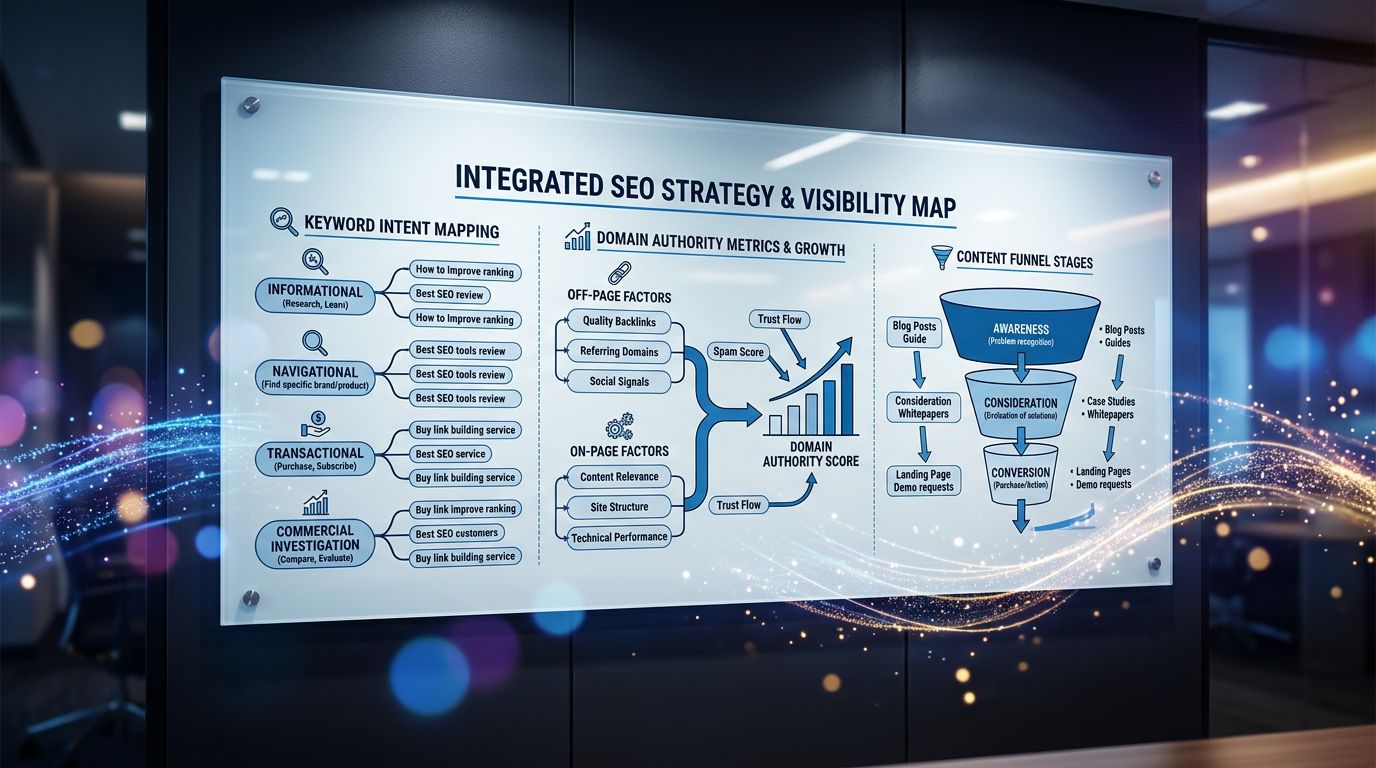
- Identify queries with specific transactional or informational intent
- Target long-tail keywords where your domain can genuinely compete
- Structure content around intent, not word count
User experience: the invisible signal
Google measures what users do after clicking on your result. Time on page. Bounce rate. Pages per session. Return to search results (the notorious “pogo-sticking”).
Generic AI content, with no distinctive angle, no proprietary data, no concrete examples drawn from real experience — it sends readers away fast. And Google notices.
What AI content guides never tell you: perceived quality from the user’s perspective is a ranking signal just as powerful as the technical quality of the content.
Claude Opus 4.5: More Powerful, But Still Not an SEO Strategy
Let’s get technical, since that’s my area. Anthropic has just launched Claude Opus 4.5 with a major feature: improved token handling and an extended context window. In practice, the model can now process longer documents, maintain coherence across complex content, and handle detailed editorial briefs without losing track.
This is a genuine evolution. In our stack at Nova-Mind, Claude is the primary writing engine for article generation — and this improvement concretely translates into more coherent long-form content, with better capacity to follow precise editorial guidelines throughout an entire article.
But — and this is the crucial point — a more powerful model doesn’t change the fundamentals of SEO.
Claude Opus 4.5 can produce a perfectly structured 3,000-word article with optimal semantic density and well-considered tags. If that content is published on a domain with no authority, no distribution strategy, no link acquisition — it won’t rank any better than an article written by an intern.
“The best content in the world on a weak domain will lose to average content on a strong domain. Every time.” — Rand Fishkin, co-founder of Moz
The power of the AI model amplifies your existing strategy. It doesn’t replace it.
What Actually Moves Rankings in 2025
Let’s flip the situation. If AI content alone isn’t enough, what actually works?
Thematic authority built methodically. Publishing 50 articles in the same area of expertise, interconnected, with a coherent topic cluster structure. AI accelerates production — but the thematic strategy must be human.
Content with proprietary data. Articles that cite original studies, internal data, real-world experience — those are the ones that earn natural backlinks. No AI can invent your field experience. It can give it shape.
Active distribution, not passive. Publish and wait is dead. Every piece of content needs a distribution plan: outreach for backlinks, promotion across social channels, newsletters, editorial partnerships. AI can help automate parts of this workflow — but the distribution strategy remains human work.
Impeccable technical optimisation. Core Web Vitals, URL structure, internal linking, schema.org markup. These are foundations that AI content doesn’t touch. And without these foundations, even the best content struggles to rank.
How to Integrate AI into a Real SEO Strategy
My expert advice, after building and testing this workflow at Nova-Mind:
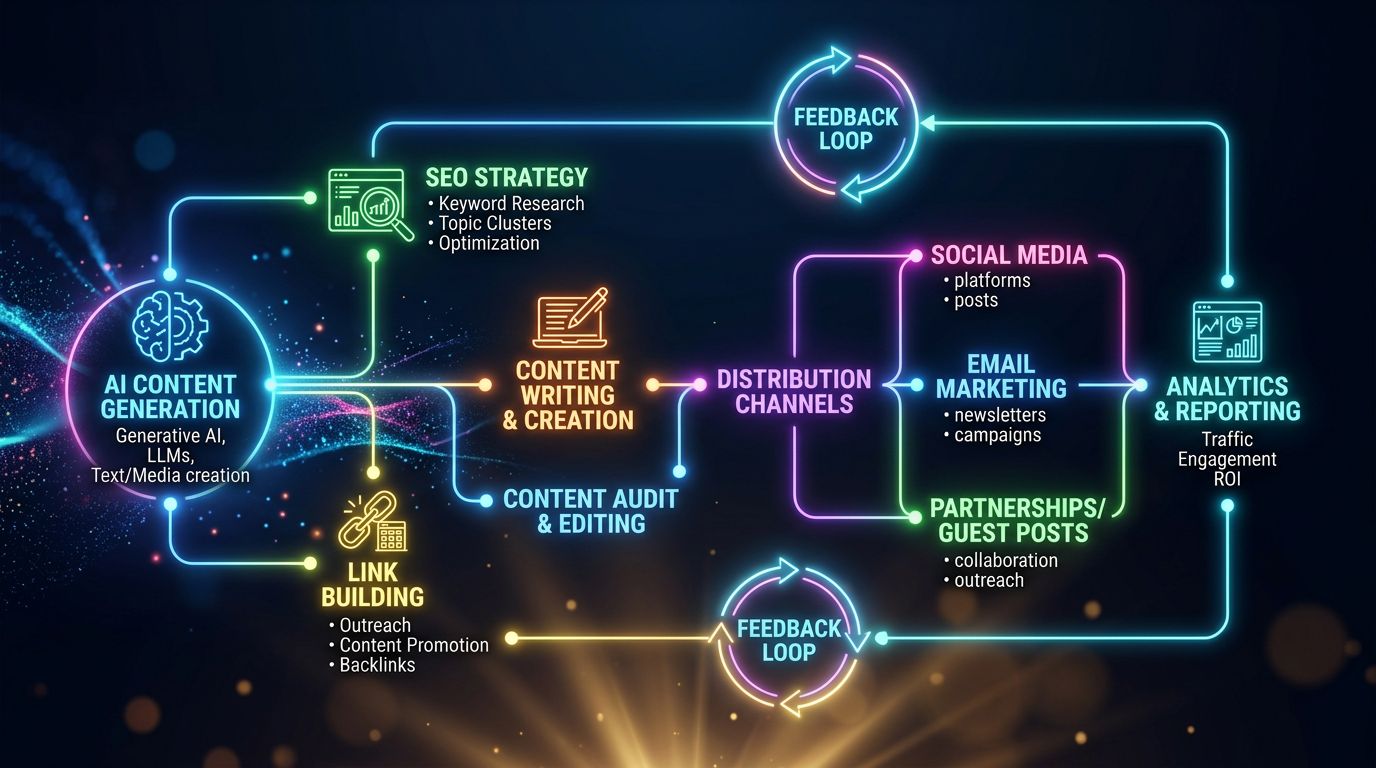
AI should intervene after the strategy, not before. The right order:
- Keyword research and intent analysis — human or specialist tool (Ahrefs, Semrush)
- Topic cluster mapping — human
- Precise editorial brief — human, with intent, angle, data to include
- Writing and structuring — AI (Claude, Gemini depending on the case)
- Enrichment with proprietary data and real experience — human
- Technical optimisation — AI + human validation
- Distribution and link acquisition — human + partial automation via AI
In this workflow, AI accounts for roughly 40% of total time. The remaining 60% is strategy, enrichment, and distribution — human activities.
The gain is real: we go from 8 hours per article to 3 hours. But AI hasn’t replaced the strategy. It has compressed execution time.
What This Concretely Changes for Your Workflow
Experience has shown me that teams that consistently outperform in SEO with AI all share one thing: they’ve invested as much in their strategy as in their tools.
They know precisely which keywords they can compete for. They have an active link acquisition plan. They measure behavioural signals, not just raw traffic.
And they use AI to go faster — not to think for them.
Three concrete actions to implement this week:
Audit your inbound link profile. If your Domain Authority is stagnating below 30 and you’re publishing AI content without a link-building strategy, you’re wasting time. Start with authority.
Analyse the search intent behind your last 10 published articles. Do they actually correspond to a query your prospects type? Or did you let the AI choose the angle?
Measure time on page for your AI content vs your human content. If the gap is significant, you have an engagement problem that volume won’t solve.
The Real Question to Ask Yourself
AI content is a force multiplier. But a multiplier of zero is still zero.
If your SEO strategy is solid — domain authority built, search intents well targeted, active distribution — AI will allow you to scale that strategy at a speed impossible to achieve manually.
If your SEO strategy is non-existent, publishing 50 AI articles a month will change nothing. You’ll just have 50 articles nobody reads.
At Nova-Mind, we built the article generation pipeline precisely to slot into a strategic workflow: monitoring qualified sources, editorial briefs configurable per project, publishing integrated via GitHub Actions or webhook. The generation is automated. The strategy remains human.
Because that’s where SEO is really won.
Want to see how this workflow fits into your content strategy? Nova-Mind is available from €39/month — persistent memory, complete content pipeline, and an assistant that genuinely knows your projects. Try Nova-Mind and build the strategy your content deserves.
Share this article
Social networks
Analyze with AI

Charles Annoni
Front-End Developer and TrainerCharles Annoni has been helping companies with their web development since 2008. He is also a trainer in higher education.