

Integrated ERP: How It Transforms Project Management in Manufacturing and Construction
Article Summary
📖 9 min readIn manufacturing and construction, delays and budget overruns are rarely due to a lack of skills — they stem from data fragmented across silos. An integrated ERP centralizes accounting, inventory, and project management on a single engine to shift from reactive reporting to predictive steering.
Key Points:
- Most delays in manufacturing and construction stem from a lack of visibility and departmental silos, not from a lack of competence.
- A truly integrated ERP runs on a single data engine: purchase orders, budgets, schedules, and accounting update in real time without manual re-entry.
- According to McKinsey, large construction projects overrun their budgets by an average of 80% and their timelines by 20 months, mainly due to data fragmentation.
- The value of an integrated ERP lies not in its individual features but in the friction it eliminates between those features.
- Three non-negotiable conditions for a successful implementation: data quality at entry, genuine field-team adoption, and process mapping before any configuration.
Classic project management has a structural problem
Fifteen years of observing project teams in manufacturing and construction have taught me one thing: most delays do not come from a lack of skill. They come from a lack of visibility. The project manager steers without a dashboard. Accounting works inside its silo. Inventory sends alerts that nobody connects to delivery lead times.
The result? Decisions made on data that is 48 hours old. Budget overruns discovered too late. Projects delivered behind schedule for reasons everyone could have anticipated.
That is precisely the structural problem that integrated ERPs like Acumatica have decided to tackle head-on.
What “integrated” really means
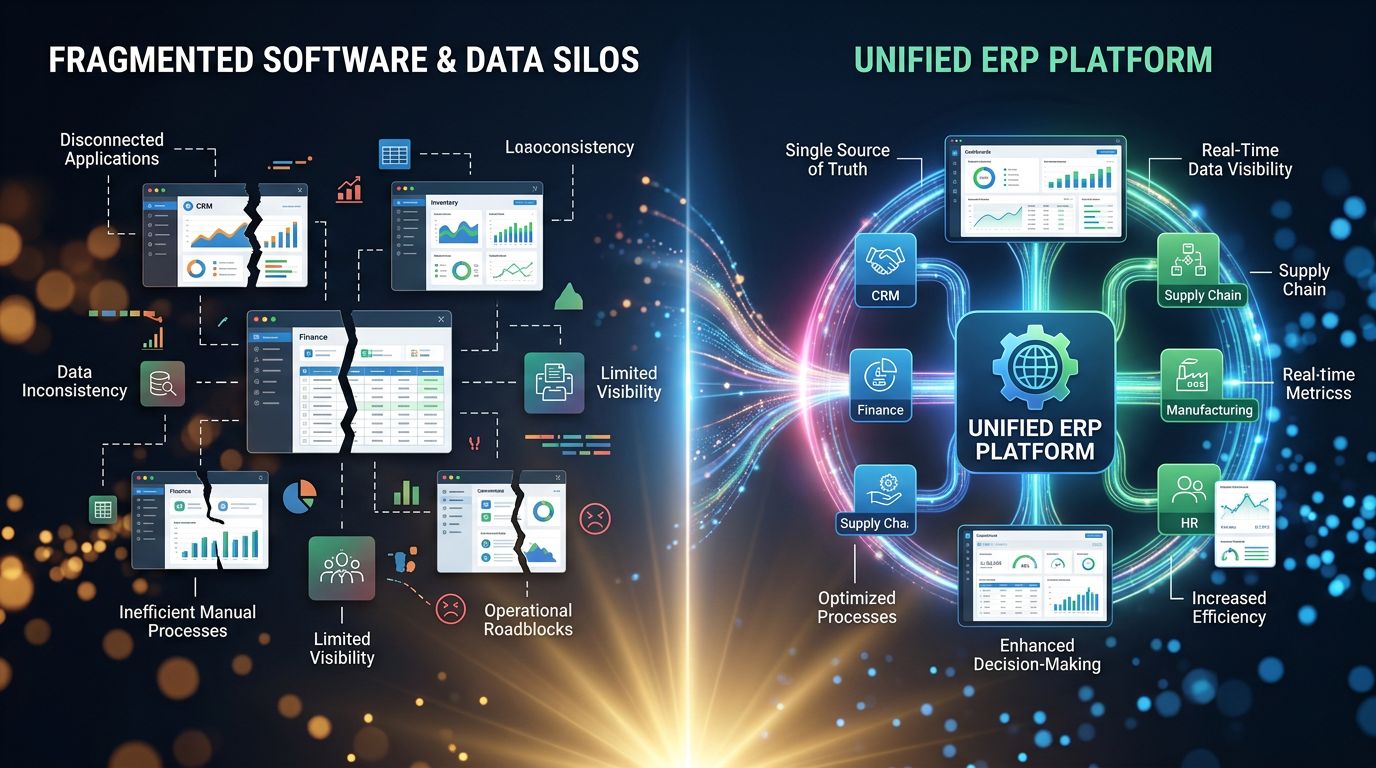
Here is where it gets interesting. When vendors talk about an “integrated” ERP, many people hear “we put several software tools inside the same interface.” That is not it. Not at all.
A truly integrated ERP is a single source of truth. Accounting, finance, inventory, project management, HR — everything runs on the same data engine. A purchase order placed in production automatically updates the project budget in real time. A supplier delivery delay triggers an alert directly inside the project manager’s schedule. An hours overrun on a job site feeds immediately into the financial indicators.
No re-entry. No Friday-evening Excel consolidation. No sync meeting to reconcile figures that never match.
Data flows. Decisions follow.
What commercial brochures never tell you: the value of an integrated ERP is not in its individual features. It is in the friction it eliminates between those features.
Construction and manufacturing: two sectors, one shared challenge
Let us flip the picture. One might think that manufacturing and construction are too different to share the same management problems. One produces at scale; the other builds one unit at a time. One optimises production lines; the other manages shifting job sites.
And yet.
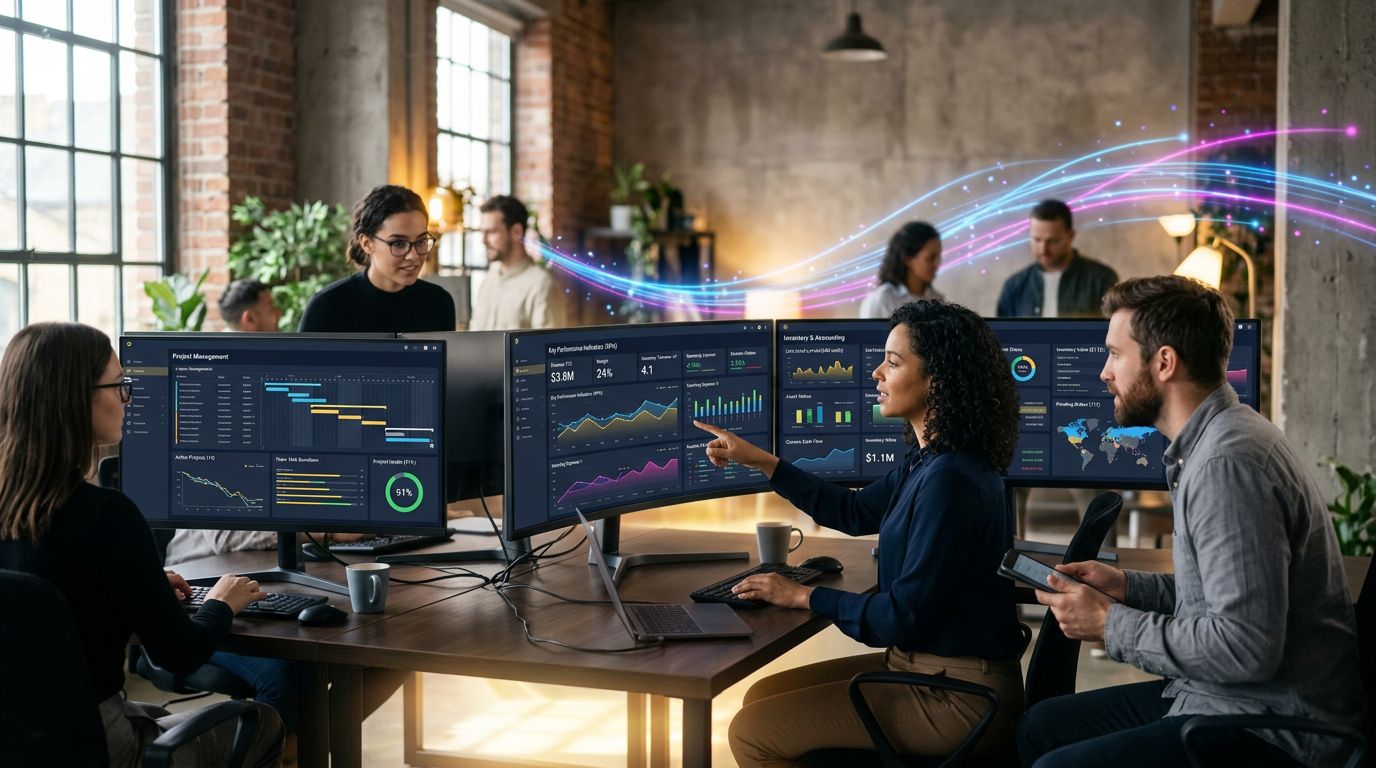
Both sectors share a fundamental constraint: project management is inseparable from the management of physical and financial resources. A construction project without materials inventory tracking is a budget that drifts. A manufacturing line without visibility into component delivery lead times is a schedule waiting to collapse.
In construction, the stakes are particularly critical. According to a McKinsey study, large construction projects overrun their budgets by an average of 80% and their timelines by 20 months. The causes? Data fragmentation, poor communication between teams, and no real-time visibility on costs.
In manufacturing, the pressure is different but equally real. Margins are tight. Customers demand ever-shorter lead times. A single component shortage can paralyse an entire line.
My analysis shows that in both cases, the answer comes down to the same lever: converging operational and financial data into a single system.
What an ERP like Acumatica concretely changes
Let us look at this from a different angle. Rather than listing features, let us look at what changes in teams’ day-to-day work.
The project manager finally sees the real numbers
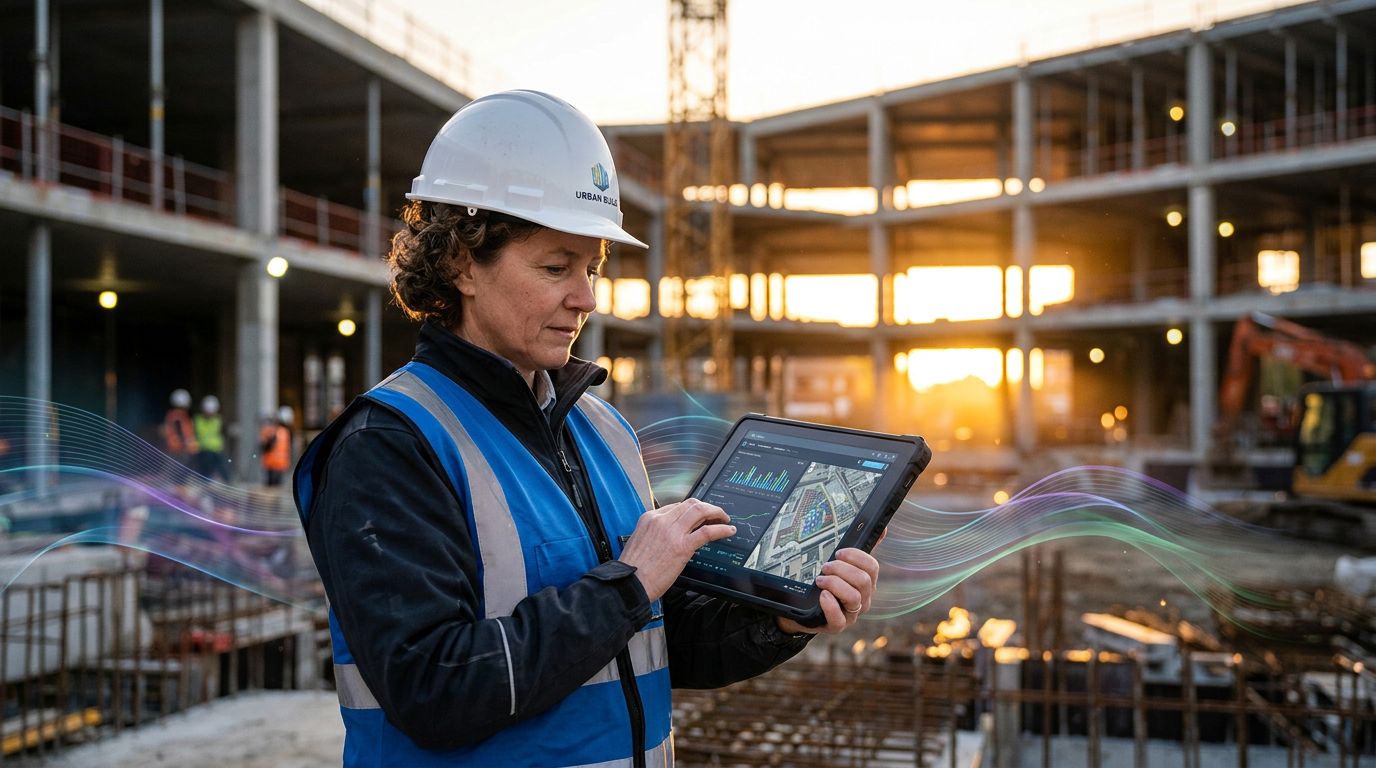
With an integrated ERP, the project manager no longer waits for accounting to send a cost report at month-end. They access committed costs, hours consumed by task, and budget variances by work package in real time. They can make an arbitration decision in the morning, using data from that same morning.
Accounting never re-enters data again
Every purchase order, every timesheet, every materials receipt automatically generates the corresponding accounting entries. The finance team moves from re-entry to analysis. That is a complete shift in posture.
Inventory becomes a project lever
In a siloed ERP, inventory is a constraint you endure. In an integrated ERP, it becomes a planning lever. The system can anticipate materials needs based on the project schedule, trigger automatic reorders, and alert on shortage risks before they impact the job site or the production line.
This is no longer reactive management. It is predictive management.
The real transformation: from reporting to steering
But beware of the trap. Many companies implement an ERP, configure dashboards, and carry on managing their projects exactly as before. The tool changes; the practices stay the same.
The real transformation is the shift from reporting to steering.
“An ERP is not an information system. It is a decision system. The difference is fundamental.” — Gartner Research
Reporting means looking in the rear-view mirror. You consolidate past data, produce reports, note variances. Useful, but insufficient in sectors where deadlines are counted in days and budgets in millions.
Steering means anticipating. It means using real-time data to detect a derailment before it becomes irreversible. It means simulating the impact of a decision before taking it. It means allocating resources where they create the most value, at the right moment.
Acumatica, for example, integrates project accounting capabilities that allow you to track project profitability in real time, by phase, by work package, by resource. That level of granularity was reserved for large corporations a decade ago. Today it is accessible to mid-market companies and SMEs.
The three conditions for it to actually work
Experience has taught me that the ERP does not do the work for you. Three conditions are non-negotiable if you want to extract maximum value.
First condition: the quality of input data. An integrated ERP amplifies the quality of your data — in both directions. If your data-entry processes are broken, the system will propagate errors at industrial speed. Data governance is not optional.
Second condition: genuine adoption by field teams. The most sophisticated system in the world is worthless if site managers keep running their schedules on paper. Implementing an ERP is as much a change-management project as a technical one. Studies on ERP adoption show that 60% of failures are linked to human issues, not technology.
Third condition: process alignment before implementation. You cannot digitise chaos. If your budget approval or change-order processes are unclear, the ERP will simply make that lack of clarity more visible — and more costly. Map your target processes before configuring anything.
What this means for your stack
My expert advice, if you are running an agency, an industrial SME, or a construction team: stop looking for the best project management tool on one side, the best accounting tool on the other, and the best CRM on top of that.
That “best-of-breed” logic makes sense in some contexts. Not in sectors where the project, the finances, and the physical resources are structurally linked. In those contexts, tool fragmentation costs more than the individual features bring in.
The question is not “what is the best project management tool?” The question is “what platform gives me a unified view of my project, my costs, and my resources?”
That is a different question. It calls for a different answer.
Three points to keep in mind before deciding
If I were your strategist on this topic, here is what I would tell you to hold onto:
1. Integration is the product. The individual features of an ERP are rarely revolutionary in isolation. What creates value is the fluid flow of data between those features. Evaluate an ERP on its native integrations, not its feature list.
2. Measure the cost of your current fragmentation. Before calculating the ROI of an ERP, calculate the real cost of your current situation: re-entry hours, reporting delays, decisions made on incorrect data, budget overruns not caught in time. That figure is often higher than you think.
3. Implementation is a project in itself. Budget time and resources for change management, training, and post-deployment optimisation. A poorly implemented ERP is worse than no ERP — it creates false confidence in incorrect data.
The next step, concretely
The transformation that integrated ERPs enable in construction and manufacturing is not a marketing promise. It is a measurable reality for teams that have done the implementation work correctly.
But this transformation has one prerequisite: accepting that the tool is not the answer. The tool is the lever. The answer is the clarity of your processes, the quality of your data, and the commitment of your teams.
If you manage complex projects — in construction, manufacturing, or any sector where physical and financial resources are at the heart of execution — the question is no longer whether an integrated ERP can help you. It is whether you are ready to make the most of it.
Start by auditing your current friction points. Where are you losing time reconciling data? Where are you making decisions on incomplete information? Where do your project and finance teams speak different languages?
Those friction points are your implementation roadmap.
At Nova-Mind, we work on exactly this kind of problem: centralising information, eliminating silos, giving teams a unified view of their projects and clients. If this resonates, explore what Nova-Mind can do for your workflow — persistent memory, integrated CRM, project management, and an AI assistant in a single tool.
Share this article
Social networks
Analyze with AI

Charles Annoni
Front-End Developer and TrainerCharles Annoni has been helping companies with their web development since 2008. He is also a trainer in higher education.