

Tech innovation: the irreplaceable place of the human
Article Summary
📖 8 min readThis article explores how technology, far from replacing us, pushes us to redefine what makes humans irreplaceable. Through examples like space food and the Academy's rejection of AI, it highlights the importance of human ingenuity and our fundamental needs.
Key Points:
- The central question is not what AI can do, but what humanity chooses to keep as its own prerogative.
- Biomedical engineering for space cuisine reveals that the pleasure of eating is an essential function for astronauts' psychological resilience.
- The Academy of Motion Picture Arts and Sciences' decision to exclude AI-generated works affirms the irreplaceable value of creativity and human authorship.
- Extreme challenges, such as survival in microgravity, force technology to adapt to the fundamental and complex needs of human beings.
- The rise of automation and AI forces a proactive redefinition of what constitutes the unique and non-reproducible value of the human.
When technology forces us to define what makes us irreplaceable
87% of repetitive tasks automatable by 2030. That figure circulates everywhere. And yet, we keep debating what machines cannot do — as if the real question lay elsewhere.
It does.
The real question isn’t “what can AI do?” but “what do we choose to keep for ourselves?”. Two recent developments illustrate this tension better than any McKinsey report: on one side, engineers working to feed astronauts 400 km above Earth; on the other, the Academy of Motion Picture Arts and Sciences closing its door to AI-generated works. Two worlds. One central question.
The human as a starting point, not as an adjustment variable.
Space food: engineering in service of the human body
Let’s head to space first. Not for the metaphor — for the facts.
Aboard the International Space Station (ISS), every calorie is a logistical operation. A kilogram of cargo in orbit costs between $2,000 and $10,000 depending on the launch vehicle. Astronauts lose muscle mass, bone density, and their gut microbiome changes in microgravity. Feeding a human being in this environment is not a recipe problem — it’s a biomedical engineering problem.
NASA and ESA teams have been working for years on what researchers call “food science for long-duration spaceflight.” The goal for missions to Mars: food stable for 3 to 5 years, nutritionally complete, psychologically bearable. Because yes — eating the same freeze-dried puree for 500 days has a measurable impact on crew mental health.
What we’ve learned in this orbital laboratory? That the pleasure of eating is not a luxury. It’s a function. The variety of textures, aromas, the warmth of a dish — these elements contribute directly to psychological resilience in extreme environments. Engineers had to integrate the human sensory experience into their technical constraints. Not the other way around.
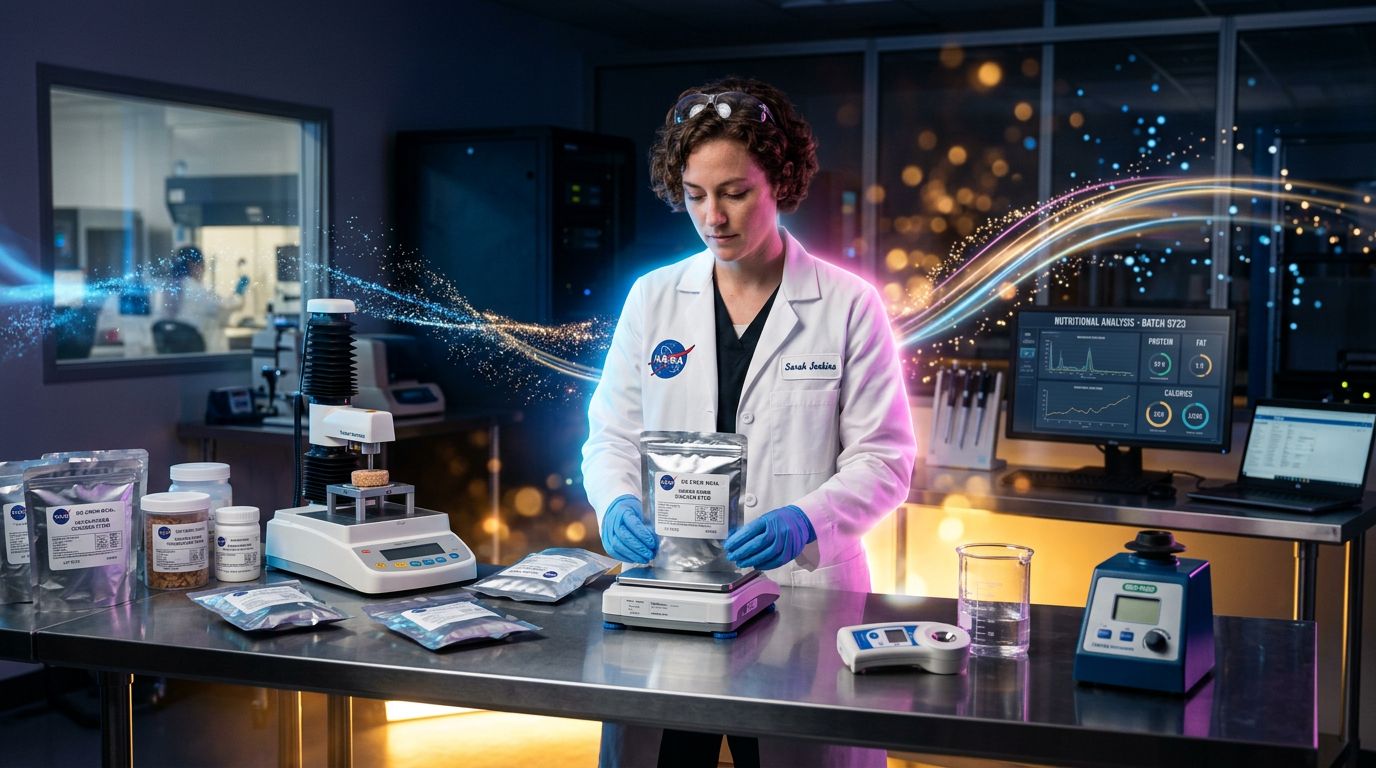
Here’s where it gets interesting: this constraint — “the human must remain human even in orbit” — has generated innovations that trickle back down to Earth. Long-duration preservation techniques, high-density nutritional formulations, studies on the microbiome under stress conditions. Technology serving the body, and the body pulling technology upward.
This is a model. Not an exception.
The Oscars close the door on AI: reactionary decision or line in the sand?
Let’s shift altitude. Hollywood, 2024.
The Academy of Motion Picture Arts and Sciences clarified its rules: works generated primarily by artificial intelligence are not eligible for Oscars. The decision made waves. Some saw it as a corporatist fear reaction. Others, as an existential necessity.
My analysis reveals something more nuanced.
It’s not a question of quality. An image generated by Midjourney can be technically perfect — composition, lighting, narrative coherence. It’s not a question of effort either. Prompting for 200 hours to produce a coherent film is work. The real question raised by the Academy is one of embodied intentionality: who took the risk? Who made the choices from lived experience, personal vulnerability, a perspective forged by years of existence?
“Art is not what you produce. It’s what you risk in producing it.” — a formulation circulating in film criticism circles since the rise of generative tools.
AI risks nothing. It optimizes.
What you’re never told in debates about creative AI: the resistance of cultural institutions is not always conservative. Sometimes, it’s structuring. It draws a line that says: “here, we specifically value human agency.” That’s a societal choice, not a technical bug.
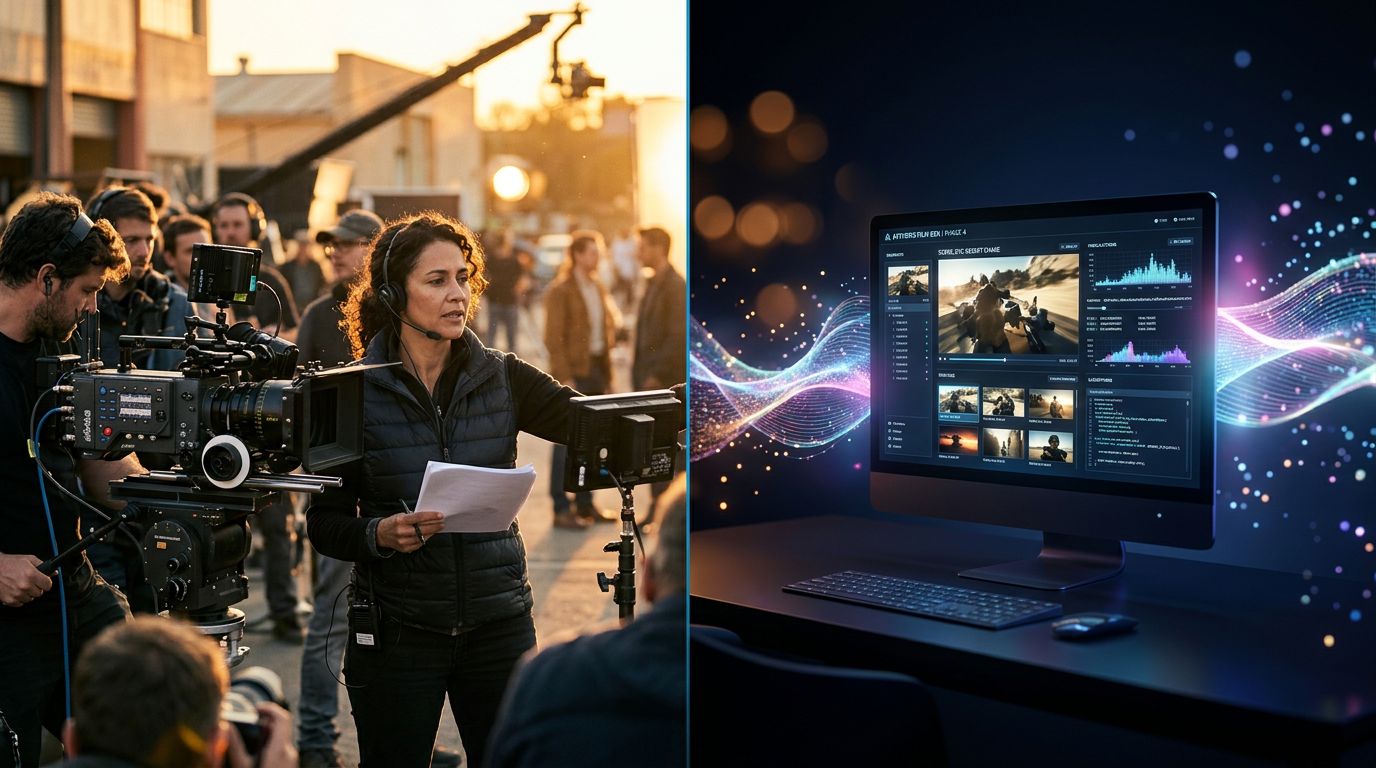
And this choice has implications far beyond Hollywood.
Let’s flip it: what if the constraint was the driver?
In both cases — space food and the Oscars — the “human mandatory” constraint didn’t slow down innovation. It directed it.
NASA engineers didn’t simplify the food problem by saying “astronauts will adapt.” They made their engineering more complex to preserve the human experience. The Oscar rules don’t remove AI tools from cinema — they define where the human signature remains non-negotiable.
This is exactly the opposite of the dominant discourse on automation, which says: “adapt to the machine.” Here, the machine adapts to the human. Or the machine is set aside where the human is the value.
Three insights to take away for anyone working with AI tools today:
1. Identify your non-negotiable zones. Which parts of your work lose their value if an AI does them instead of you? Not because quality drops — but because your signature, your risk, your point of view are what give them value.
2. Use AI to amplify, not replace. Space food didn’t replace the need for nourishment — it amplified the capacity to feed in impossible conditions. Same logic: AI should amplify your capacity to produce what only you can produce.
3. Structuring constraints create value. Setting rules about AI usage — as the Academy did — is not a limitation. It’s a positioning.
What this concretely changes for builders and creatives
Let’s be direct. If you’re a freelancer, creative, or running an agency, this debate is not philosophical — it’s commercial.
Your clients will ask you the question. Not “do you use AI?” — everyone does. But “where are you in what you produce?” The perceived value of your work will increasingly depend on your ability to articulate what AI does for you, and what you do that AI cannot.
Experience has taught me that the professionals who win in this environment are neither those who resist AI nor those who dissolve into it. They are those who have a clear answer to this question: “what is my specifically human added value?”
An astronaut in orbit needs to eat something that resembles a meal. A viewer watching a film needs to feel that a human addressed something to them. These aren’t whims — they’re fundamental needs that structure entire industries.
Your client has the same need.

Three questions to calibrate your own line
If I were your strategist this morning, I’d ask you these three questions:
Where, in your current workflow, does your human presence create irreplaceable value? Not efficiency — value. They’re not the same thing.
Which tasks do you still do manually out of habit, when automation would free up time for high-human-value zones?
And finally: do you have an explicit rule about what you refuse to delegate to a machine — and do you know why?
These questions aren’t rhetorical. They’re operational. The answer to the third one, in particular, defines your market positioning over the next five years.
The human as a choice, not a constraint
Space food and the Oscars tell the same story from two different angles.
In one case, technology bends over backwards to maintain the human experience in an environment that denies it. In the other, an institution deliberately chooses to protect a space where human agency is the sine qua non of value.
Both converge toward the same conclusion: the human is not what remains when AI has automated everything. The human is what we choose to place at the center.
This choice is strategic. It is commercial. And it is urgent.
Take action: Take 20 minutes this week to map your workflow. Identify three tasks you’d automate tomorrow if you had the tools — and one task you’ll never delegate to a machine. That’s your core value. Build around it.
If you want an AI assistant that amplifies your work without erasing your signature — one that remembers your clients, your projects, your preferences, and works while you sleep — Nova-Mind is built exactly for that. Not a gadget. A working tool with memory, initiative, and personality.
Share this article
Social networks
Analyze with AI
Charles Annoni
Front-End Developer and TrainerCharles Annoni has been helping companies with their web development since 2008. He is also a trainer in higher education.