


'Open' AI: Understanding the nuance between open source and open weight
Article Summary
📖 9 min readThis article demystifies the concept of 'open' AI by explaining the fundamental difference between open source and open weight models. It reveals the industrial strategies and data sovereignty stakes hidden behind this vocabulary, essential for making informed AI choices.
Key Points:
- Nearly half of developers think they're using open source AI without understanding its exact definition, leading to strategic confusion.
- A truly open source AI model offers full access to training code, documented data, and a permissive license, enabling audit and reproduction.
- An open weight model, by contrast, only publishes the neural network's weights, keeping the training data and pipeline opaque, often with license restrictions.
- Players like Alibaba, with Qwen 3.8, illustrate the open weight approach, which allows a model to be distributed while retaining strategic control over its construction and evolution.
- The confusion between open source and open weight is not accidental; it serves massive industrial strategies and impacts users' data sovereignty.
- Auditing and understanding a model's license is crucial before deployment, to avoid unwanted technical and legal commitments.
The word “open” often hides something
47% of developers think they’re using open source AI. Half of them are wrong. Not for lack of intelligence — for lack of a clear definition. And this confusion isn’t accidental.
The global AI landscape is being reshaped around one word: open. Open source, open weight, open access — the terms keep multiplying, and so do the press releases. But behind the vocabulary of transparency lie massive industrial strategies, data sovereignty questions, and technical choices that commit organizations for years.
Let’s decode this without sugarcoating it.
Open source vs open weight: the distinction that changes everything
Let’s start with the fundamentals. Because confusing the two is like thinking “free” and “libre” are synonyms.
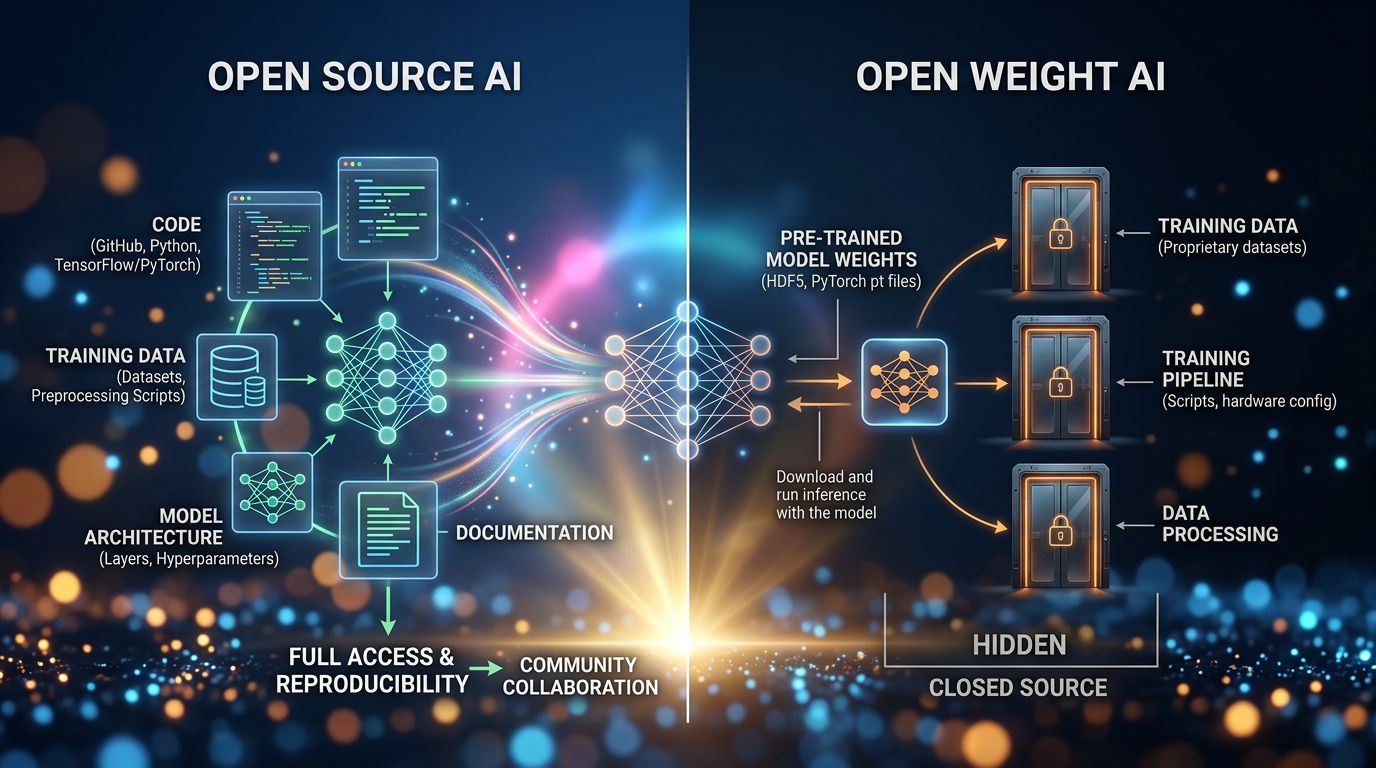
What is a truly open source model? Accessible training code. Documented training data (ideally public). Transparent architecture. Permissive license across the whole stack. You can audit, reproduce, modify, redistribute. This is the level of transparency defended by the Open Source Initiative, which published its first formal definition of open source AI in 2024.
An open weight model is different. The neural network’s weights are published — you can download the model and run it locally. But the training data remains opaque. So does the training pipeline. Sometimes the license imposes commercial or geographic restrictions. You get the engine, not the blueprints.
Alibaba’s Qwen 3.8, released recently, perfectly illustrates this category. An impressive model, competitive performance, publicly accessible weights — and yet Alibaba retains control over the data that built it, over alignment choices, over the roadmap. That’s open weight, not open source. The nuance is technical. The implications are strategic.
“Partial transparency is sometimes more dangerous than total opacity — it creates a false impression of control.”
Here’s where it gets interesting: most of the models presented as “open” by major players — Meta with Llama, Mistral with certain versions, Alibaba with Qwen — are actually open weight. That’s not a flaw in itself. But calling it “open source” without qualification is marketing.
The strategy behind “openness”
What press releases never tell you: publishing model weights is also a competitive weapon.
Let’s break down the mechanics. When Alibaba publishes Qwen, when Meta publishes Llama, they’re not doing technological philanthropy. They’re executing a precise strategy:
Creating a captive ecosystem. Developers who build on Qwen become familiar with Alibaba’s architecture. When they need compute power, they think Alibaba Cloud. The free model funds the paid infrastructure.
Eroding closed competitors’ position. OpenAI and Anthropic sell proprietary APIs. A high-performing open weight model reduces the perceived value of those APIs for standard use cases. It’s competitive judo.
Attracting talent and research. Researchers want to publish, experiment, contribute. An open ecosystem attracts top talent — who often end up joining the company that published the model.
NVIDIA plays an even more sophisticated game. Their strategic partnerships span every ecosystem — they supply compute power to OpenAI, to Anthropic, to Mistral, to Alibaba. In a market fragmented between open and closed models, NVIDIA wins every time. Their “openness” to the ecosystem is a calculated position of neutrality that maximizes their value capture.
My analysis reveals a simple truth: in AI, “open” is always relative to a strategy.
Data sovereignty: the real issue for organizations
Let’s flip the situation. For a business or freelancer that has to choose its AI stack, the open source / open weight question isn’t philosophical. It’s operational.
Three concrete scenarios:
You use a proprietary API (GPT-4, Claude, Gemini). Your data goes to OpenAI, Anthropic, Google. You have no visibility into what happens to it beyond the terms of service. For sensitive client data, that’s a real legal and reputational risk — particularly under GDPR.
You deploy an open weight model locally. Your data stays on your infrastructure. You control the execution environment. But you don’t know exactly what data the model was trained on, nor what biases it may have absorbed. Control over inference, not over training.
You use a truly open source model. Full control, complete traceability. Cost: high technical expertise required for deployment and maintenance. This is maximum sovereignty — with the corresponding price tag.
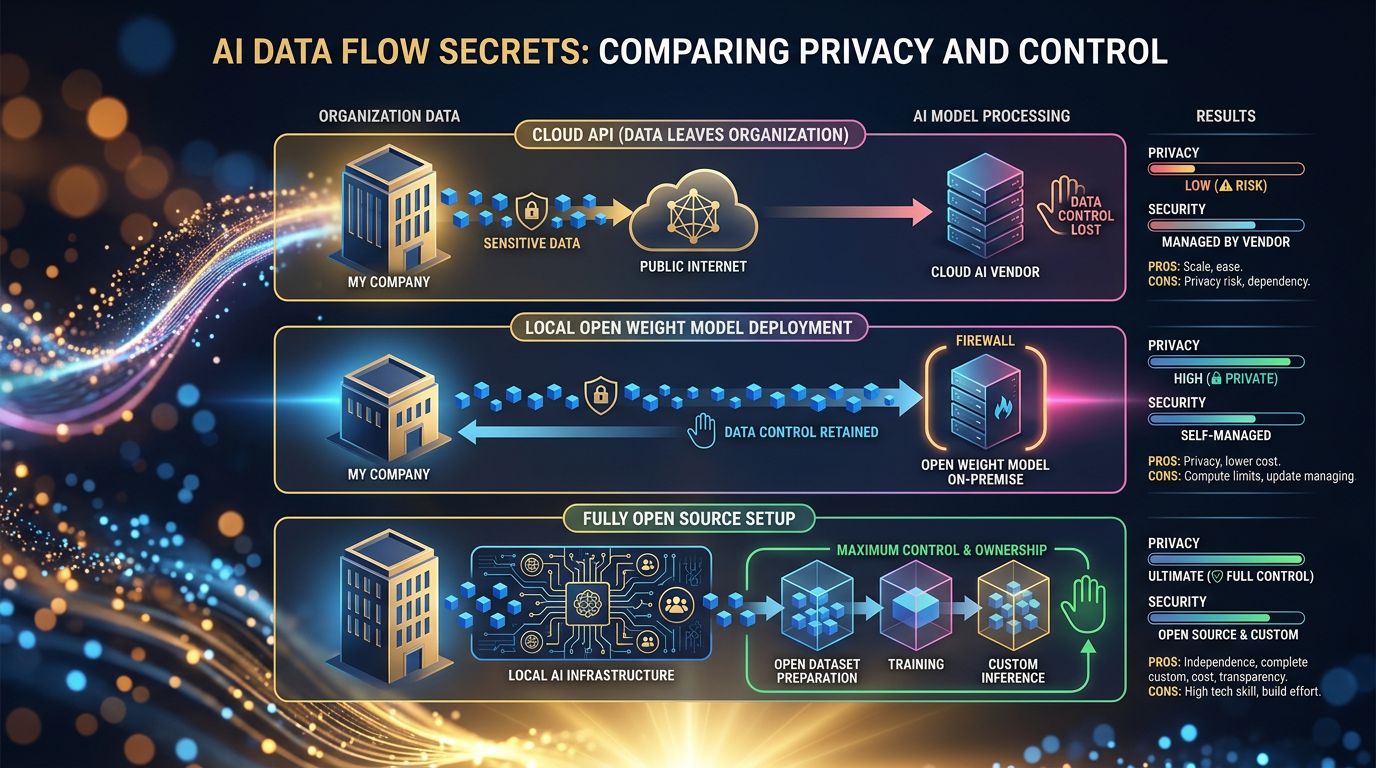
Experience has taught me that most organizations default to the proprietary API because it’s the path of least resistance — not because it’s the optimal choice for their context. That’s a problem.
“Data sovereignty isn’t a luxury for large companies. It’s a matter of responsibility toward your clients.”
The global ecosystem: complex, competitive, and highly political
Let’s look at this from another angle. The open source / open weight debate doesn’t exist in a technological vacuum. It plays out in a charged geopolitical context.
Alibaba publishes Qwen with performance that rivals the best Western models. China has an explicit national AI strategy — and Chinese companies that publish “open” models are participating in that strategy, whether we like it or not. That’s not a reason to avoid using these models, but it is a variable to factor into your analysis.
The European Union is pushing the AI Act, which imposes differentiated transparency obligations based on a system’s risk level. Open source models benefit from specific exemptions — creating regulatory incentives toward openness. Mistral, a French player, clearly leans into this angle.
The United States oscillates between supporting open innovation and national security concerns. Export restrictions on NVIDIA chips to China show that hardware is already a battleground — software will likely follow.
In this context, choosing your AI stack also means taking a position within a global ecosystem where the rules are changing fast.
What this concretely changes for your workflow
Enough macro. Here’s the ground level.
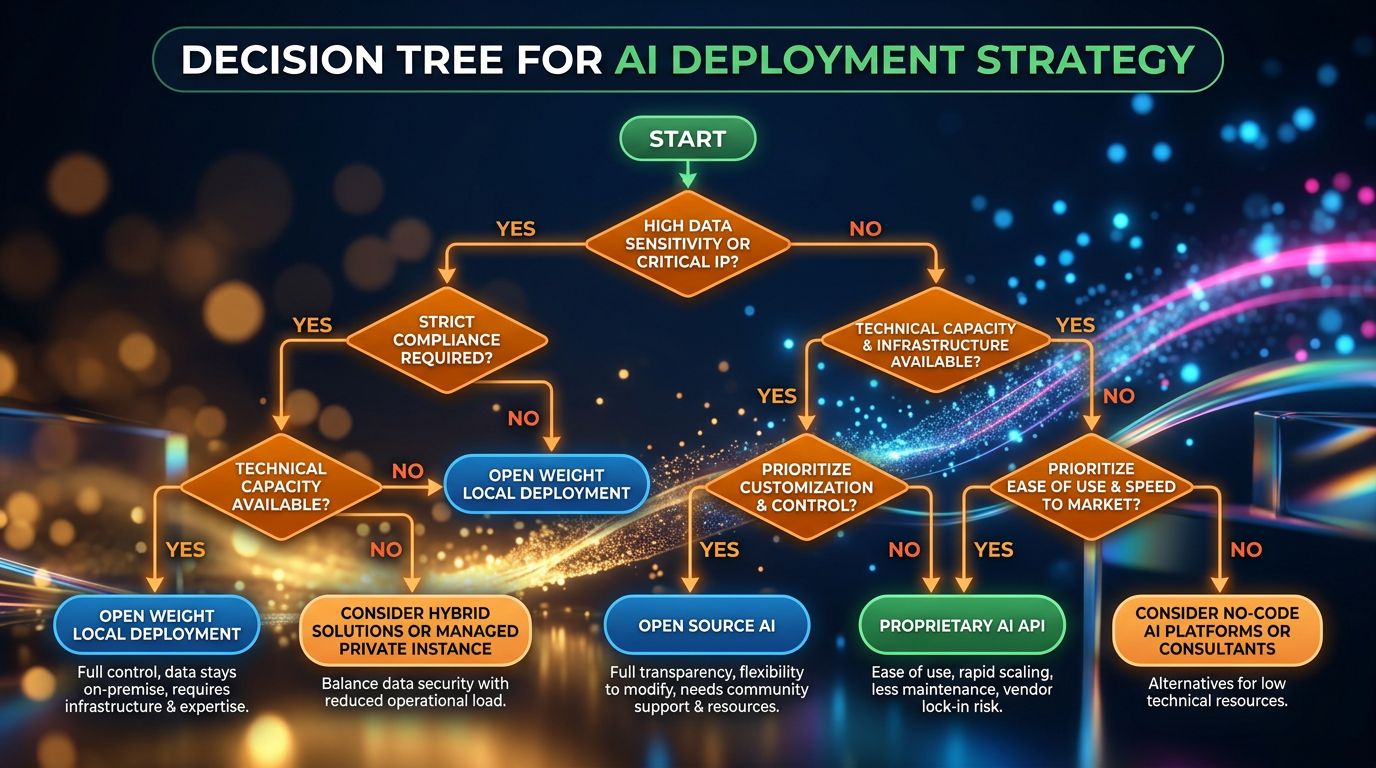
If you’re a freelancer, solopreneur, or run a small agency, here are the questions to ask yourself before choosing your AI tool:
How sensitive is my data? Client data, financial information, intellectual property — each category carries a different risk level. The most sensitive data deserves local deployment or a solution with solid contractual guarantees.
Do I need to understand the model’s behavior? For critical applications — automated decisions, content published without systematic review — model traceability matters. An auditable open source model offers stronger guarantees than an opaque open weight one.
What’s my technical capacity? Deploying and maintaining a local model requires resources. For many teams, a proprietary API with contractual GDPR guarantees remains the pragmatic solution — as long as it’s embraced as a deliberate choice, not a default.
What’s my time horizon? Proprietary models can change their terms, raise their prices, get deprecated. An open weight model you host yourself is more stable over time — you keep the version that works.
Three key takeaways
1. “Open weight” ≠ “open source”. The distinction isn’t semantic — it determines your real level of control over the model and your compliance obligations.
2. Openness is a strategy, not a philosophy. Major players who publish “open” models do so for precise business reasons. Understanding those reasons helps you assess dependency risks.
3. Data sovereignty is chosen, not inherited. Your AI stack should be a deliberate choice based on your data’s sensitivity, your technical capacity, and your regulatory context — not the path of least resistance.
The frontier is moving fast — position yourself now
What nobody tells you: in 18 months, the cards will be reshuffled. Today’s open weight models will be surpassed by new versions. Regulations will get more precise. Dominant players will consolidate their positions.
The organizations that come out on top aren’t the ones that chose the best model — they’re the ones that built a clear decision architecture around their data and their tools. Who know why they use what they use. Who can switch stacks without rebuilding everything.
That’s exactly why, at Nova-Mind, we built a multi-model approach with persistent memory and private data. Claude for writing, Gemini for certain analyses, pgvector for contextual memory — all hosted on your own Supabase, not on our servers. You keep control. We supply the intelligence.
If you want to go further, start by auditing your current stack: what data are you sending where, under what conditions, with what guarantees? That’s the first step toward real AI sovereignty — not a concept, a workflow.
Try Nova-Mind and see for yourself how an AI architecture designed for confidentiality changes your daily work. €39/month. Your data stays with you. Permanent memory. No compromise on control.
Share this article
Social networks
Analyze with AI

Charles Annoni
Front-End Developer and TrainerCharles Annoni has been helping companies with their web development since 2008. He is also a trainer in higher education.