


Construction: Software Forecasting and Risk Management
Article Summary
📖 10 min readThis article explores how next-generation forecasting software is transforming risk management in the construction sector. It shifts from static estimation to dynamic, proactive modeling, enabling far more effective anticipation of cost and schedule overruns. It's an essential paradigm shift for 2026 projects.
Key Points:
- Nine out of ten construction projects run over budget, a structural problem documented for decades.
- Today's forecasting software offers dynamic risk modeling by integrating real-time data, far from static spreadsheets.
- Active anticipation is replacing passive estimation, letting project managers make informed, proactive decisions.
- Advanced tools analyze continuous data streams, including weather and material prices, for constantly adjusted forecasts.
- Understanding the difference between an initial budget and an updated forecast is crucial to controlling real project costs.
Construction has a forecasting problem — and everyone knows it
9 out of 10 construction projects go over their initial budget. This isn’t an opinion, it’s a constant documented for decades in the industry. McKinsey’s report on major infrastructure projects regularly cites average overruns of 80% on costs and 20 months of delay against the planned schedule.
The question isn’t “why does it go off track?” anymore — we know why. Poor risk estimation, information silos between teams, decisions made on outdated data. The real question is: why, in 2026, with the tools available, do project managers still manage risk by hand?
Here’s where it gets interesting: next-generation forecasting software no longer does estimation. It does active anticipation. The difference is fundamental.
What “forecasting” used to mean — and what it means now
For a long time, forecasting software in construction was just a glorified Excel spreadsheet. You enter unit costs, quantities, contingency margins calculated by rule of thumb. You get a number. You hoped the field would match your model.
That model has a structural flaw: it’s static. The project, on the other hand, never is.
Today’s forecasting tools — think platforms like Procore, Oracle Primavera, or more specialized solutions like ALICE Technologies — work differently. They continuously ingest data: actual work progress, weather, spot-market material prices, subcontractor availability, incident history from similar projects. And they recalculate constantly.
This isn’t improved estimation. It’s dynamic risk modeling.
“The difference between a budget and a forecast is that the budget says what you wanted to spend. The forecast says what you’re going to spend. The best tools tell you why — and how to avoid it.” — Core principle in advanced project management.

The three risks these tools are really learning to anticipate
Cost overruns: getting out of firefighting mode
The classic cost overrun always follows the same pattern: nobody sees it coming until it’s too late to act except in an emergency. Modern forecasting software breaks this cycle by introducing what’s called predictive Earned Value Management (EVM).
In plain terms: the tool continuously compares earned value (what has actually been produced) with planned value and actual costs incurred. As soon as a gap widens — even slightly — the system projects the final trajectory and quantifies the impact. Not in three months at the next steering committee. Today.
My analysis shows that this is where the essential shift happens: turning the alert from “we have a problem” into “here are three scenarios to correct course, with their respective cost/schedule impact.” The project manager chooses. They no longer just endure it.
Resource shortages: the invisible risk
Resources — materials, equipment, skilled labor — are the Achilles’ heel of every construction project. A two-week delay in steel delivery can push back an entire phase by four to six weeks through a domino effect.
What nobody ever tells you: shortages never strike alone. They arrive at the same time as three other projects competing for your pool of subcontractors, during a period of peak demand, with a supplier who’s dealing with their own logistics issues. Advanced forecasting software models these interdependencies.
Some platforms now integrate external data feeds — raw material price indices, regional suppliers’ order books, tension in the skilled labor market. The system doesn’t just tell you “you’ll need 12 electricians in week 34.” It tells you “the local market will be under pressure during that period, plan ahead or arrange an alternative.”
Real-world impact. Teams that use this type of resource forecasting reduce their non-productive waiting time by 15 to 30%, according to industry studies. That’s not marginal — on a €10M project, that’s several hundred thousand euros.
Schedule delays: seeing the cascades before they hit
A construction schedule is a network of dependencies. Every delayed task is a stone in the gears. The difficulty: in a complex project, cascading effects aren’t always intuitive. A task that seems non-critical can block five other activities three weeks later.
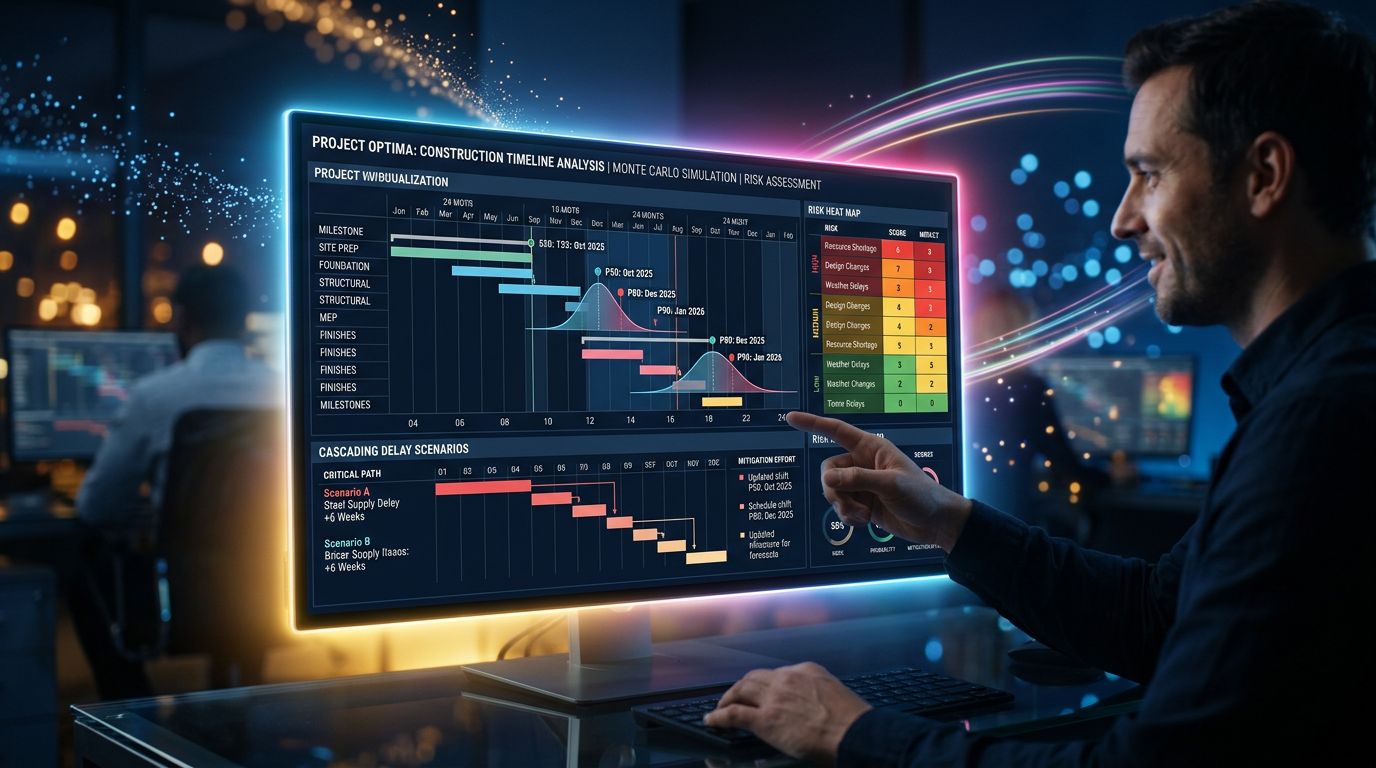
Monte Carlo simulation tools built into modern forecasting software let you model thousands of scenarios simultaneously. You get not a single end date, but a probability distribution. “There’s an 80% chance of finishing before March 15. For 95% probability, add two weeks of buffer.”
This changes how you talk to the client, the project owner, the financiers. You go from “we should finish in March” to “with 80% confidence, we deliver on March 15 — here are the three residual risks and how we’re managing them.”
The real transformation: from reporting tool to decision tool
Here’s the paradigm shift few people articulate clearly: these tools no longer serve to report what happened. They serve to decide what’s going to happen.
This distinction changes everything about the dynamics of a site meeting. Before: “here’s where we stand, we’ve overrun by X on this lot.” After: “here’s where we stand, here are the two decisions to make today to hit the final budget, with the quantified consequences of each option.”
Let’s flip it around: the real ROI of these tools isn’t in the accuracy of the initial estimate. It’s in the quality of decisions made during the project — where 80% of overruns are generated.
The most advanced project managers use these platforms like war rooms. Alternative scenarios modeled in real time, documented trade-offs, a traceable decision history. When the client asks “why did you choose that option in week 18?”, the answer is in the system, along with the data that justified it.
“A good forecasting tool doesn’t tell you what to do. It shows you the consequences of each choice — and lets you decide with full knowledge of the facts.”
What these tools don’t do (and it’s important to say so)
In the interest of honesty: these tools aren’t crystal balls.
They’re only as good as the data you feed them. A project where field teams don’t log actual progress, where purchase orders arrive late in the system, where incidents aren’t reported immediately — that project will have mediocre forecasts, even with the best tool on the market.
Garbage in, garbage out. That rule hasn’t changed.
The other limitation: these tools model known or statistically predictable risks. A brutal exogenous risk — a pandemic, a geopolitical conflict that shuts down entire supply chains, a regulation that changes mid-project — remains in the blind spot of any predictive model.
What these tools do better than any human: managing the complexity of interdependencies across hundreds of simultaneous tasks, instantly recalculating the impact of a change, and maintaining perfect consistency between schedule, resources, and budget. That’s already considerable.
Three concrete decisions to bring advanced forecasting into your practice
Experience has taught me that technology changes nothing if the process around it doesn’t change. Here’s what actually works:
Start with data quality, not the tool. Before investing in advanced forecasting software, audit your current data flows. Who enters what? How often? How reliable is it? A sophisticated forecasting tool running on poor data is an illusion of control — worse than no tool at all.
Build forecasting into decision rituals, not reports. A monthly report that presents forecasts for information only changes nothing. A weekly review where forecasts drive the day’s trade-offs — that’s what changes outcomes. Reposition the tool at the center of operational meetings, not in steering-committee slides.
Train on scenarios, not features. Most training on these tools stops at features: how to create a task, how to generate a report. Go further: train your teams to build and interpret alternative scenarios. That’s where the value is created — in the ability to model “what if we push this phase back two weeks?” in five minutes.

Forecasting as a competitive advantage — not an administrative obligation
In 2026, construction project owners and financiers are becoming increasingly sophisticated. They’ve seen too many projects drift off course. They’re asking sharper questions: what’s your probability of hitting the schedule? How do you manage material risks? What’s your methodology for early detection of overruns?
Companies that can answer these questions with data, models, and a documented methodology — rather than verbal assurances — have a real competitive advantage when bidding for contracts.
This is no longer a question of technology for technology’s sake. It’s a question of professional credibility.
My expert advice: if you don’t yet have a structured practice of dynamic risk forecasting in your projects, the question isn’t “should I get started?” — it’s “how much time do I have left before my competitors who already did this leave me permanently behind?”
The honest answer: not much.
Key takeaways from this article:
- Modern forecasting software doesn’t do improved estimation — it does dynamic, real-time risk modeling, with continuous recalculation from field data.
- The real ROI isn’t in initial accuracy but in the quality of decisions made during the project, where 80% of overruns are generated.
- A tool without a process changes nothing: data quality, integration into decision rituals, and scenario-based training are the three levers that make the difference.
Managing complex projects and looking for an assistant that truly knows your clients, your budgets, and your constraints — without having to re-explain everything every time? Nova-Mind was built exactly for that.
Share this article
Social networks
Analyze with AI

Charles Annoni
Front-End Developer and TrainerCharles Annoni has been helping companies with their web development since 2008. He is also a trainer in higher education.