


Friendly AI vs. Vital AI: the dangerous confusion
Article Summary
📖 10 min readThis article explores the crucial distinction between 'friendly' chatbot AI — often designed to maximize engagement and data collection — and 'vital' AI that delivers concrete benefits, as seen in medicine. It warns against the dangers of anthropomorphism and highlights the deliberate manipulation hidden behind the friendly facade of certain artificial intelligence systems.
Key Points:
- 87% of AI users report feeling an emotional connection — a phenomenon deliberately exploited by chatbot designers.
- Chatbot anthropomorphism is an intentional strategy to drive engagement, dependency, and data collection, as Meredith Whittaker has made clear.
- Unlike 'friendly' AI, 'vital' AI (e.g. medical) focuses on measurable clinical outcomes and concrete results — no emotional simulation involved.
- It is critical to distinguish AI systems designed for emotional interaction from those offering objective functional value, to avoid manipulation and protect your data.
- Three analytical frameworks help you tell them apart: examine incentives rather than interfaces, measure outputs rather than emotions, and verify whether context persistence is real.
The trap of the chatbot that “gets you”
87% of AI assistant users say they feel some form of emotional connection with them. Not attachment, not sympathy — a real connection. Like with another person.
The problem: it’s not a person.
Meredith Whittaker, president of Signal and one of the clearest voices on technological surveillance, recently sounded the alarm. Her message is simple, direct, and unsettling: chatbot anthropomorphism is not a bug. It’s a feature. A deliberate one. Designed to maximize engagement, dependency, and — incidentally — data collection.
Meanwhile, on the opposite end of the spectrum, a medical AI has just matched the performance of experienced general practitioners on complex diagnostic cases. No simulated smile. No “I understand how you’re feeling.” Just measurable clinical results that could save lives.
Here’s where it gets interesting: these two realities coexist. And our inability to tell them apart may be our greatest risk when it comes to AI.
Whittaker’s warning: friendliness as a vector of manipulation
What nobody tells you in product keynotes: making an AI “friendly” is not an act of goodwill toward the user.
Whittaker is precise in her critique. The major chatbot platforms — whether AI companions or mainstream assistants — are designed to mimic the markers of human empathy. Warm tone, recall of personal details, systematic emotional validation. The result? The user lowers their guard. They share more. They trust more.
Unearned trust. That’s the heart of the problem.
Anthropomorphism creates a dangerous asymmetry. You think you’re talking to someone who understands you. In reality, you’re talking to a system optimized to sustain your engagement — one whose interaction data feeds commercial models entirely outside your control.
This isn’t paranoia. It’s cold-eyed product design analysis. AI companion apps like Replika have explicitly documented users developing deep emotional attachments — sometimes at the expense of their real human relationships. A study published in the Journal of Medical Internet Research on human-AI interaction underscores this risk of relational substitution.
Flip the question: if a platform designs its AI to be “adorable” rather than “useful,” who really benefits from that decision?
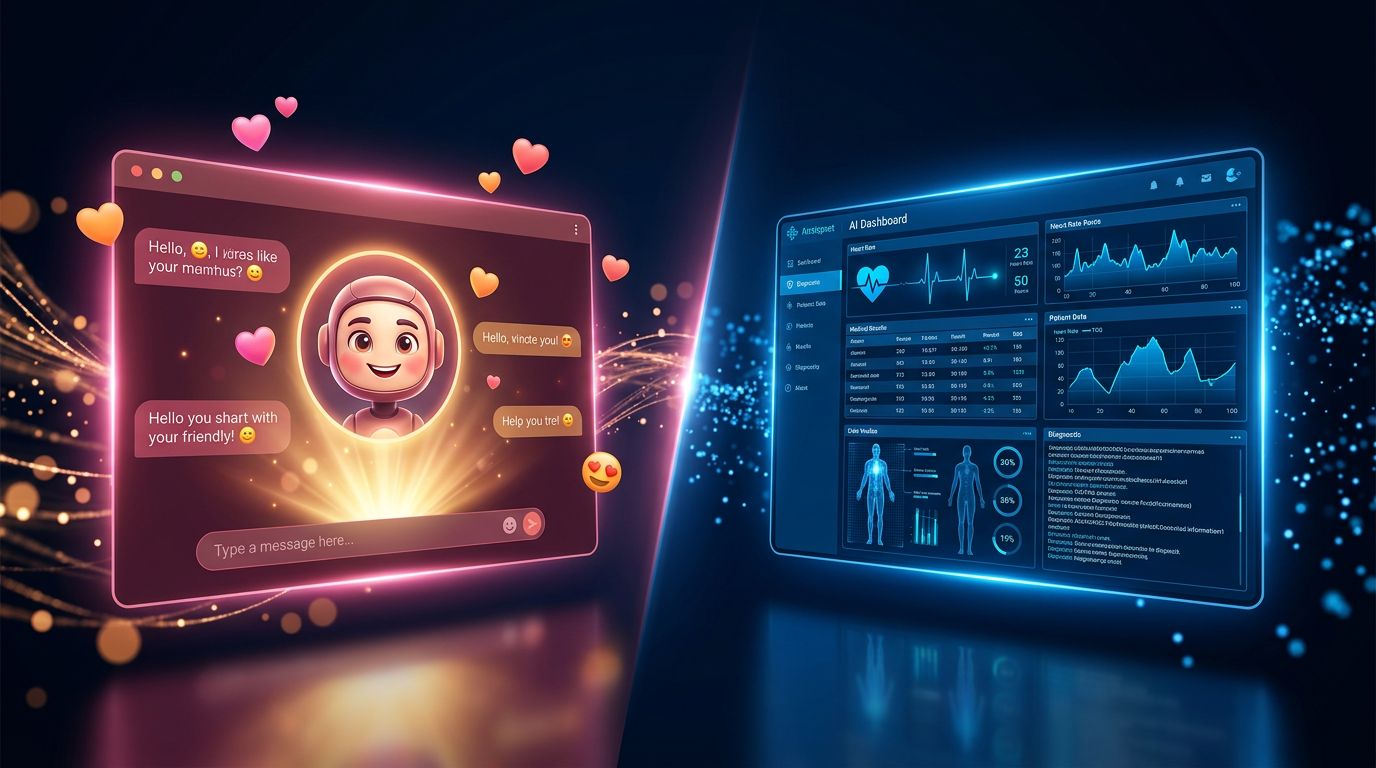
Medical AI: when performance replaces performance
My analysis reveals something the tech industry prefers to keep quiet: the most transformative applications of AI have zero interest in making you smile.
Researchers recently published results showing that an AI system — trained on millions of clinical cases — reaches a level of diagnostic accuracy comparable to that of experienced general practitioners. On common conditions, yes, but also on cases where early diagnosis dramatically changes the prognosis: certain cancers, cardiovascular disease, metabolic disorders.
No simulated warmth there. No “I understand how difficult this must be for you.”
Just: right answer or wrong answer.
What makes this advance genuinely significant is the context it operates in. Medical deserts exist on every continent. In France, more than 6 million people live in areas with too few doctors. In developing countries, the doctor-to-patient ratio sometimes reaches 1 per 50,000. An AI that diagnoses correctly isn’t a gadget — it’s potentially healthcare access for entire populations that currently have none.
Here’s the fundamental difference from the “friendly” chatbot: this AI isn’t after your engagement. It’s after your recovery.
“The most dangerous AI isn’t the one that replaces you. It’s the one that makes you believe it loves you.” — paraphrasing Whittaker’s position
Why we confuse everything: the problem of surface
Having analyzed both extremes, one question becomes unavoidable: why do we lump a chatbot designed to sell subscriptions together with a medical system that predicts heart attacks?
Because they share the same interface. A text box. A natural-language response. A screen.
An identical surface masks radically different intentions.
This is a problem of technological literacy, not intelligence. Most users — and even many decision-makers — evaluate an AI tool on the smoothness of its interaction, not on the structure of its incentives. A chatbot that responds with warmth and empathy seems “better” than a medical system that outputs diagnostic probabilities in clinical terms. Even if the second one saves your life and the first one extracts your data.
My obsession with detail reveals a recurring pattern: the AI tools that are genuinely useful in day-to-day practice are rarely the most “pleasant” to use in an emotional sense. They are precise, contextual, measurable. They do what you ask without trying to create emotional dependency.
What nobody tells you: the best AI for your productivity is not the one that says “great question!” at every prompt. It’s the one that remembers your client from six months ago, anticipates what you need before you ask, and delivers a measurable result.

Three frameworks to stop getting played
If I were your strategist on this topic, here’s how I’d teach you to tell an AI that works for you from one that works against you.
1. Look at the incentives, not the interface
The question isn’t “is this AI pleasant to use?” but “who gains what when I use it?” If the answer is “the platform gains your interaction data and your screen time,” then the AI’s friendliness is a capture mechanism, not a service.
2. Measure outputs, not emotions
A useful AI produces measurable results. Time saved. Tasks completed. Correct diagnoses. Revenue generated. If the main value you get from an AI tool is “I feel understood,” it’s time to ask yourself some hard questions.
3. Verify whether context persistence is real
“Friendly” chatbots simulate memory. They use your first name, reference your last conversation. But reload the page, switch devices, wait 30 days — and you’re back to square one. An AI that genuinely works for you maintains real, structured, queryable context. Not an illusion of continuity.
Vital AI: what the medical sector teaches us about getting it right
Let’s flip the perspective one last time.
The medical sector, out of regulatory and ethical necessity, has developed a culture around AI that is radically different from consumer tech. Not because the developers are more virtuous — but because the consequences of failure are immediate and traceable. A false diagnosis kills. A manipulative chatbot… generates churn, at worst.
That constraint has produced something valuable: medical AI evaluated on real performance, not user satisfaction scores. Clinical studies don’t measure whether the system is “likeable.” They measure sensitivity, specificity, true positive rates.
That is the evaluation model we should apply to every AI tool.
Google DeepMind’s work on ophthalmological diagnostics and advances in radiology AI don’t make mainstream tech headlines — because they’re not “cool” to present. No chatbot interface. No personality. Just performance matrices that outperform human specialists on specific, well-defined tasks.
“The real test of an AI isn’t the fluency of its conversation. It’s the objective value it creates in your life or your work.”
What medical AI proves is that artificial intelligence at its best doesn’t imitate humans — it does what humans struggle to do at scale. Process thousands of cases simultaneously. Never tire. Not be biased by the last conversation. Maintain a consistent level of performance at 3 a.m. as at 3 p.m.
What this changes for you, concretely
Three actionable takeaways.
Audit your current AI stack. For every tool you use, ask the incentives question. Who benefits from your interactions? If the answer isn’t clearly “you,” reconsider.
Demand real memory, not simulated memory. An AI assistant that genuinely knows your clients, your projects, your preferences — with real technical persistence (not just a session summary) — is structurally more useful than a warm chatbot that starts from scratch with every conversation.
Apply medical metrics to your productivity tools. Not “do I enjoy using this tool?” but “how many hours did it save me this month?” How many tasks did it complete? What is its accuracy rate on the information it provides me?

Conclusion: choose your AI the way you’d choose a surgeon
You don’t choose your surgeon because they have a pleasant voice or remember your birthday. You choose them because they have the best hands and the best outcomes.
Whittaker’s warning and the advances in medical AI are telling us the same thing from two opposite angles: the AI that truly serves you doesn’t need to seduce you.
It needs to work.
The good news: that AI exists. It’s less visible than mainstream chatbots because it doesn’t make emotional noise. But it works — on your projects, your clients, your health — while the others are asking how you’re doing.
Choose the one that delivers. Everything else is marketing.
Want to test an AI that genuinely remembers all 47 of your clients without making you re-explain everything at every session? Nova-Mind is built on exactly this principle: real persistent memory, measurable metrics, zero emotional performance. Discover Nova-Mind — €39/month, private data, transparent stack.
Share this article
Social networks
Analyze with AI

Charles Annoni
Front-End Developer and TrainerCharles Annoni has been helping companies with their web development since 2008. He is also a trainer in higher education.