


Sales meets project management: the rigor that changes everything
Article Summary
📖 8 min readThis article explores how applying project management principles can transform sales team performance. By treating every opportunity as a project, reps gain predictability, accountability, and repeatability — and results improve significantly.
Key Points:
- 47% of sales reps miss their quarterly targets, often because their sales cycle lacks structure, not because they lack effort.
- Top-performing teams don't just sell better — they manage their opportunities better, treating each one as a distinct project.
- Applying project management gives sales teams sharper revenue predictability through clear milestones for every opportunity.
- Clarifying roles and ownership for each deal ensures nothing slips through the cracks, strengthening accountability.
- Documenting sales processes lets teams replicate what works and keep improving performance over time.
- Teams that structure and document their sales process close 23% more deals on average than teams that improvise.
Sales is organized chaos you could finally get under control
47% of sales reps miss their quarterly targets. Not because they don’t work hard enough. Because they work without structure.
Here’s where it gets interesting: the teams that outperform aren’t selling better — they’re managing better. They’ve figured out that every sales cycle is, in practice, a project. With a start, an end, resources, risks, and measurable deliverables.
Flip the frame. What if your pipeline wasn’t a list of contacts to chase, but a portfolio of projects to run?
What project management actually brings to sales teams
Project management isn’t just for developers or product managers. It’s a way of thinking. And sales teams that adopt it win on three specific fronts.
Predictability. When every opportunity is treated as a project with defined milestones, revenue forecasting becomes reliable. No more “gut feel” on the quarter’s close — actual data instead.
Accountability. A project has an owner. So does a deal. When roles are clear, follow-ups stop falling through the cracks.
Repeatability. What works once can work a hundred times — as long as it’s documented. That’s exactly what a structured approach delivers.
The pattern is consistent: teams that document their sales process close 23% more deals than teams that improvise. Structure isn’t the enemy of sales spontaneity. It’s the foundation for it.

Excel and Word templates: the underrated starting point
Let’s get practical. Before investing in a five-figure CRM or an AI platform, most sales teams need one thing: clarity on what they’re already doing.
That’s where Excel and Word earn their keep again — not as final tools, but as a structural testing ground.
The sales tracking Excel template
A well-built spreadsheet can hold everything needed to run a pipeline: deal status, estimated value, close probability, date of last interaction, next planned action. Each row is a mini project.
Here’s what nobody tells you: the value isn’t in the file, it’s in the discipline of updating it. A template abandoned after two weeks is worthless. An imperfect template filled in every day becomes a source of truth.
The Word template for proposals
Structuring a proposal like a project deliverable changes everything. Context, needs analysis, proposed solution, rollout plan, pricing, next steps. That document logic forces the rep to think before writing — and the client to understand before signing.
“Sales isn’t a mysterious art. It’s a process. And every process can be improved.” — W. Edwards Deming
A Word structure imposes a narrative rigor that rushed emails never have. And when a proposal gets rejected, a post-mortem becomes possible because the reasoning was explicit.
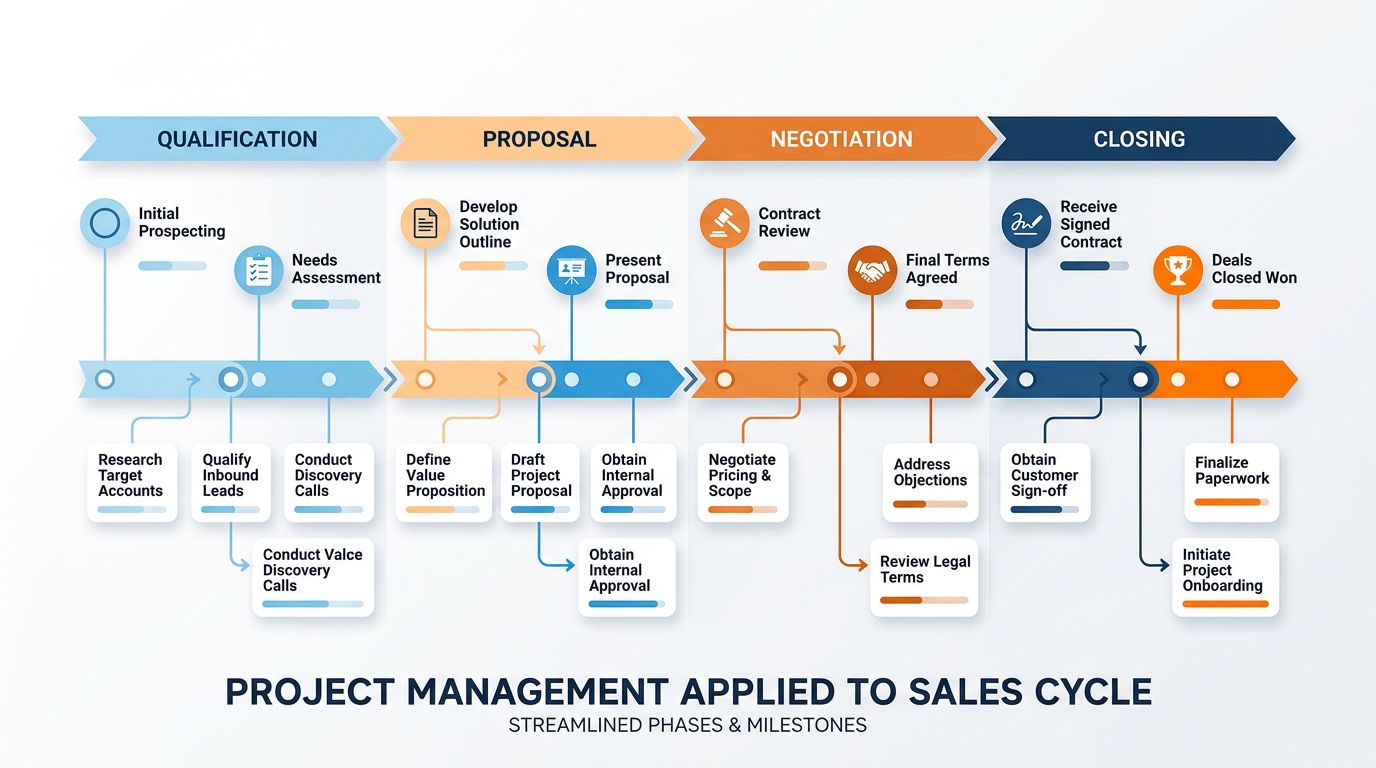
Mapping the sales cycle onto project phases
Here’s the mapping that changes how you work.
Phase 1 — Qualification (= project scoping). Define the scope. Who’s the decision-maker? What’s the budget? What’s the real timeline? Like a project brief, this phase decides whether you move forward at all. No scoping, no project. No qualification, no deal.
Phase 2 — Proposal (= design). You deliver a document. With assumptions, constraints, a solution. Good reps treat this step with the same rigor a project manager brings to a technical spec.
Phase 3 — Negotiation (= risk management). Every objection is an identified risk. Project management teaches you to anticipate, mitigate, document. Applied to sales, it turns negotiation into a structured conversation instead of an emotional standoff.
Phase 4 — Closing and onboarding (= delivery). A signed deal isn’t the finish line — it’s the delivery of a promise. Teams that treat onboarding as a project phase reduce churn and increase customer lifetime value.
Performance measurement: think in KPIs like a project manager
What nobody tells you about sales dashboards: most measure outcomes, not process. Revenue, deals closed, overall conversion rate. Lagging indicators — useful for confirming what happened, useless for fixing it.
Project management thinks differently. It measures leading indicators: qualifications completed this week, average time between phases, percentage of proposals sent within 48 hours of the first call.
Those metrics let you step in before the quarter is already lost.
My advice: build two separate dashboards. One for leadership — results and trends. One for the team — activity and process. The first one informs. The second one improves.
“What gets measured gets improved.” — Peter Drucker
Applied to sales: measure behavior, not just numbers. The results will follow.
Three actions you can take starting this week
No grand overhaul. No rebuilding your entire sales org. Three concrete moves, this week.
-
Audit your pipeline like a project manager. For every active deal, define: what phase is it in? What’s the next deliverable? Who owns it? If you can’t answer in 30 seconds, the deal isn’t managed — it’s drifting.
-
Build a five-section proposal template. Client context, identified problem, proposed solution, action plan, investment. This document becomes your reference deliverable. Adapt it — don’t reinvent it every time.
-
Introduce a weekly pipeline review ritual. 30 minutes, every Monday. Every active deal gets reviewed: progress, blockers, next action. It’s the most profitable meeting your team will hold.
What if AI handled the tedious part?
Here’s where 2026 reality kicks in.
Applying project management principles to sales is powerful. But it takes discipline, documentation, follow-through. And on a sales team under pressure, that’s exactly what gets dropped first.
That’s why platforms like Nova-Mind exist. The AI assistant remembers every client, every deal, every interaction — without the rep having to re-explain context each time. The built-in CRM with semantic search lets you pull up information in plain language. Recurring tasks, follow-ups, tracking: handled automatically.

Cerebro’s proactive coaching detects when a deal has been stalling too long without action — and steps in with a contextual suggestion. Not a generic notification. An analysis based on the actual pattern of that deal, that client, that team.
15 hours saved per week on data entry, manual follow-ups, and re-explaining context. €39/month. Simple math.
Tools like Notion or Trello can also work as a starting point for running a pipeline project-style — but they lack the persistent memory and proactive initiative that make the real difference over time.
Structured selling isn’t a constraint — it’s a competitive edge
Experience has taught me one thing: teams that resist structure do it out of fear of losing their agility. The opposite happens.
When the process is clear, the rep can focus on what actually matters: the relationship, understanding the need, creativity in the solution. Structure frees you up. It doesn’t box you in.
Treating every sales opportunity as a project gives it the best possible chance of succeeding. It means documenting what works so you can repeat it. Measuring what can be improved. Turning an activity often seen as intuitive into a repeatable discipline.
The impact. Teams that adopt this approach don’t sell harder. They sell smarter.
Want to see what it looks like when an AI assistant truly knows your clients and runs your deals like a project manager? Try Nova-Mind — and stop re-explaining context to every tool you open.
Share this article
Social networks
Analyze with AI

Charles Annoni
Front-End Developer and TrainerCharles Annoni has been helping companies with their web development since 2008. He is also a trainer in higher education.