


AI agents and real-time web data: what Microsoft Web IQ really changes for your marketing
Article Summary
📖 9 min readMicrosoft Web IQ opens the Bing index (100 billion pages) to AI agents via structured Grounding APIs, enabling marketing teams to move from an AI that hallucinates on outdated data to agents grounded in their market's current reality.
Key Points:
- Microsoft Web IQ relies on an index of 100 billion Bing pages opened to AI agents via structured grounding APIs.
- The Grounding APIs deliver three capabilities: real-time web search, verifiable citations with URLs, and thematic filtering by industry.
- Digital marketing concentrates an exceptional density of concrete and measurable AI use cases among the top 100 identified for 2026.
- Automated competitive intelligence can continuously monitor competitors' offers, customer reviews, and communication tone changes.
- The combination of persistent client memory and real-time web grounding is identified as the key differentiator for useful AI agents in 2026.
The real-time web: new fuel for AI agents
100 billion indexed pages. That is the scale of the Bing engine Microsoft has just opened to AI agents via its new Web IQ Grounding APIs. Not a cosmetic update — a complete infrastructure so your agents stop reasoning in a vacuum.
Ask yourself honestly: how many of your AI workflows are still running on frozen data, knowledge snapshots that are months old? Most of them. And that is precisely where the gap is widening between the teams that will gain ground in 2026 and those that will struggle.
Here is where it gets interesting: Microsoft is not just offering access to Bing. Web IQ is a structured grounding system — meaning the ability for an AI agent to verify, anchor and contextualise its responses in current, verifiable web sources with citations. For digital marketing, the implications are massive.
What “grounding” really means in practice
The term is technical, but the reality is simple. An AI agent without grounding hallucinates. It fills gaps with simulated confidence. An agent with real-time web grounding anchors its responses in recent facts, current prices, and this week’s trends.
Concretely, Microsoft’s Web IQ Grounding APIs enable three distinct things:
- Real-time web search integrated directly into the agent’s reasoning
- Verifiable citations with sources and URLs for each factually risky claim
- Thematic filtering to restrict sources to relevant domains for your industry
What product announcements never tell you: grounding is also about accountability. When your marketing agent generates a competitive analysis, you want to be able to trace where the data came from. Web IQ makes that possible at scale.

The top 100 AI use cases in 2026: marketing arrives in force
Analysis of the leading AI use cases in 2026 confirms a clear trend: digital marketing concentrates an exceptional density of concrete, measurable applications. Not promises — active deployments.
Among the most structurally important cases for marketing teams and agencies:
Automated competitive intelligence leads the way. Not the “I receive a weekly digest” kind of monitoring — intelligence that detects in real time that a competitor has just launched a promotional offer, that customer reviews on a competing product have dropped by 0.8 points, that the tone of their communications changed this month.
Contextualised content generation is evolving radically. The challenge is no longer about generating content — it is about generating content anchored in your market’s current reality. An article that cites last week’s data. A newsletter that reacts to an emerging trend. That is exactly what real-time web grounding makes possible.
Sentiment analysis at scale is becoming operational for smaller teams. Monitoring what is being said about your brand, your competitors, your industry — continuously, without a dedicated team.
My analysis reveals something important in this list: the use cases that create the most value are not those where AI replaces a human. They are those where AI processes a volume of data no human could absorb, and distils what matters into an actionable form.
Why your AI agents need the web to be useful
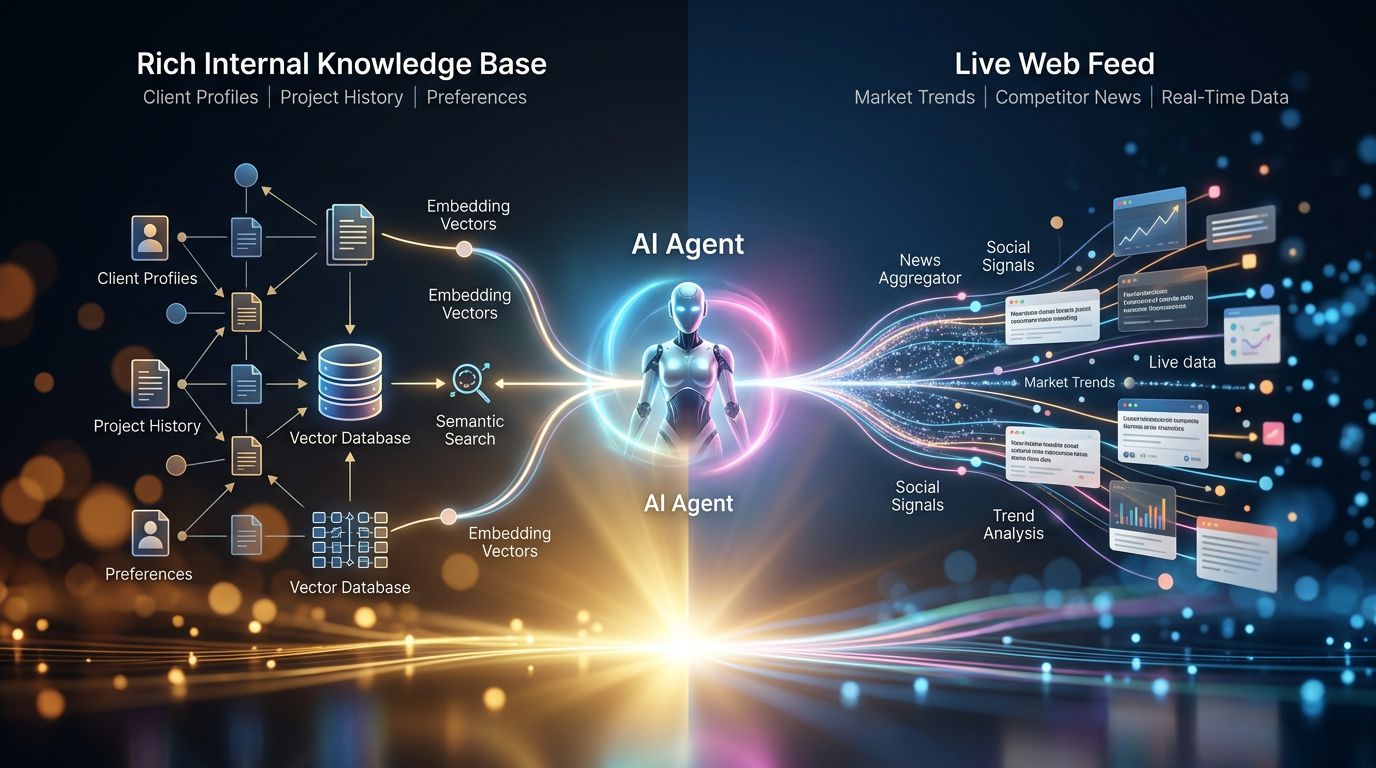
Let us flip this around. There is a lot of talk about “long-term memory” for AI agents — and it is real, it is fundamental. But long-term memory without fresh data is like an expert who knows your history perfectly… but has no idea what is happening outside.
“The best AI systems of 2026 will not be those with the largest internal memory — they will be those that combine persistent memory with real-time access to the world.” — AI Trends Synthesis, Q1 2025
That is the complete equation. On one side, knowledge of your context: your clients, your projects, your preferences, your history. On the other, knowledge of the world: what is happening right now in your market.
An agent that only has the first half helps you do better what you were already doing. An agent that has both helps you adapt before you even realise something has changed.
What this changes for freelancers and agencies using AI daily
Let us be direct about the on-the-ground implications. If you manage clients in digital marketing — whether you are a freelancer, solopreneur or small agency — here is what this shift concretely makes possible.
Automatically enriched client reports
No more monthly reports where you spend three hours manually compiling data from disparate sources. An agent with web access can continuously aggregate ranking data, brand mentions, SERP evolution on target keywords. You validate, you contextualise, you deliver.
Content briefs anchored in current events
Your agent not only generates the brief, it anchors it in what is being published this week on the topic. What questions are emerging in forums? What angle has not been covered yet? What recent news deserves a reference? The resulting content is structurally more relevant — and it shows in engagement metrics.
Delegated competitive monitoring
Monitoring 5, 10, 20 competitors continuously — their new pages, pricing changes, announcements — used to require a team effort. With a properly configured agent and real-time web access, it becomes a background task that runs while you sleep.
Experience has taught me one thing about this type of automation: the real gain is not in the time saved on the task itself. It is in the reactivity it generates. You know before your competitors. You adjust before the trend becomes obvious.
Three questions to ask before deploying
But watch out for the trap. Real-time web access for your agents is powerful — and it can also generate noise if poorly configured. Before deploying, three questions are essential.
Which sources carry authority in your industry? An agent that scrapes the web without filtering will mix primary sources with low-quality content. The thematic filtering that Web IQ offers is designed for exactly this — but it needs to be configured with intention.
What is your latency tolerance? Real-time grounding adds processing time. For a weekly analysis, no problem. For a real-time client interaction, it needs to be evaluated against your specific case.
How do you integrate this into your existing stack? APIs are good. Integration into a coherent workflow is better. The real value comes when web grounding connects with your client memory, your project management, your publication pipeline — not when it is just one more isolated tool.

Three actionable insights to move forward
What articles on new AI APIs never tell you: technology is not the bottleneck. Your capacity to define what you want to monitor, generate and automate is.
First insight. Start with a use case that has measurable ROI. Competitive intelligence on 3 direct competitors, with an automated weekly report. Measure the time saved. Then expand.
Second insight. Web grounding is more powerful combined with persistent client memory. If your agent knows your client targets SMEs in the industrial sector in the Île-de-France region, its web monitoring will be structurally more relevant than generic monitoring. Internal context + external data = real differential.
Third insight. Document your prompts and configurations the way you would document code. What works today must be reproducible tomorrow, and transferable to a collaborator or client.
“AI does not replace strategy. It accelerates the execution of those who have a clear strategy.” — A foundational principle, worth pinning above your desk.
The next step: agents that truly work for you
Look at it from another angle. Microsoft Web IQ and the wave of AI use cases in 2026 are not topics to watch from a distance. They are infrastructures deploying right now, creating a measurable gap between those who integrate them and those who wait.
For freelancers and agencies managing dozens of clients and projects simultaneously, the question is no longer “can AI help me?” — it is “does my AI stack have access to the right data at the right time?”
Persistent memory on your clients and projects. Real-time web grounding on your market. Automated publication pipeline. These three elements combined produce an agent that does not sleep, does not lose context, and surfaces actionable insights before your first coffee.
If you want to see what that looks like in practice — an assistant that knows your 47 clients, monitors your market in real time, and publishes content while you sleep — Nova-Mind is built exactly for that. €39/month. Not a gadget — a daily work tool with memory, initiative and access to the world.
The web is open. The question is: are your agents taking advantage of it?
Share this article
Social networks
Analyze with AI

Charles Annoni
Front-End Developer and TrainerCharles Annoni has been helping companies with their web development since 2008. He is also a trainer in higher education.