

Anthropic, OpenAI, SpaceX: why the next great tech cycle concerns freelancers too
Article Summary
📖 9 min readThe mega-valuations of Anthropic, OpenAI and SpaceX signal a tech cycle comparable to the Internet — but three times faster. For freelancers, the window of competitive advantage is open right now, not in ten years.
Key Points:
- Anthropic is valued at $61B, OpenAI at over $150B and SpaceX at $350B — signals of anticipation, not speculation.
- AI democratizes competence the way the Internet democratized information: a solo freelancer can now operate with the processing power of a team of ten.
- There are three levels of AI integration; only level 3 (augmented stack with persistent memory) generates a lasting competitive advantage.
- Starlink is expanding the geographic market of potential clients, opening niches that large agencies are still ignoring.
- The early adopter advantage window closes in roughly 18 months: level-3 practices will become the standard clients expect.
The calm before the storm
-
The internet barely existed in the collective consciousness. The freelance developers who spotted it early built empires. The others caught the train — or missed it entirely.
-
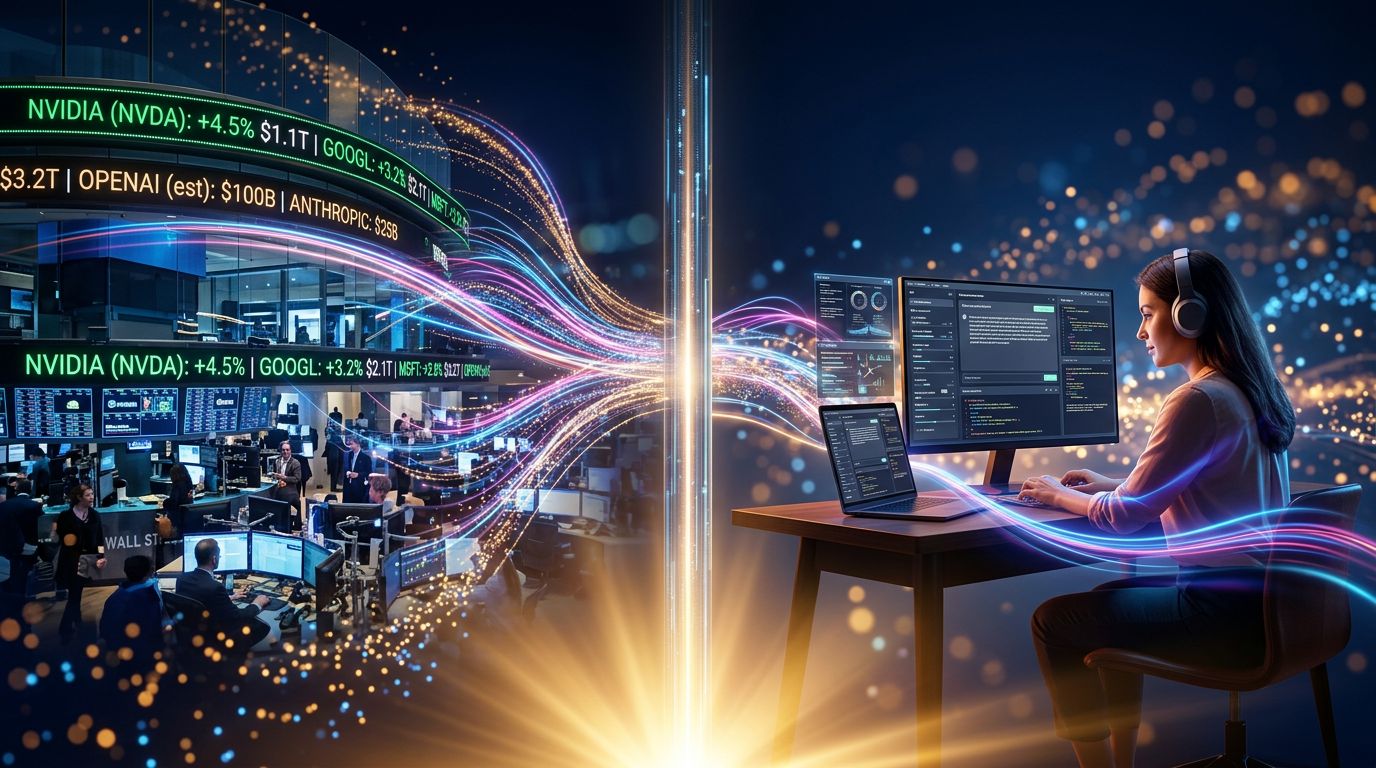
Wall Street is preparing to live through something equivalent. Anthropic valued at $61 billion. OpenAI at over $150 billion. SpaceX exceeding $350 billion. These figures are not market anomalies — they are signals.
The question no one is asking freelancers and solopreneurs: what does this actually change for you?
Spoiler: a lot more than you think.
What Wall Street sees that others don’t yet
Financial markets have one flaw and one quality. The flaw: they get carried away. The quality: they anticipate. When institutional funds start positioning massively on companies like Anthropic or OpenAI even before their IPO, that isn’t blind speculation — it’s trend-reading.
Here’s what classic tech articles never tell you: great technological cycles don’t just create giants. They entirely restructure the economy of the small.
The internet didn’t only create Google and Amazon. It created millions of freelancers capable of working for clients on the other side of the world from an apartment. Generative AI follows the same logic — but at a radically faster adoption speed.
“AI will create more wealth than the Industrial Revolution, but in ten times less time.” — A common estimate among Goldman Sachs and McKinsey economists, repeated in their 2024 reports.
The fundamental difference from the internet? The internet democratized access to information. AI democratizes access to competence. A solo freelancer can now operate with the processing power of a team of ten.
The real issue for solopreneurs: value concentration
Let’s flip the situation. When Anthropic raises billions, when OpenAI is about to go public, when SpaceX integrates AI into its Starlink satellite systems — who captures the value created?
Classic answer: investors, founders, equity-holding engineers.
Less classic but more useful answer: those who master the tools first.
This is the historical pattern. Printers who adopted Gutenberg before others dominated. Agencies that understood SEO in 2003 rather than 2008 built lasting competitive advantages. Developers who learned React in 2015 charged double for three years.
My obsession with detail reveals something interesting in current data: the productivity gap between freelancers who use AI in an advanced way and those who use it superficially is already widening. Not marginally — massively.
This isn’t a question of who uses ChatGPT. Everyone uses ChatGPT. It’s a question of depth of integration.
Depth of integration: the metric that will change everything
Here’s where it gets interesting.
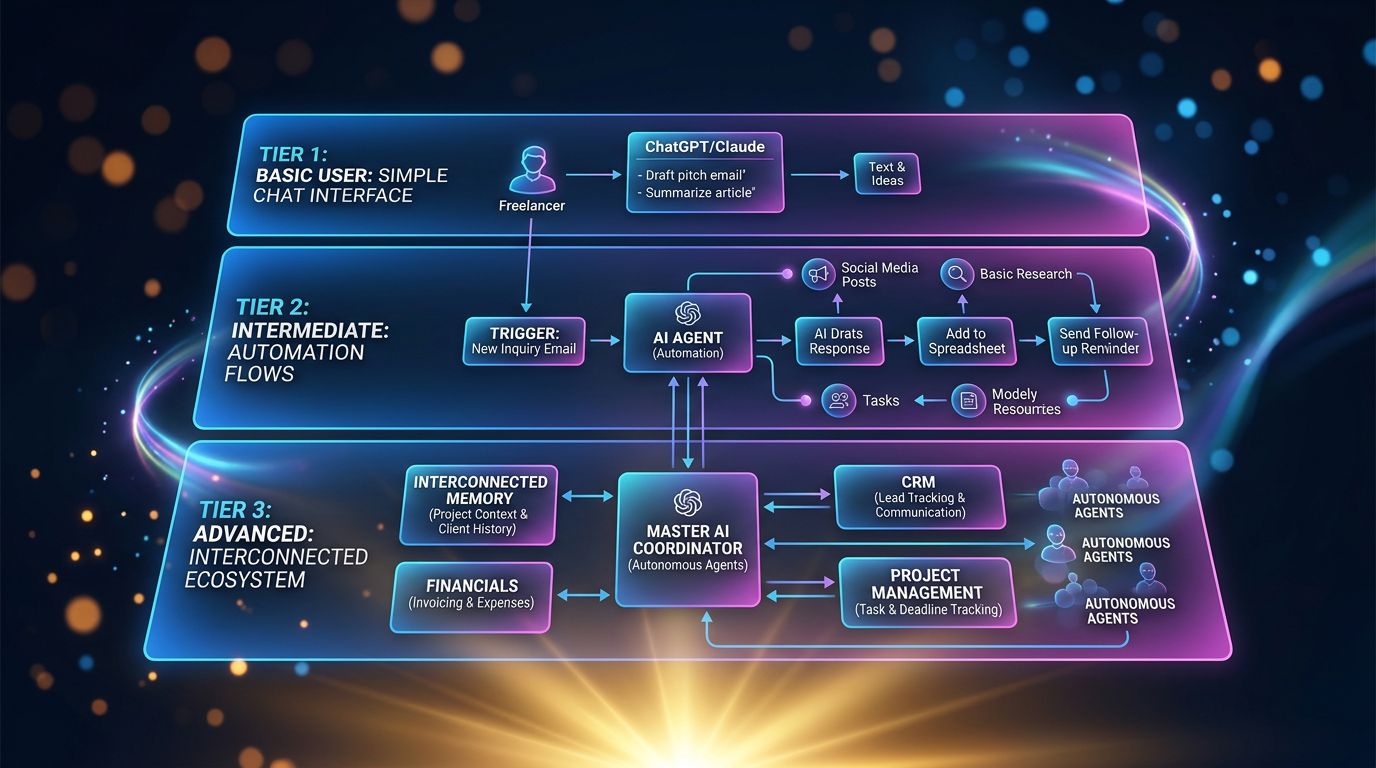
There are three levels of AI use for a freelancer or agency:
Level 1 — Occasional user. ChatGPT for writing emails, Midjourney for one-off visuals. Real time savings but limited. No lasting competitive advantage.
Level 2 — Basic integrator. Simple automations, refined prompts, a few workflows. Measurable gain — roughly 3 to 5 hours per week according to studies on AI adoption in professional settings.
Level 3 — Augmented stack. Persistent memory on clients and projects, automated content pipelines, intelligent CRM, proactive coaching based on work patterns. Documented gain: 10 to 15 hours per week.
The difference between level 2 and level 3? It’s the difference between having an assistant who forgets everything the next day and having a partner who knows your 47 clients, their histories, their preferences, and works for you while you sleep.
Wall Street values Anthropic at $61 billion because the underlying model — Claude — is the infrastructure on which hundreds of level-3 tools will be built. You’re not buying Anthropic stock. But you can use the tools that their infrastructure makes possible.
SpaceX in the equation: the invisible infrastructure
SpaceX gets less attention in the AI context, and that’s a mistake.
Starlink is currently deploying high-speed connectivity in areas that previously lacked it. The direct result: the potential client market for digital freelancers is expanding geographically in a significant way. Companies in previously under-connected regions are becoming reachable — and they need digital services.
The strategic angle: while large agencies look at their traditional markets, entire geographic niches are opening up. A well-positioned freelancer with the right tools can capture these markets before the competition even realizes they exist.
What no one tells you: great technological disruptions always create intermediate markets that giants ignore because they’re too small for them — and perfect for independents.
The three actionable insights to remember
First insight: the advantage window is closing.
Not in ten years. In eighteen months. Advanced AI adoption by freelancers follows a classic S-curve. We are currently in the early adoption phase. In two years, level-3 practices will be the standard clients expect. Those who master them now are building an advantage that will be very hard to catch up with.
Second insight: your AI stack must have memory.
An AI assistant that forgets everything after each conversation is not a competitive advantage — it’s a tool. Real value comes from context persistence: a system that remembers your clients, your projects, your preferences, and builds on every interaction. That’s the difference between a tool and a partner.
Third insight: automate what repeats, humanize what matters.
The freelancers who win in this cycle aren’t those who automate the most — they’re those who automate intelligently. Automated content pipeline, project management with recurrence, intelligent CRM: everything that is process. Client relationships, strategic creativity, complex problem-solving: everything that is human. That ratio is your real competitive advantage.
What “the greatest tech cycle since the Internet” means for your business
My analysis reveals a consistent pattern across great tech cycles: they don’t replace competent independents — they eliminate average independents and multiply the value of excellent ones.
The internet didn’t kill writers. It killed writers who refused to learn the web. It created massive demand for those who combined their domain expertise with mastery of new tools.
AI follows exactly the same logic. Except the transition speed is three times faster and the depth of transformation three times greater.
“The question is not whether AI will change your industry. The question is whether you’ll be the one using it or the one replaced by someone who does.” — Andrew Ng, deep learning pioneer and founder of Coursera.
If I were your strategist right now, here’s what I’d tell you: stop watching Wall Street valuations as entertainment. Look at them as a barometer. When billions align on a technology, the question is no longer “will this change things?” — the question is “how fast do I need to adapt?”

The decision to make now
The tech cycle Wall Street is anticipating is not a financial abstraction. It’s a restructuring of economic value — and freelancers, agencies and solopreneurs are on the front line, in both directions.
Front line of opportunities: never in history has an independent had access to so much processing power, automation and augmented intelligence at such a low cost.
Front line of risks: those who don’t adapt don’t lose their market gradually — they lose it brutally, when a competitor with an augmented stack delivers twice the value at the same price.
The good news? We’re still early. The window is open.
The concrete question: does your current stack have memory? Does it work for you when you’re not connected? Does it know your clients as well as you do?
If the answer is no, now is the right time to change that. Nova-Mind is built exactly for this — persistent memory on your clients and projects, automated pipelines, proactive coaching, all in a tool designed for freelancers and agencies who want to operate at level 3.
The next great tech cycle is coming. The only real question: which side of the curve are you positioning yourself on?
Share this article
Social networks
Analyze with AI

Charles Annoni
Front-End Developer and TrainerCharles Annoni has been helping companies with their web development since 2008. He is also a trainer in higher education.