


AI keeps improving, and that's exactly where the problem starts
Article Summary
📖 8 min readAI model improvements mask a structural problem: without native contextual memory, productivity gains plateau. The solution isn't better iPaaS integration — it's an assistant that actually remembers.
Key Points:
- Benchmark gains (MMLU, etc.) don't translate directly into real-world productivity gains for professionals.
- Most time wasted with AI is spent re-contextualizing, not correcting errors.
- iPaaS integration platforms (Workato, Boomi) add complexity and failure points rather than solving the underlying problem.
- Native memory (pgvector, sub-second) structurally outperforms API-based synchronization in reliability and speed.
- A powerful model without business context is unusable in real conditions — AI ROI depends on context quality, not the model.
The promise that recedes as you approach it
Paradox. The more capable AI becomes, the more it reveals what it cannot do.
This isn’t a criticism. It’s a field observation. After integrating dozens of AI workflows into my daily stack, a pattern became impossible to ignore: tools improve, outputs get more refined, but the actual time saved — that — plateaus. Sometimes even regresses.
Why? Because the original promise wasn’t “here’s a more powerful tool.” It was “here’s a tool that thinks for you.” And that touches something fundamentally different.
Here’s where it gets interesting.
What “improving” really means for an AI
When GPT-4 launched, then Claude 3, then Gemini Ultra — each iteration was presented as a qualitative leap. Benchmarks, scores, comparisons. The rhetoric of progress.
What nobody tells you: improving on benchmarks is not improving on your workflow.
A model jumping from 72% to 89% on MMLU (an academic knowledge test) doesn’t save you an extra hour per week. It might draft a slightly better-worded email. It summarizes a document with fewer factual errors. But the real problem — context, continuity, knowledge of your trade — remains entirely intact.
“Generative AI is extraordinarily good at producing content that looks like what you asked for. It’s extraordinarily bad at knowing what you actually asked for.”
That’s the flaw. And it widens as expectations rise.

The empty context problem: re-explaining forever
You have 47 clients. Each with their preferences, history, quirks. Julien at Agence Volta hates overly detailed reports. Marie at Studio K always wants both a short and a long version. The anonymous client from November 2023 who cost you 3 extra weeks because the brief was unclear.
Claude knows none of this. Neither does ChatGPT. Every session starts from scratch.
This is the hollow promise revealed by model improvements: they get better at generating, but they remain amnesiac by design. And amnesia, in a professional context, is a dealbreaker.
My analysis reveals a simple figure: the majority of time “wasted with AI” isn’t spent correcting errors. It’s spent re-contextualizing. Rewriting the brief. Re-stating who the client is. Explaining the brand tone. Specifying technical constraints. Again. And again.
This isn’t a model problem. It’s an architecture problem.
Workato, Boomi, and the real question of integration
This is where the debate about iPaaS (Integration Platform as a Service) becomes relevant — and often poorly framed.
Workato vs. Boomi is a question teams ask when they want to connect their tools. Automate data flows. Get their CRM talking to their project management tool, their AI talking to their client database.
It’s a good question. But it masks a deeper one: why do you need a complex integration platform if your tools were truly designed to work together?
Workato shines on complexity. Advanced conditional logic, granular error handling, enterprise connectors. Powerful. Also expensive — several thousand euros per month for serious use. And complex to maintain.
Boomi, on the other hand, offers a more accessible approach, with a low-code interface and an extensive connector library. Well-suited to teams that want automation without a dedicated engineer.
But in both cases, we’re talking about glue. Glue to hold together tools that were never designed to work together.
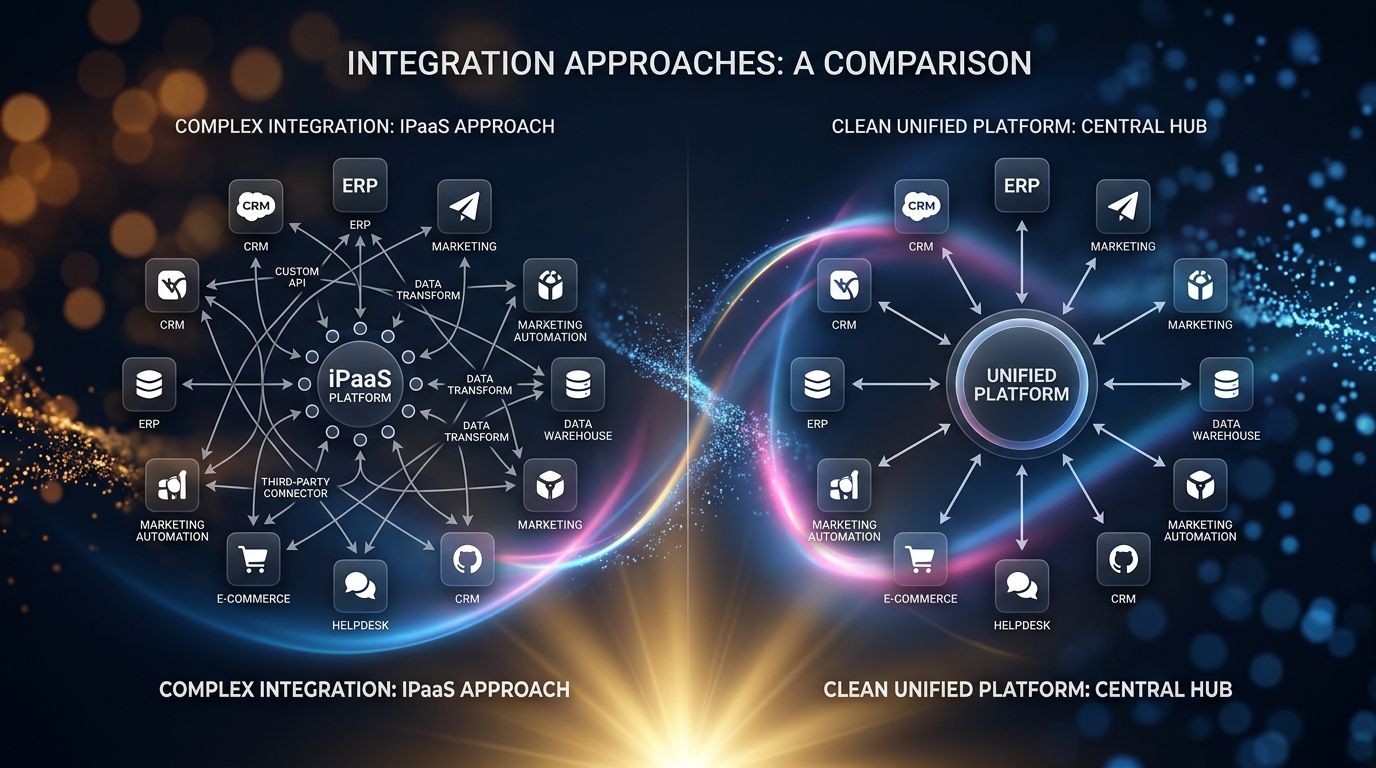
The real alternative: native memory, not forced integration
Let’s flip the situation.
What if the problem isn’t “how do I connect my 12 tools together” but “why do I have 12 tools that don’t talk to each other”?
The obsession with detail I developed while building Nova-Mind led me to a simple conclusion: AI-augmented productivity cannot rest on layers of integration. It must rest on native memory.
Concretely, what does that mean?
It means that when you mention “Julien at Agence Volta,” your assistant already knows. Not because it queried an external CRM via a Workato API configured by a developer. But because that information lives in the same system as your assistant, indexed via pgvector, accessible in milliseconds.
The friction difference is radical. Not marginal. Radical.
A workflow with iPaaS integration: you ask a question → the AI queries a connector → the connector calls an API → the API returns data → the AI interprets it → you get an answer. 4 to 8 seconds. Potential for error at every step.
A workflow with native memory: you ask a question → the AI searches its memory → you get an answer. Sub-second. Zero external failure points.
What model improvements really reveal
My expert advice, after testing and integrating these stacks for months: the best AI models amplify your existing systems. They don’t replace them. And if they’re fed poor context, they amplify your gaps too.
A Claude 3.7 without contextual memory of your clients is a Formula 1 engine in a car with no steering. Powerful. Unusable in real conditions.
That’s where the promise falls apart. You were sold the power of the engine. Nobody told you that you’d also need to build the car around it.
“The real ROI of AI doesn’t come from the model used. It comes from the quality of the context in which that model operates.”
Three actionable insights to take from this observation:
1. Audit your contextual friction. Count how many times per week you re-explain the same context to your AI. If it’s more than 5 times, you have an architecture problem, not a model problem.
2. Question the iPaaS need. Before investing in Workato or Boomi, ask yourself whether the problem is the fragmentation of your tools rather than the absence of integration. Glue is expensive — in money and in maintenance.
3. Prioritize native memory over synchronization. A system that remembers is worth more than ten systems that synchronize. Synchronization can fail. Native memory is always there.

The next step: tools that work even while you sleep
AI is improving. That’s real. The models of 2025 are objectively more capable than those of 2023.
But improving capabilities without solving the context and continuity problem is a half-kept promise. Impressive in a demo. Frustrating in production.
The real breakthrough won’t come from a more powerful model. It will come from an assistant that knows your trade, your clients, your preferences — and that acts proactively on that knowledge, even when you’re not there.
Not a faster ChatGPT. A system that detects you’re approaching burnout because it analyzed your work patterns over 3 months. That reminds you a client hasn’t heard from you in 6 weeks. That generates your weekly report while you sleep, knowing exactly which format each recipient prefers.
That’s what I built with Nova-Mind. Permanent memory via pgvector. Proactive coaching via Cerebro. 36 MCP tools. No re-explanation. No iPaaS glue to maintain.
€39/month. Private data. Desktop macOS, Windows, Linux.
If you’re tired of re-explaining context, paying for glue between your tools, and waiting for “AI to improve just a little more” — Nova-Mind is available now. The memory is here now. Not in the next version.
Share this article
Social networks
Analyze with AI

Charles Annoni
Front-End Developer and TrainerCharles Annoni has been helping companies with their web development since 2008. He is also a trainer in higher education.