
AI vs. Influence: Who's Winning the Trust Battle?
Article Summary
📖 8 min readThis article explores the current paradox in which artificial intelligence is gaining credibility with the public — including in sensitive areas like healthcare — while influencer marketing, battered by scandals and growing cynicism, is losing trust. It examines what this reversal means for the future value of influence as a marketing channel.
Key Points:
- Artificial intelligence is rapidly gaining credibility with the public, including on sensitive topics like health and finance, according to recent studies.
- Influencer marketing, by contrast, is facing eroding trust driven by transparency scandals and growing audience cynicism.
- The current paradox sees the machine gaining perceived reliability while the human — within the influence framework — is losing it.
- Users are beginning to trust AI tools for medical questions, sometimes even more than traditional search results cluttered with unreliable sources.
- This trust reversal raises a fundamental question about the future value proposition of influencer marketing and the strategies marketers must adopt.
The paradox every marketer should find alarming
15 years of watching digital trends has taught me one thing: the most brutal reversals always happen where no one is looking. Right now, something fascinating — and deeply uncomfortable for the digital marketing industry — is unfolding.
On one side: AI. ChatGPT, Claude, Gemini. Tools that public opinion viewed with deep suspicion just two years ago, accused of hallucinating, lying, fabricating medical sources. Today? Study after study shows the perceived reliability of these systems is rising — including in areas as sensitive as healthcare, law, and finance.
On the other side: influencer marketing. A human industry, embodied, built on relationships and authenticity. And yet: transparency scandals keep piling up, audiences are growing cynical, regulators are losing patience.
Here is the paradox. The machine is gaining credibility. The human is losing it. And for digital marketing strategists, this reversal raises a question no one really wants to ask: what is the value of influencer marketing actually built on anymore?
AI in healthcare: the ultimate credibility test
For a long time, healthcare served as the ultimate argument against AI. “You wouldn’t trust an algorithm with your health, would you?” It was the conversation-ender, the definitive rebuttal.
It’s no longer that simple.
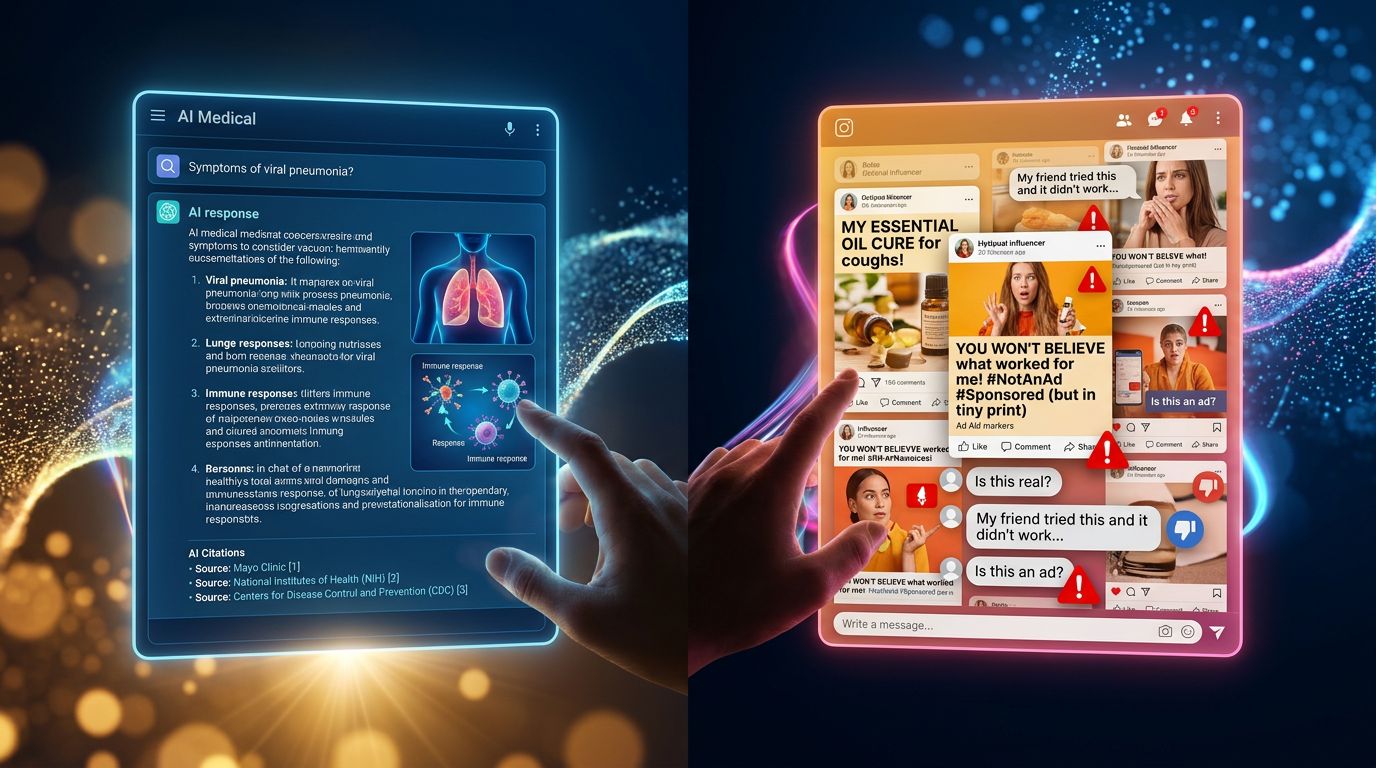
Recent research shows users are beginning to trust the responses of tools like ChatGPT on medical questions — sometimes more than a standard Google search, buried under sponsored results and unreliable sites. This isn’t blind acceptance: the most sophisticated users cross-reference sources, verify, challenge. But the baseline trust is there, and it’s growing.
Here’s where it gets interesting: that trust didn’t fall from the sky. It was built. The publishers of these models invested massively in reducing hallucinations, citing sources, and implementing editorial guardrails. They treated the credibility problem as an engineering problem — and they solved it, at least in part.
“Trust is not a feeling. It’s a system. And systems are designed.” — A principle that influencer marketing would do well to take seriously.
Influencer marketing facing its credibility crisis
Let’s flip the picture. While AI was methodically building its credibility, what was influencer marketing doing?
Some numbers that sting. According to a study by the ARPP (France’s professional advertising regulator), a significant share of sponsored content still fails to comply with legal transparency requirements. The #ad and #partnership disclosures are there… when they’re not forgotten, buried, or deliberately minimized. And audiences are not fooled.
What no one tells you at marketing conferences: audience cynicism is not a generational problem. It’s not “young people who don’t trust anything anymore.” It’s a rational response to years of manipulation. Consumers have learned to decode the codes of influence — the too-perfect product placement, the “spontaneous discovery” of sponsored items, the glowing reviews of mediocre services.
Trust is lost in seconds. It takes years to rebuild.
And the industry has yet to find its equivalent of “reducing hallucinations.” No systematic protocol. No credibility engineering. Ethical guidelines that are often cosmetic, regulations that perpetually chase practices rather than lead them.
Why this paradox is not a coincidence
My analysis points to something structural behind this contrast.
AI is a product. A product with bugs to fix, metrics to optimize, users to retain. When ChatGPT hallucinates, OpenAI knows — users report it, benchmarks measure it, teams fix it. Credibility is a KPI like any other, baked into the product roadmap.
Influencer marketing, by contrast, is a fragmented industry. Thousands of individual creators, agencies of varying size, platforms with no direct incentive to reduce the volume of sponsored content — even problematic content. There is no “bug report” for a misleading commercial integration. There is no rollback when an influencer loses the trust of their community.
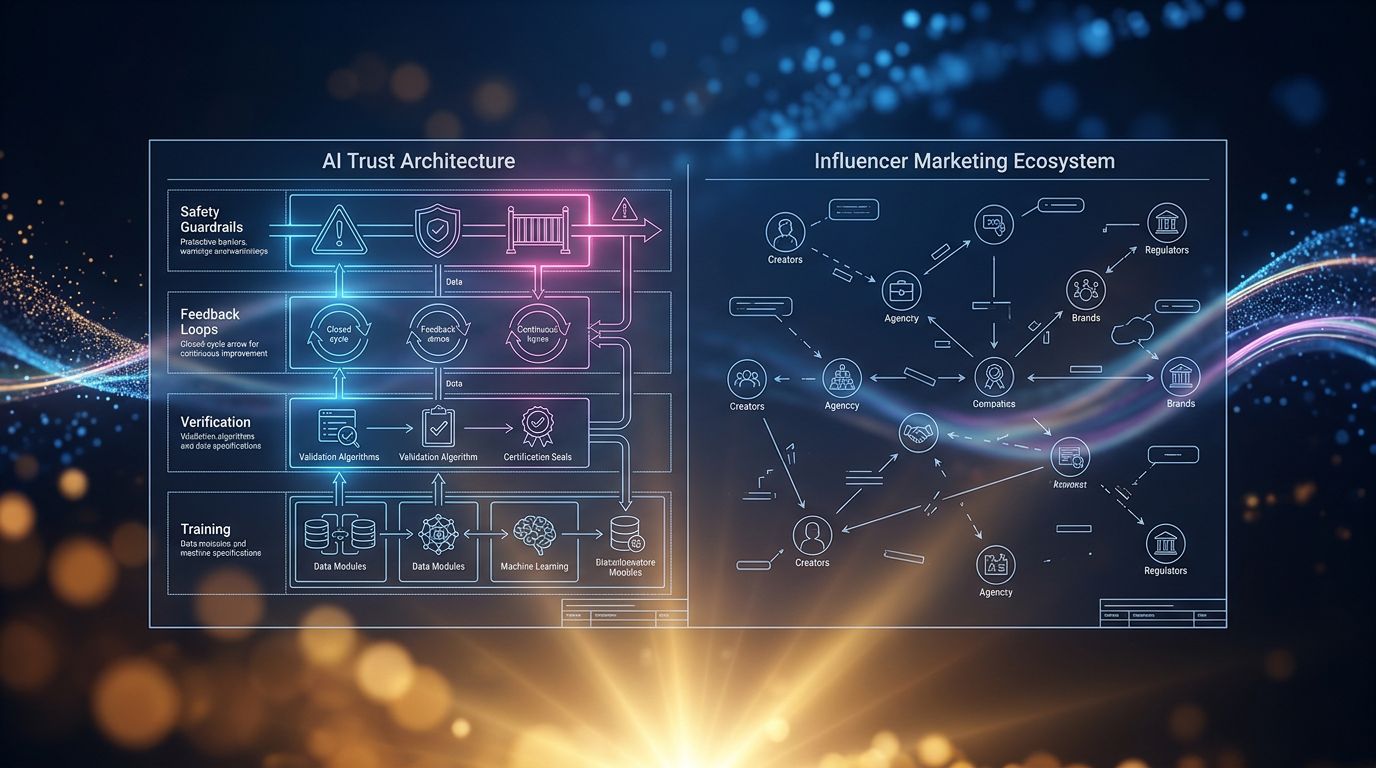
Here is the real issue: AI has a trust architecture. Influencer marketing does not.
This is not a question of individual goodwill. It’s a question of systems. And in the absence of a system, trust depends entirely on the individual virtue of each creator — which is not scalable, and historically unreliable.
What digital strategists need to understand now
If I were your strategist, here is what I would tell you straight.
First reality to internalize: AI is not replacing influencer marketing, but it is raising the credibility standards your audiences are exposed to. A consumer who gets a sourced, verifiable medical answer from Claude, then sees an influencer promoting a dietary supplement without a single nuance — the contrast has become unbearable. Standards are rising. Everywhere.
Second reality: transparency is no longer a differentiator, it’s the entry fee. The creators winning in 2024–2025 are those who understood that radical authenticity — clearly disclosing what is sponsored, why they accepted the partnership, what they didn’t like about the product — generates more trust than simulated perfection.
Third reality: brands bear responsibility for the trust architecture they build or destroy. Demanding reach KPIs without demanding transparency standards is optimizing for the short term while sabotaging the long term.
“The real ROI of influencer marketing is not measured in impressions. It’s measured in trust accumulated — or squandered.”
Toward trust engineering in influencer marketing
What we can learn from AI is not the technology. It’s the method.
Treating credibility as a system to design, not a state to hope for. What does that mean in practice?
Systematic verification processes before any collaboration — not just engagement metrics, but the creator’s transparency track record. Contracts that include non-negotiable disclosure clauses. Post-campaign feedback mechanisms that measure the impact on audience trust, not just clicks.
It also means accepting that less volume with more integrity always beats more volume with less credibility — in the medium term.
AI has proven that a system can rebuild its reputation by investing heavily in reliability. Influencer marketing has the same opportunity. But the window will not stay open indefinitely. Audiences that have lost trust do not come back easily.
Three insights to take away
1. Credibility is an engineering problem, not a good-intentions problem. AI solved it with systems. Influencer marketing must do the same — binding codes of conduct, verification processes, trust metrics.
2. The standards of one industry contaminate others. Your audiences are (unconsciously) comparing the reliability of AI to that of influencers. The gap is growing. Act before it becomes insurmountable.
3. Radical transparency is the only durable moat. In a world where AI can generate perfect content infinitely, verifiable authenticity — the kind that accepts imperfections and contradictions — is the only competitive advantage the machine cannot replicate.
Conclusion: choosing your side in the credibility battle
The AI versus influencer marketing paradox is not an intellectual curiosity. It’s a warning signal.
AI has understood something that influencer marketing still refuses to admit: in the attention economy, trust is the only currency that doesn’t devalue. Everything else — reach, impressions, algorithms — fluctuates. Capitalized trust endures.
The strategists who come out ahead this decade are not those who chose AI or influence. They are the ones who understood that both sectors are now playing the same game — the credibility game — and built their strategies accordingly.
The question is no longer “should we do influencer marketing?” The question is: with what standards, what systems, and what trust architecture?
At Nova-Mind, we work precisely on these questions — how AI tools can help marketing teams track, measure, and build trust systematically. If this resonates, explore what Nova can do for your strategy.
Share this article
Social networks
Analyze with AI
Charles Annoni
Front-End Developer and TrainerCharles Annoni has been helping companies with their web development since 2008. He is also a trainer in higher education.