


Generative AI: the human as a rare luxury amid data overload
Article Summary
📖 9 min readGenerative AI produces a colossal volume of data, turning abundance itself into a challenge. Rather than rendering humans obsolete, this explosion reveals the irreplaceable value of strategic, empathetic, and contextual skills — shining a light on what only humans can still do.
Key Points:
- Adopting generative AI without a data management strategy leads to information overload and a real productivity loss for teams.
- AI acts as an amplifier: it multiplies the impact of a solid organisation and magnifies the chaos of a dysfunctional one.
- Contrary to popular belief, the abundance of AI-generated content makes truly unique human skills even more valuable and rare.
- The professionals who thrive with AI are those who bring contextual judgment, strategic empathy, and the ability to read emotional nuance.
- Generative AI illuminates human singularity by exposing the irreplaceable skills that mechanical, automatable tasks have long overshadowed.
When abundance becomes a problem
47,000 files generated per month. That’s the reality for some teams that adopted generative AI without any management strategy behind it. The tool keeps producing. The humans drown. And the promised productivity gains evaporate under mislabelled folders and lost context.
You were sold AI as a solution to everything. The truth? It’s an amplifier. If your organisation is shaky, AI amplifies the chaos. If your stack is solid, it multiplies your impact tenfold.
Here’s where it gets interesting: the abundance of generative AI does not make humans obsolete. It does the exact opposite — it turns your unique skills into a rare luxury in a market saturated with generic content.
But for that equation to work, you need to solve a very concrete problem: intelligently managing the explosion of data that AI produces.
What generative AI truly reveals about human value
A head-on contradiction: everyone says AI will replace humans. What if the exact opposite were happening?
After analysing dozens of workflows from teams using AI daily, the pattern is clear. The professionals losing value are those who were doing mechanical production — rephrasing, compiling, copy-pasting. AI does that better, faster, around the clock.
Those gaining value? Strategists. Editors who know that a paragraph generated by Claude is technically correct but emotionally wrong for their audience. Consultants who understand that the client behind the brief is afraid, not just carrying a functional need.
Human singularity is not under threat. It is being brought into the light.
What no one tells you: generative AI works like a photographic developer. It exposes what was blurry — the skills that were never really skills, and those that are truly irreplaceable. Contextual judgment. Strategic empathy. The ability to make decisions under uncertainty with incomplete data.
“Automation does not destroy jobs — it redistributes value toward what machines cannot do.” — McKinsey Global Institute report, 2023
That is exactly what is playing out right now.

The data explosion: the other side of the coin
Let’s flip the situation. You’ve adopted generative AI. You’re producing more. But producing more also means storing more, organising more, retrieving more.
A freelancer using AI for their content generates on average 3 to 5 times more files than before. Images, drafts, variants, exports, versions. Without the right infrastructure, the time saved in production is swallowed up by the time lost in management.
That is the AI abundance paradox: the tool sets you free on one side while data entropy engulfs you on the other.
The concrete problems I see:
- Lost context — the client brief is in an email, the approved version is in Drive, the assets are in Slack. Finding the information takes longer than recreating it from scratch.
- Invisible duplicates — 14 versions of the same visual, and you can’t tell which one is correct without opening every single file.
- Fragmented memory — your AI has no idea what you produced last week. You rebuild context from zero at every session.
That last point is particularly costly. How many times have you re-explained to Claude who your client is, what their tone of voice is, what their constraints are? Every session, you pay in time and cognitive energy to reconstruct context your tool should have remembered.
Intelligent storage: not just GB, but organised memory
My obsession with detail has taught me one thing: the difference between a basic cloud storage tool and an intelligent solution is not storage capacity. It’s the ability to retrieve, contextualise, and connect information.
What does robust cloud storage for the AI era actually look like?
Semantic search. Not “find the file named brief-client-final-v3.docx.” Find “Dubois client tone-of-voice preferences” and land on the right document, the right conversation, the right context — even if no one named the file correctly.
Context persistence. Your data isn’t a collection of isolated files. It’s made up of elements belonging to a project, a client relationship, a strategy. Intelligent storage preserves those connections. pgvector, vector databases — that’s exactly what they do: transform your data into structured memory rather than dead archives.
Multi-context accessibility. Desktop, mobile, API, integrated into your tools. Your data needs to be where you work, not sitting in a silo you visit once a week.
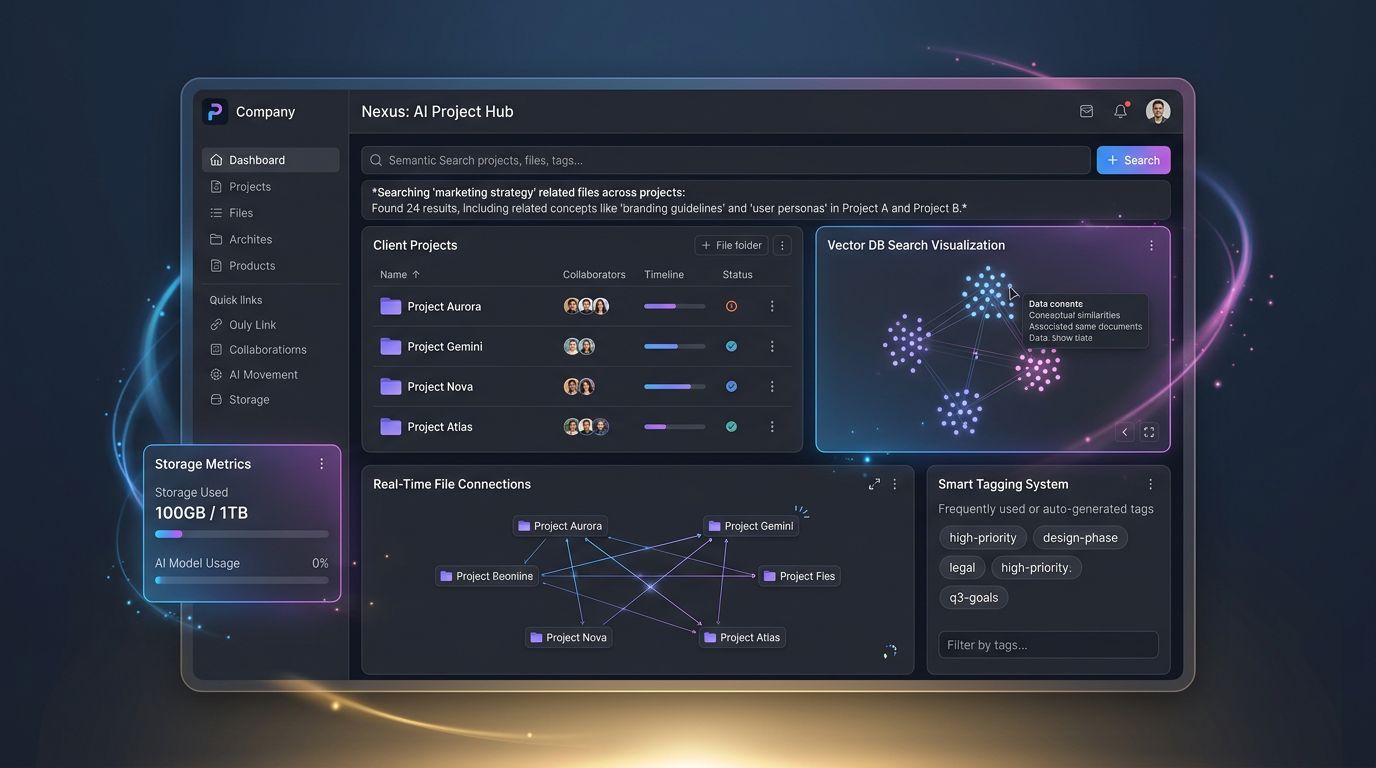
What cloud storage comparisons never tell you: GB capacity is the least important criterion. What matters is the architecture behind it — how your data is indexed, how it connects to itself, how your AI can leverage it without you having to re-explain everything from scratch.
The synergy that changes everything: human + AI + structured memory
Look at it from another angle. Real productivity gains don’t come from AI alone. They come from the triangle: your human expertise × the generative power of AI × organised data memory.
Break one side of the triangle and everything collapses.
Without human expertise: you produce generic content that nobody can distinguish from the competition. Volume without value.
Without AI: you’re limited by your own execution speed. Human singularity is there, but you can’t scale it.
Without structured memory: you lose context at every session. Your AI starts from zero. So do you. The time savings evaporate into organisational friction.
“Productivity isn’t about speed. It’s about eliminating friction between intention and execution.”
That is precisely the philosophy behind Nova-Mind. The assistant memorises every client, every project, every preference — via pgvector, not your faulty 10 PM memory. When you open a working session, the context is there. You jump straight to human added value, not context reconstruction.
100 GB of integrated storage, semantic search in the CRM, files connected to projects and clients. This isn’t storage — it’s organised memory in service of your singularity.
Three actionable insights for navigating AI abundance
My expert advice, after building and using these workflows every day:
1. Audit your context friction. Time how long you spend rebuilding context before you can actually work — client brief, project history, validated preferences. If it’s more than 15 minutes a day, you have an infrastructure problem, not a productivity problem.
2. Choose your memory layer before your AI tool. Most professionals do it backwards: they choose Claude, ChatGPT, or Gemini first, then try to manage the data around it. That’s a mistake. Structured memory is the foundation. Generative AI plugs into it. Without a foundation, you’re building on sand.
3. Identify your irreplaceable 20% of value. What do you do that AI cannot reproduce — not technically, but with the same perceived value for your clients? That’s where you must focus your human time. Everything else is a candidate for intelligent automation.

AI abundance is an opportunity, not a threat — with one condition
What no one says clearly enough: generative AI will keep improving. Models will become more powerful, faster, cheaper. Automated production will accelerate.
In that context, two types of professionals will emerge. Those who drown in abundance — producing more without strategy, accumulating data without organisation, losing their singularity in the noise. And those who use abundance as leverage — who have solid infrastructure to manage data, who have identified their irreplaceable value, and who let AI amplify their expertise rather than replace it.
The condition? Adapted infrastructure. Intelligent storage, persistent memory, organised context. It’s not glamorous. It’s the foundation.
Human singularity is your competitive advantage. Intelligent storage is the infrastructure that preserves it.
Tired of rebuilding context at every session? Of hunting for files across five different tools? Of losing 2 hours a day to organisational friction that AI was supposed to eliminate?
Nova-Mind is built exactly for that — persistent memory, 100 GB of storage connected to your projects and clients, semantic search, and an assistant that remembers your 47 clients without you having to re-explain everything. Discover Nova-Mind and see concretely how many hours you get back from day one.
Share this article
Social networks
Analyze with AI

Charles Annoni
Front-End Developer and TrainerCharles Annoni has been helping companies with their web development since 2008. He is also a trainer in higher education.