


e-Builder: construction project management under the microscope
Article Summary
📖 8 min readAn unsparing analysis of e-Builder (Trimble), the construction program management software designed for institutional owners. We clarify its true positioning, its opaque enterprise pricing, its three recurring limitations, and when a lighter tool like Nova-Mind is a better fit.
Key Points:
- e-Builder is a CPMS (Construction Program Management Software) acquired by Trimble in 2018, designed for asset owners and institutional capital program managers — not for contractors or small job sites.
- Its strongest suit is cost control: budget commitment tracking at every stage and permanent visibility into the gap between the original budget and the projected cost at completion.
- Pricing is not public (this is enterprise territory): expect several tens of thousands of euros per year for a mid-sized organization, plus a significant upfront implementation cost.
- Three recurring limitations: a 3–6 month learning curve, flexibility constrained by the platform's own workflows, and ERP/BIM integrations that are far from plug-and-play.
- ROI only makes sense at scale: 1% savings on a €200M program covers the subscription cost — but the equation breaks down entirely for an organization managing €5M.
Construction is the industry where projects go off the rails most often
A 15% average cost overrun on large construction projects. This figure, drawn from decades of industry studies, is not an anomaly — it is the norm. Could technology finally be changing that?
e-Builder is one of the answers the market has built for this specific problem. Not a general-purpose tool bent into shape for construction. A platform designed from day one for asset owners, capital program managers, and institutional program teams. Let’s see what it’s really worth — no sugarcoating.
What e-Builder actually is
e-Builder is a Construction Program Management Software (CPMS) acquired by Trimble in 2018. Its target users: organizations managing large portfolios of construction projects — universities, hospital systems, public administrations, airports.
This is not a tool for small job sites or tradespeople. It is an enterprise system, built to centralize the entire lifecycle of a capital project: from initial budget planning through final closeout, covering procurement, contracts, payments, and document management.
The core idea: replace information silos (Excel for budget, email for contracts, SharePoint for docs) with a single source of truth.
In practice, if your organization is running 50 simultaneous projects with dozens of stakeholders — contractors, architects, engineers, internal teams — e-Builder aims to ensure that everyone works from the same data, in real time.

Key features — what actually makes a difference
Budget and cost management
This is where e-Builder is strongest. The cost control module tracks budget commitment at every stage: approved budget, contract commitments, change orders, invoices received, payments made.
The real benefit: complete visibility into the gap between the original budget and the projected cost at completion, at any point in time. For organizations managing hundreds of millions in capital projects, this is the difference between a nasty surprise at year-end and a proactive decision made three months earlier.
Document management and workflows
e-Builder centralizes documents and — crucially — automates approval processes. A change order moves through a defined workflow: submission, review, approval, signature. Every step is tracked, every delay is measured.
What nobody tells you about this kind of feature: the value is not in storing documents — it is in auditability. When a dispute arises (and in construction, disputes always arise), being able to prove who approved what and when is worth its weight in gold.
Bid management and contracts
The bid management module handles the full invitation-to-tender process, bid reception, and contract award — all within the platform. Contracts are then linked to budgets, payments, and documents, so everything stays connected.
Reporting and dashboards
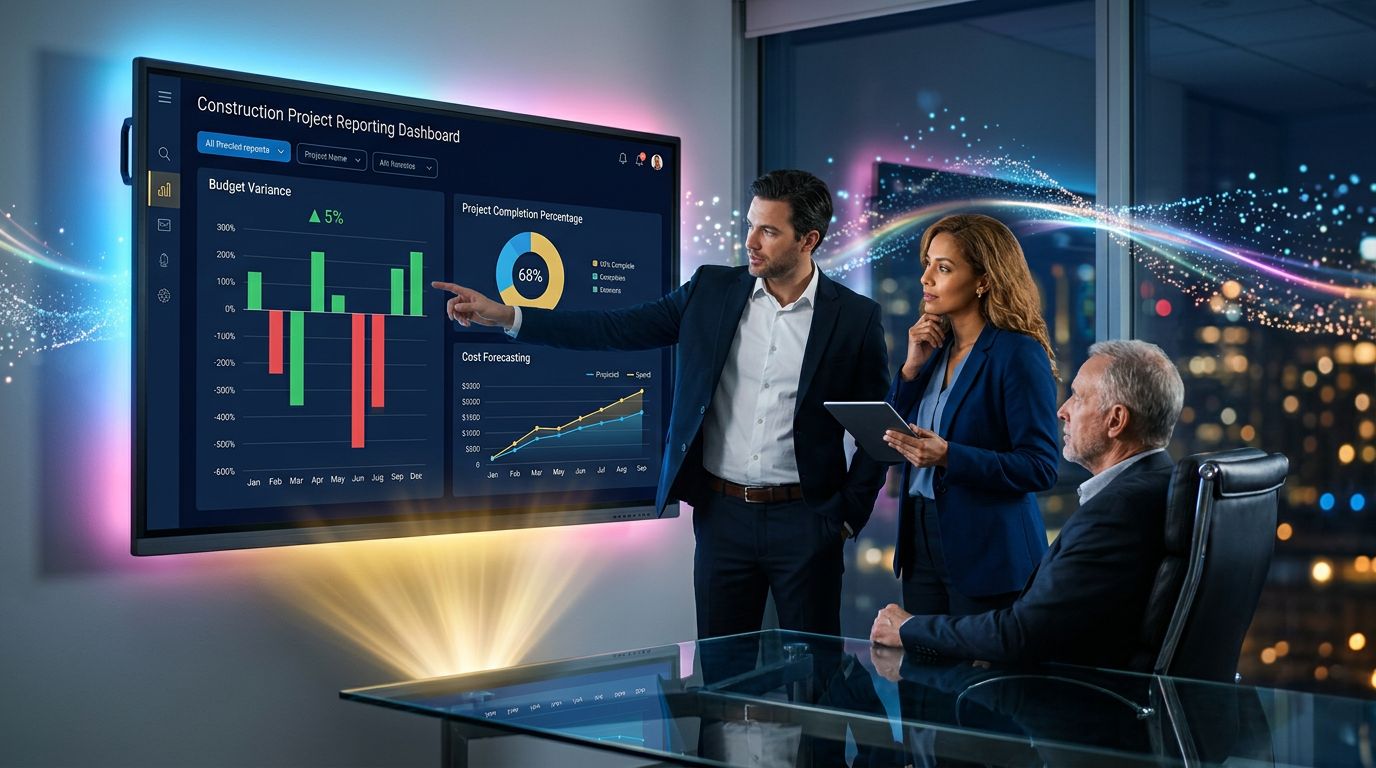
e-Builder’s executive dashboards are built for decision-makers who do not want to dig through raw data. Physical progress, budget commitment rate, change order processing timelines — all configurable and shareable.
Who it’s built for — and who it’s not
This is where it gets interesting. e-Builder is frequently mispositioned in general discussions about project management tools. Let’s be clear.
e-Builder is a fit if you are:
- An institutional owner (university, health system, municipality) managing a multi-year capital construction program
- A capital program management team running 10+ simultaneous projects
- An organization subject to strict audit and compliance requirements
e-Builder is probably not your tool if you are:
- An agency, freelancer, or SMB looking for a general-purpose project management tool
- A general contractor — e-Builder is designed for the owner side, not for the execution side
- A team that values agility and flexibility — this is a heavyweight system built for rigor, not speed
This distinction is fundamental. Many organizations buy e-Builder thinking it is a “better Microsoft Project” — and end up with a tool massively oversized for their actual needs.
Pricing — the real question
e-Builder does not publish its pricing publicly. That is a clear signal: this is enterprise territory, with commercial negotiation, a mandatory demo, and annual contracts.
Market feedback (G2, Capterra) places costs in a high bracket — think several tens of thousands of euros per year for a mid-sized organization. The initial implementation often adds a substantial cost on top: workflow configuration, data migration, team training.
The potential ROI is real, but you need the project volume to justify it. For an organization managing €200M in annual capital programs, even 1% savings on cost overruns comfortably covers the subscription. For an organization managing €5M, the equation is far less obvious.
“Technology doesn’t solve organizational problems. It amplifies them — in both directions.” — A foundational principle of enterprise software adoption.
The limitations nobody tells you about
My analysis identifies three recurring friction points in user feedback.
The learning curve is real. e-Builder is powerful, but complex. Teams report adoption timelines of 3 to 6 months before genuinely exploiting the platform’s capabilities. Without a dedicated internal champion, the risk of partial adoption is high.
Flexibility has its limits. Workflows are configurable, but within the framework the platform defines. Organizations with highly specific processes may run into the system’s constraints. This is the classic trade-off between standardization and customization.
Integrating with your existing ecosystem takes work. e-Builder connects with ERP systems (SAP, Oracle) and BIM tools, but these integrations are not plug-and-play. Budget time and IT resources accordingly.

What this reveals about project management in 2025
Let’s flip the perspective. e-Builder exists because a fundamental problem persists in construction: information is fragmented, processes are manual, and organizations pay the price for that chaos in the form of overruns and disputes.
The real question is not “is e-Builder good?” — it is “why, in 2025, does capital program management remain this complex?”
The answer comes down to three words: stakeholder multiplicity. A construction project involves dozens of independent entities with sometimes conflicting interests, different systems, and incompatible processes. No software solves that by magic — it simply creates a shared framework that makes things work a little less badly.
That is where tools like e-Builder have genuine value: not in the promise of digital transformation, but in the concrete reduction of operational friction.
3 actionable insights if you are evaluating e-Builder
1. Start by mapping your current data flows. Before any demo, identify where your critical data lives (budget, contracts, documents) and how much time your team spends consolidating it manually. That is your baseline for measuring potential ROI.
2. Negotiate a pilot on a limited program. Before rolling out across your entire portfolio, ask to test on 3 to 5 representative projects. Implementation surprises are far easier to absorb at small scale.
3. Invest in change management as much as in the software. The tool is worthless without adoption. Plan a training budget and designate a dedicated internal administrator from day one.
The straight conclusion
e-Builder is a solid tool for a specific problem: large-scale capital program management in institutional organizations. If that matches your profile, it genuinely deserves serious evaluation. If you are looking for an agile project management tool for your agency or product team — move on, this is not built for you.
The productivity tool market has evolved. Modern teams — freelancers, solopreneurs, agencies — no longer need heavy enterprise systems to have real project management with contextual memory and intelligent automation.
If you fall into that second category, that is exactly what Nova-Mind was built to solve: project management, CRM, an AI assistant with permanent memory of your clients, and automation — in a single tool at €39/month. Not an enterprise system. A daily work tool that knows your context and works for you even while you sleep.
Share this article
Social networks
Analyze with AI

Charles Annoni
Front-End Developer and TrainerCharles Annoni has been helping companies with their web development since 2008. He is also a trainer in higher education.