


iOS 27, Siri AI and Claude Fable 5: what these releases really reveal about augmented work
Article Summary
📖 9 min readA breakdown of the iOS 27 announcements (Siri AI, Liquid Glass) and Claude Fable 5, and their shared blind spot: they improve the model and the interface, not the memory. The article demonstrates why architecture — persistent memory, workflow awareness, proactive initiative — matters more than raw model power for independent professionals.
Key Points:
- iOS 27 rebuilds Siri from the ground up with generative AI integrated at the system level (contextual understanding, cross-app actions, real-time screen awareness) wrapped in the Liquid Glass aesthetic — but Apple is selling an experience, not a workflow.
- Claude Fable 5 marks a qualitative leap in reasoning according to early access testers: better consistency on long tasks and improved understanding of implicit constraints.
- Both announcements share the same blind spot: they improve the engine, not the memory — neither Siri nor Fable 5 remembers who you are the next day.
- The hidden cost of the problem: an independent professional spends ~2.5h/week re-explaining their context to AI, totalling 130h/year and roughly €10,400 in evaporated productivity at €80/h.
- An assistant that genuinely delivers rests on three pillars — persistent memory (pgvector), workflow awareness, and proactive initiative — it's a matter of architecture, not model.
The week that changes the rules
47 seconds. That’s how long it took me to realise that this week’s announcements were not simple product updates. iOS 27 with its completely reimagined Siri AI, Liquid Glass redefining Apple’s visual interface — and on the other side, Claude Fable 5 prompting testers to say “this feels like a different level entirely”. Two giants, two directions, one shared question: what does an assistant that truly works for you actually look like?
Spoiler: the answer isn’t in Apple’s keynote.
iOS 27 and Siri AI: Apple finally plays its hand
For years, Siri carried the reputation of being the least useful assistant on the market. The joke was easy, but it was accurate. iOS 27 changes the game — on paper, at least.
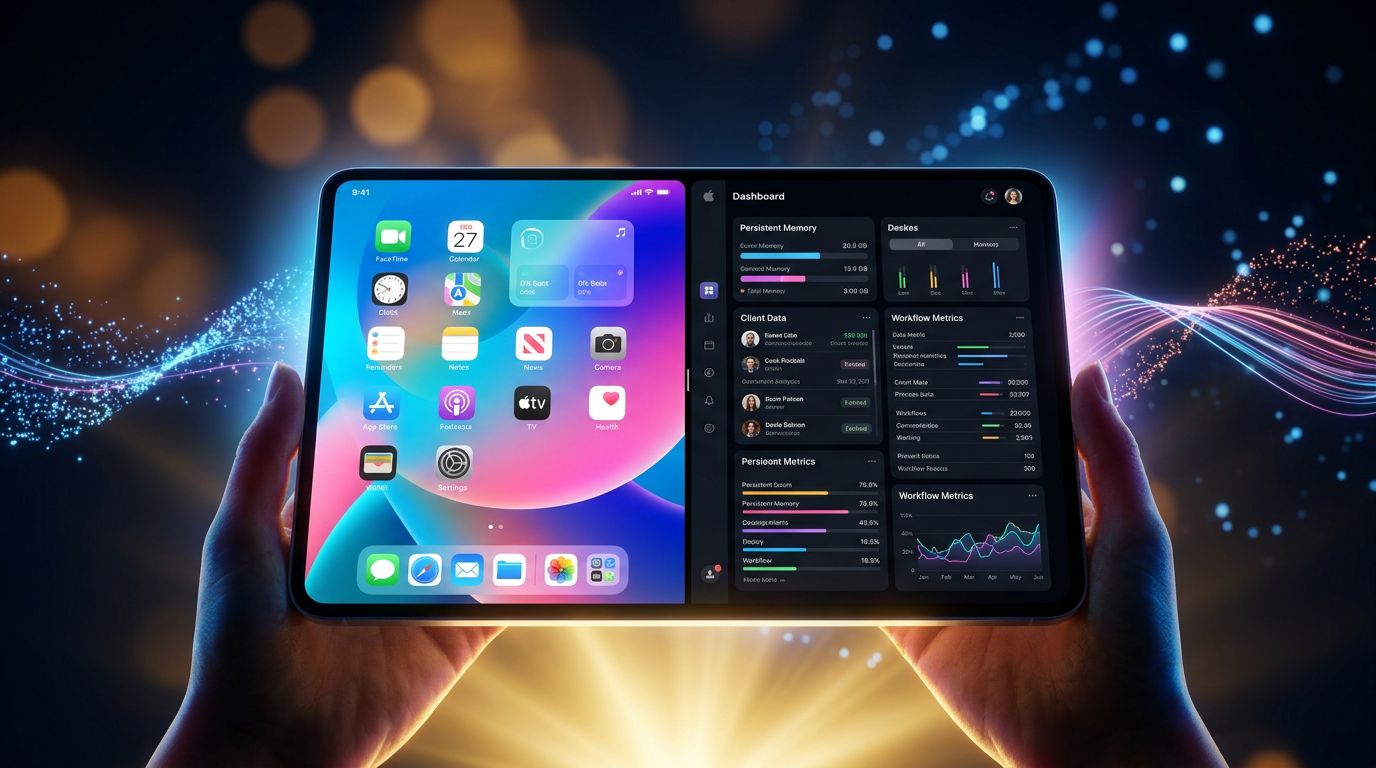
Apple announces a deeply rebuilt Siri, integrating generative AI capabilities directly at the system level. Improved contextual understanding, cross-application actions, real-time screen awareness. All wrapped in the Liquid Glass aesthetic: translucent, fluid interfaces that make the OS feel like it breathes.
It’s beautiful. It’s technically impressive. And that is precisely the problem.
Apple is selling an experience. Not a workflow.
Here’s where it gets interesting: the fundamental difference between an assistant that impresses and one that delivers. Siri AI can understand what’s on your screen. But does it know that your client Dupont Architecture has been waiting three days for a quote? Does it know your day rate, your deadline constraints, the full history of your exchanges with that client over the past 18 months?
No. It starts from scratch every session.
Claude Fable 5: when “next level” actually means something
On the other end of the spectrum, Claude Fable 5 is generating serious discussion. Testers with early access are using phrases like “qualitatively different reasoning”, “consistency across long conversations”, “nuanced understanding of complex instructions”.
This isn’t hype. It’s a measurable evolution in how the model handles complexity.
“The leap from Fable 4 to Fable 5 is larger than any previous Anthropic update. This is a qualitative difference, not just a quantitative one.” — field feedback from early access developers
What concretely changes: the ability to sustain reasoning across long tasks without drifting, better understanding of implicit constraints, and consistency in tone and style across extended outputs. For anyone using Claude to generate articles, client briefs, or content strategies — this is directly measurable in output quality.
But — and this is the point no one emphasises enough — a better model without memory is still an amnesiac tool.
The real problem these announcements don’t solve
Let’s flip the perspective for a moment.
Both of this week’s announcements share the same blind spot: they improve the engine, not the memory. More powerful Siri AI? Yes. More precise Claude Fable 5? Absolutely. But neither one remembers who you are the next morning.
This is the AI paradox of 2025: increasingly capable models deployed in fundamentally stateless systems.
My obsessive attention to detail has taught me to quantify this problem: a freelancer or agency spends an average of 2.5 hours per week re-explaining context to their AI. Who the client is, what the project involves, what the constraints are, what tone to use. Week after week. 130 hours per year. At €80/hour, that’s €10,400 in productivity evaporated on “re-briefing”.
This is not a model problem. It’s an architecture problem.

What architecture actually changes
Here’s what keynote articles never tell you: the power of an AI assistant doesn’t live in the model. It lives in what the assistant already knows before you start talking.
The difference between “hello, I’m Nova, what can I do for you?” and “hello, I noticed the Dupont project is two days behind on the mockups, and you have a meeting tomorrow — shall we prepare the status update?”
That difference doesn’t come from Fable 5 or Siri AI. It comes from pgvector. From MCP. From a semantic database that stores every interaction, every client, every project decision. From an architecture that makes the AI know your context rather than ask for it.
The three pillars of an assistant that genuinely delivers:
- Persistent memory: every client, project, and preference stored and retrievable via semantic search
- Workflow awareness: the AI knows where you stand on your projects without you having to specify
- Proactive initiative: it acts when relevant, not only when asked
This is exactly what Claude Fable 5 could do — if deployed in a stateful architecture. The model is there. The infrastructure, more often than not, isn’t.
Three actionable insights to avoid missing the turning point
1. Evaluate your tools on their architecture, not their model
The next time an AI tool impresses you in a demo, ask one simple question: “Does it remember what I told it last week?” If the answer is no, the underlying model doesn’t matter. You’re in a Sisyphean workflow — roll the rock to the top, watch it roll back down, repeat.
2. Measure your re-briefing time
For one week, note every time you re-explain context to your AI. Client, project, constraint, tone. Multiply by your hourly rate. The number you get is your argument for switching tools or changing your architecture. Not a gut feeling — a measurable ROI.
3. Distinguish model improvements from system improvements
Claude Fable 5 is a model improvement. iOS 27 Siri AI is an interface improvement. Neither is a system improvement. An AI system that works for you means memory + model + initiative + integration into your existing tools. Evaluating the parts separately means missing the whole.
The AI that works while you sleep
Experience has taught me that the best productivity tools are the ones working when you’re not watching.
iOS 27 and Claude Fable 5 are reactive tools. You speak, they respond. You close the app, they stop. That’s already a significant improvement on what came before — but it’s still the 15th-century paradigm applied to AI: the tool waits for the craftsman.
The paradigm that’s emerging is different: an assistant that monitors your projects, detects delay risks, identifies clients who haven’t been followed up with in too long, and delivers a briefing to you in the morning before you’ve opened your first email. Not because you asked. Because it knows what matters to you.
That’s the difference between a smarter tool and an autonomous collaborator.
“The true measure of an AI assistant isn’t what it does when you talk to it. It’s what it does when you don’t.”

What this means for you, concretely
This week’s announcements are real and significant. Siri AI on iOS 27 will make millions of Apple users more efficient in their daily interactions. Claude Fable 5 will produce higher-quality outputs for everyone using it in their content and analysis workflows.
But if you’re a freelancer, solopreneur, or running a small agency, the question isn’t “which model is best right now?” The question is: does my AI know my 47 clients as well as I do?
If the answer is no, you’re leaving productivity on the table. Not a little — hundreds of hours per year.
The model improves every quarter. The architecture doesn’t change on its own. Choosing it is your responsibility.
Conclusion: choosing your camp
iOS 27 and Claude Fable 5 represent two visions of AI: one centred on user experience and interface fluidity, the other on depth of reasoning. Both are advancing fast. Both deserve attention.
But neither solves the fundamental problem facing professionals who spend their days juggling clients, projects, and deadlines: the absence of persistent contextual memory.
AI-augmented productivity isn’t a more powerful model inside a prettier interface. It’s a system that learns from you, remembers for you, and works in your place when you have other things to do.
If you want to see what this architecture looks like in practice — pgvector memory, MCP integration, proactive coaching, automated monitoring and publishing — Nova-Mind is built exactly for that. €39/month. Private data. No more context re-explaining.
Try it. Measure the hours recovered. The ROI calculates in weeks, not months.
Share this article
Social networks
Analyze with AI

Charles Annoni
Front-End Developer and TrainerCharles Annoni has been helping companies with their web development since 2008. He is also a trainer in higher education.