


Steroid Olympics, Artemis III and the ISS: what these three stories reveal about human limits
Article Summary
📖 9 min readThree seemingly unrelated stories — openly legalized doping at the Steroid Olympics, the physiological preparation for Artemis III via the ISS, and the overhaul of the Mythos safety system — converge on a single editorial angle: the blurry boundary between performance optimization and systemic overexposure to risk.
Key Points:
- The Steroid Olympics legalize doping but trigger a biological arms race with no ceiling and no long-term follow-up protocol.
- The endurance records set by Parmitano and Pesquet on the ISS are critical datasets for modeling the physiological risks of Artemis III.
- The new version of Mythos illustrates resilience engineering that starts from failure points rather than stacking additional technology layers.
- A common thread ties all three cases: progressive normalization, a gap between data and decisions, and institutions always lagging behind practice.
- For builders, the lesson is actionable — measure real workload, do not confuse legalization with safety, anticipate failure scenarios before accidents happen.
When humans test their own frontiers
Fifteen years of observing technological progress have taught me one thing: the most revealing stories are not about machines. They are about humans confronting their own limits — biological, physical, institutional.
This week, three apparently unrelated narratives converge on the same question: how far can the human body be pushed before it becomes an ethical or operational problem?
Steroid-using athletes competing openly. An astronaut breaking endurance records in space. A maritime safety system redesigned from the ground up. Nothing in common? Think again. All three are about performance, risk, and responsibility.
The Steroid Olympics: when doping becomes the rulebook
Here is where it gets interesting.
Competitions now exist where doping is not banned — it is assumed, documented, sometimes even encouraged. The Download has dubbed them “Steroid Olympics”, and the expression is as precise as it is unsettling.
The founding idea is almost seductive in its logic: if everyone dopes anyway, why not create a legal, regulated space rather than maintaining a costly hypocrisy? No more 4 a.m. anti-doping tests. No more scandals that taint entire federations.
The problem. This reasoning normalizes a biological arms race with no clear ceiling.
What no one tells you in this debate: the real issue is not competitive fairness. It is whether we accept turning the human body into a competitive testing ground — with long-term consequences that sports medicine still struggles to quantify precisely. The effects of anabolic steroids on the cardiovascular, hormonal, and neurological systems play out over decades, not training cycles.
My analysis reveals a classic pattern: every time a community creates its own rules to circumvent norms it deems hypocritical, it generates new ethical problems it had not anticipated. The Steroid Olympics are no exception.

Luca Parmitano, Thomas Pesquet and the reality of the ISS
Let us flip the perspective.
The ISS is often discussed as a symbol of international cooperation. Less often as a laboratory of extreme physiological stress. Yet that is exactly what it is.
Luca Parmitano set duration records aboard the International Space Station — records that were later broken by other astronauts, including Thomas Pesquet during his missions. This detail, seemingly anecdotal, conceals a major operational reality for Artemis III.
Why it matters. Artemis III is humanity’s return to the Moon. Not a low-orbit station where a Soyuz can bring an astronaut home in three hours in an emergency. This is the Moon. Emergency evacuation: impossible. Launch window: constrained. Human bodies exposed to different gravity, more intense radiation, a psychologically distinct form of isolation.
The data accumulated by Parmitano, Pesquet, and their colleagues on the ISS are not trophies. They are critical datasets. Muscle degradation, bone density loss, sleep disruption, vision effects — every duration record in low orbit is an experiment that feeds the risk models for lunar missions.
“Space does not forgive improvisation. Every hour spent aboard the ISS is a data point that could save a life on the Moon.” — Synthesis of ESA reports on Artemis preparation
What no one tells you: endurance records in microgravity are not athletic achievements. They are physiological sacrifices made in service of future missions. The astronauts who “break records” pay a real biological price — and they know it.

Mythos redesigned: when maritime safety catches up
Let us look at this from another angle.
Alongside these narratives of human performance, another story is unfolding — one of a maritime safety system reinventing itself. Mythos, in its revised version, represents a more robust approach to risk management at sea.
It is not the most glamorous tech story of the week. But my eye for detail reveals why it matters: safety systems that protect human lives in hostile environments share a common logic with the challenges of the ISS and even with the doping debate.
In every case, the central question is identical. How do we define an acceptable level of risk? Who decides? And what are the consequences when we get it wrong?
For Mythos, the stakes are concrete: sailors, cargo, shipping lanes growing busier in worsening climate conditions. A “safer” safety system is not a marketing slogan — it is resilience engineering, tested against real failure scenarios.
Experience has taught me that the best safety innovations do not come from adding more technology layers. They come from a fundamental re-reading of failure points — which is exactly what the new version of Mythos appears to do.
What these three stories share
My analysis reveals a common thread that no one explicitly draws.
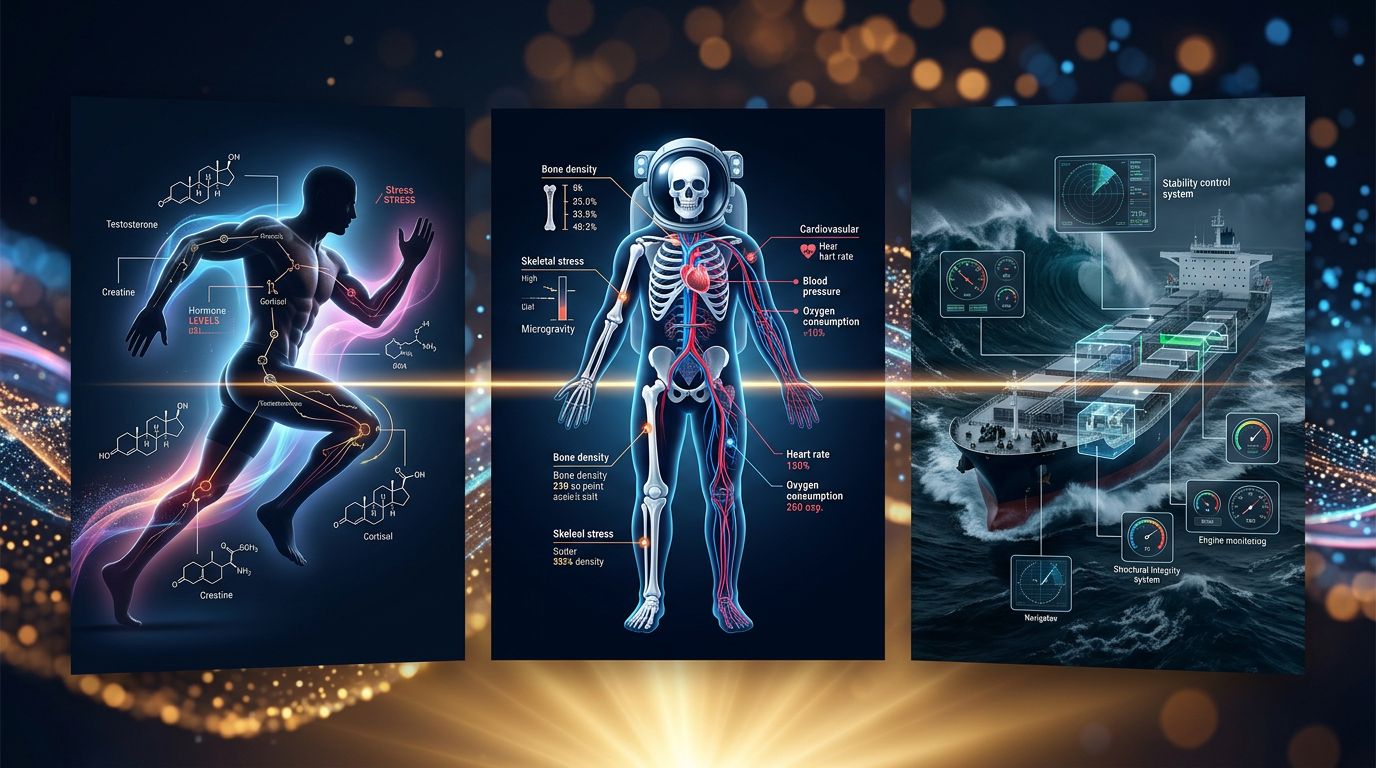
Whether it is athletes modifying their biology, astronauts pushing known physiological limits, or engineers rethinking maritime safety — all of these actors navigate the same conceptual space: the boundary between optimization and overexposure to risk.
Three patterns repeat themselves:
- Progressive normalization: what was exceptional (doping the body, spending six months in space, navigating high-risk zones) becomes ordinary, then expected, then insufficient.
- The gap between data and decisions: physiological data on astronauts has been accumulating for 60 years, yet risk models for Artemis remain partial. We know doping has long-term effects, but we accept or deny them depending on the interests at stake.
- Institutions lagging behind practice: sports federations chase doping practices that have existed for decades. Space agencies build protocols for missions that have not yet taken place. Maritime authorities legislate after accidents.
That is the real subject. Not performance itself — but our systemic inability to anticipate the consequences of our own optimizations.
Three actionable insights for builders
But beware of the trap of purely abstract analysis. These stories have concrete implications for anyone building products, teams, or workflows.
1. Your “performance records” have a hidden cost. Like Parmitano on the ISS, every intense sprint in your business leaves a mark. Workplace well-being data is not personal development — it is risk management. Measuring your team’s cognitive load is not optional if you are in it for the long haul.
2. Normalizing a risky practice does not make it safe. The Steroid Olympics perfectly illustrate this bias: legalizing something in a controlled context does not eliminate systemic effects. In a workflow, automating a badly designed task does not fix it — it just accelerates the damage.
3. Anticipating failure points beats reacting to accidents. That is Mythos’s lesson. In your stack, your processes, your client relationships — identifying failure scenarios before they happen is always cheaper than post-incident firefighting.
Performance is not an end, it is a variable
Ultimately, what links the Steroid Olympics, the ISS, and a redesigned maritime safety system is a question our era carefully avoids: what, exactly, are we optimizing for?
The honest answer is often uncomfortable. We optimize for visible metrics — completion times, records, speed — at the expense of less measurable but equally critical variables: resilience, longevity, systemic impact.
The astronauts preparing Artemis III have understood this. Every day spent on the ISS is not a performance to celebrate — it is a data point to analyze so the lunar mission goes well. The record is not the goal. The mission is the goal.
If you are building something — a product, a team, a workflow — the question is not “how far can we go?” It is “how far do we need to go for it to hold over time?”
That is the difference between sprinting and exploring.
Want an AI assistant that measures your actual workload and alerts you before burnout — not after? Nova-Mind includes a proactive coaching module (Cerebro) that continuously analyzes your work patterns. Try Nova-Mind for €39/month — because the best performances are built on endurance, not exhaustion.
Share this article
Social networks
Analyze with AI

Charles Annoni
Front-End Developer and TrainerCharles Annoni has been helping companies with their web development since 2008. He is also a trainer in higher education.