


Stripe, Twitch and AI agents: what these two signals tell us about tomorrow's digital economy
Article Summary
📖 8 min readStripe is integrating AI agents as autonomous economic actors capable of purchasing cloud infrastructure, while Twitch struggles to balance creator monetization and advertising. These two signals converge on a deep reconfiguration of the digital economy where human value — judgment, client relationships, orchestration — becomes the only irreplaceable advantage.
Key Points:
- Stripe now allows AI agents to autonomously provision and purchase cloud resources via its API, with no human intervention in the transactional loop.
- Twitch admits massive under-exploitation of advertising: CPO Mike Minton acknowledges that platform monetization has not reached its potential, and the 50/50 revenue split is under pressure.
- The creator-platform economy follows a predictable three-act cycle: generous growth, investor pressure, then cost transfer to creators — Twitch is now in acts 2-3.
- AI agents are transitioning from tools to full economic actors: they can sign transactions, manage subscriptions, scale resources — all without human supervision.
- The irreplaceable human value in an AI-first world lies in contextual judgment, client relationships, and orchestrating complex systems — not in repetitive execution.
Two pieces of news, one underlying tremor
37 billion dollars. That’s Stripe’s current valuation. And yet, the real news this week isn’t a number — it’s a direction. Stripe has just announced that it’s opening its cloud purchasing infrastructure to AI agents. Meanwhile, at Twitch, CPO Mike Minton is laying out his vision on monetization, the creator revenue split, and advertising. Two companies. Two sectors. One weak signal turning into a strong one: money flows differently now, and the platforms that will survive are those that adapt immediately.
If you’re a freelancer, agency, or solopreneur, these two pieces of news concern you directly — even if they seem far removed from your day-to-day. A no-nonsense breakdown.
Stripe opens the floodgates to AI agents: what really changes
Here’s where it gets interesting. Stripe is no longer content to be the payment rail between a human and a service. The platform is now opening up to AI agents so they can autonomously purchase cloud infrastructure — with no human intervention in the transactional loop.
Concretely: an AI agent can now provision resources, trigger purchases, manage cloud subscriptions — all via the Stripe API, programmatically and autonomously.
What nobody tells you in announcements like this is the structural implication. This isn’t just a technical feature. It’s a philosophical statement: AI agents are now treated as full economic actors, capable of signing transactions, not just suggesting them.
For the cloud market, this represents a paradigm shift. Providers like AWS, GCP, or Azure will need to adapt their billing models, permission systems, and usage policies — because a machine that buys doesn’t have the same needs as a human clicking “Subscribe.”

The real stakes for builders and agencies
My analysis reveals something many people miss: this opening massively accelerates the economy of automated workflows. If your agent can buy computing power by itself, it can also:
- dynamically scale based on workload
- optimize costs in real time without interrupting you
- manage micro-transactions across hundreds of clients simultaneously
For an agency managing 50 clients with variable needs, this could eliminate hours of infrastructure management. The question is no longer “can my agent do X?” but “does my agent have the permissions and budget to do X without me?”
This is exactly the type of workflow that tools like Nova-Mind are beginning to address — with the MCP protocol and 36 integrated tools, the logic of autonomous agents is no longer science fiction. It’s in production.
Twitch and the monetization crisis: one creator, one split, one battle
Let’s flip the script. While Stripe is automating transactions, Twitch is grappling with a far more human problem: how to fairly compensate the creators who generate the platform’s value.
Mike Minton, Twitch’s CPO, recently spoke about three burning topics: the revenue split between creators and the platform, advertising strategy, and overall monetization. What he says — and especially what he doesn’t say — is telling.
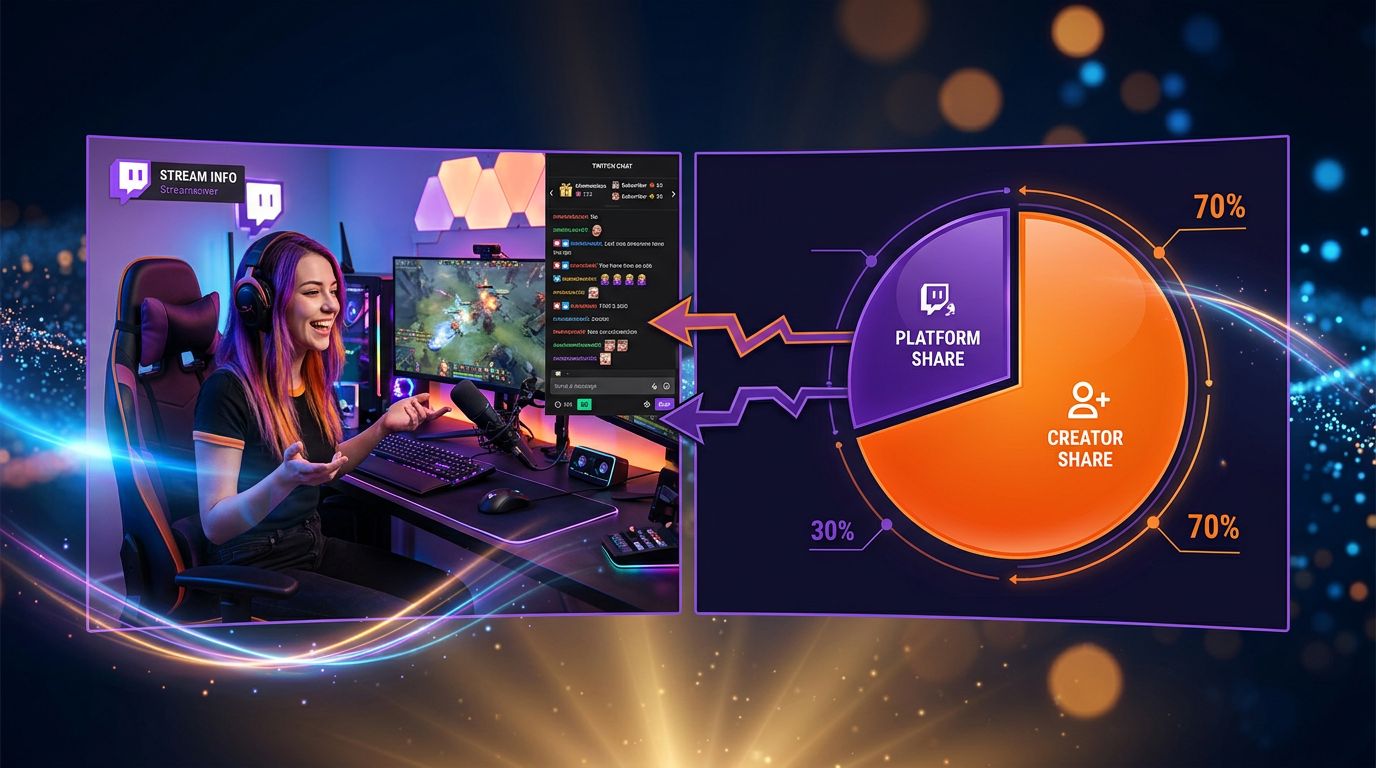
Twitch’s current split is 50/50 for most creators (versus 70/30 on YouTube for partners). Twitch attempted to roll back its 70/30 deal for top streamers in 2022, sparking a massive backlash. Minton acknowledges that advertising is under-exploited on Twitch — a rare admission from a CPO.
“Advertising on Twitch is a massive opportunity that we haven’t yet fully captured.” — Mike Minton, Twitch CPO
What nobody tells you: Twitch suffers from a structural problem that many creator platforms will face. Live streaming generates exceptional engagement but difficult-to-sell advertising inventory — the context is unpredictable, brand safety is complicated, CPMs are low. YouTube and TikTok solved this with indexable on-demand content. Twitch has not.
What Twitch reveals about the creator economy at large
Experience has taught me that platform monetization crises always follow the same three-act pattern.
Act 1: growth comes first. The platform attracts creators with generous terms, sometimes at a loss. The goal is critical audience mass.
Act 2: investor pressure arrives. Amazon has owned Twitch since 2014 for $970 million. Ten years later, the platform is still not independently profitable. The pressure is real.
Act 3: creators foot the bill. Either through less favorable splits, more restrictive advertising rules, or monetization features throttled for smaller accounts.
This cycle plays out everywhere. YouTube went through it. Instagram went through it. Patreon, Substack — all the same acts. The lesson for any creator or agency building on a third-party platform: diversify your revenue before the platform changes the rules.
The through-line: economic autonomy in an AI-first world
Here’s where the two pieces of news converge — and this is where it gets genuinely interesting.
Stripe giving AI agents the ability to buy autonomously. Twitch seeking to better monetize without alienating its creators. These two signals point to the same reality: the digital economy is entering a phase of deep reconfiguration, where traditional intermediaries (platforms, payment processors, agencies) must justify their added value against agents that can increasingly do things on their own.
For freelancers and agencies, the concrete question is: where is your irreplaceable value in this new landscape?
It’s not in repetitive execution — an agent can handle that. It’s not in information retrieval — an agent can do that too. It’s in contextual judgment, client relationships, and the ability to orchestrate complex systems around real business objectives.
The tools that will survive — and help their users survive — are those that augment human judgment rather than trying to replace it. Permanent client memory. Persistent project context. Proactive coaching on work patterns. These aren’t gimmicks — they’re the infrastructure of human value in the age of autonomous agents.
3 concrete actions to take from these two signals
1. Audit your dependency on third-party platforms. If more than 60% of your revenue comes from a single platform (Twitch, YouTube, a marketplace), you have structural risk. Twitch’s CPO just confirmed that the rules can change. Diversify now, not when the platform changes its algorithm.
2. Integrate agent logic into your workflows. The Stripe announcement isn’t anecdotal — it’s the beginning of a normalization of machine-to-machine transactions. If you haven’t yet experimented with automated workflows (n8n, Make, or AI tools with MCP), you’re falling behind competitors who already have agents working while they sleep.
3. Build your business memory independently of tools. Whether you use Stripe, Twitch, Claude, or any other platform — your client data, projects, and business context must live somewhere you own. Not in the SaaS whose terms of service can change tomorrow.
The real question for the next 18 months
My attention to detail forces me to ask the question nobody is really asking: how quickly will AI agents become full economic actors — and are you positioned to work with them rather than against them?
Stripe just answered that question on the payment infrastructure side. Twitch is answering (clumsily) on the creator economy side. Both answers converge: the economic autonomy of agents is underway, and platforms that don’t adapt will lose their relevance.
For freelancers and agencies reading this: the time to experiment with tools that truly integrate agent logic — memory, initiative, autonomous action — is now. Not in 18 months when everyone else has done it.
Want to see concretely what an AI workflow with persistent memory and autonomous agents looks like? Nova-Mind is available from €39/month — with 36 MCP tools, bidirectional synchronization, and an assistant that remembers each of your clients. Try it here before your competitors do.
Share this article
Social networks
Analyze with AI

Charles Annoni
Front-End Developer and TrainerCharles Annoni has been helping companies with their web development since 2008. He is also a trainer in higher education.